Category Archives: Labor and Worker Justice

Blaming the Workers Until the Bitter End: Company has Long History of Not Being the Hostess with the Mostest

Hostess strikers in St. Louis, MO

Hostess strikers in St. Louis, MO

From the Black Commentator

by Jamala Rogers

Hostess Bakeries was recently allowed to close its doors when mediation between the union and the company failed. In St. Louis, the company never really changed its image or racist practices in 40 years. The ITT conglomerate was hit by a boycott back in 1971 from ACTION, an interracial, direct-action protest organization. Because all the ACTION demands were never met, the boycott remained in effect.

Workers prepare Hostess Twinkies for packaging at the Interstate Bakeries Corporation facility April 20, 2005 in Schiller Park. (Photo by Tim Boyle/Getty Images)

Workers preparing Hostess Twinkies at Interstate Bakeries in Chicago, 2005.

There were three unions that represent the 18, 500 workers across the country. They are the Bakers, Confectionery, Tobacco and Grain Millers Union (BCTGM), United Food and Commercial Workers Union and the International Teamsters Union. Union workers stood tall and firm in their refusal to be intimidated by the bullying tactics of the company. They now all face unemployment.

When Hostess Brands announced it was seeking bankruptcy (again) in the midst of contract disputes with its union workers, the workers went on strike. To add insult to injury, the company announced it intended to pay $1.75 million in bonuses to 19 of its executives. The company has been in bankruptcy for about eight years of the last decade. It had stopped paying into the workers’ pensions, and decreased health benefits but seemed to be taking good care of its top execs.

Workers striking in Peoria, Illinois

Even as it was throwing the blame of the company’s dismal future at the feet of the workers, Hostess had already given its executives pay raises earlier this year. The CEO’s salary tripled from $750,000 to about $2.5 million. This doesn’t exactly sound like a company in financial trouble. It sounds more like a company who wants to maintain superprofits for the top execs and its shareholders on the backs of its workers.

Back in 1971, a boycott campaign against Hostess and Wonder Bread, led by Percy Green and ACTION, proved to be incredibly successful even without the internet and cell phones. Within a few months, stores had snatched Wonder Bread and Hostess products off their shelves. The protests and subsequent reactions dominated the local news for months.

Strikers in St. Louis, MO

Those brand names fell under ITT which stands for International Telephone and Telegraph. At one point the ITT portfolio included a number of seemingly unrelated industries such as bakeries, hotels, insurance companies and electronics for weapons of war.

The company brought out its few black employees as the front guard of their fight, including its PR man, Sam Wheeler, (former Harlem Globetrotters basketball player), who called the protest “black against black.” The black drivers who received commissions from the sales of the delivered bakery products were encouraged by Wheeler to set up a protest at the ACTION headquarters. The drivers who were misled by the company apparently hadn’t realized an important element of discrimination uncovered by ACTION: that the black drivers’ routes included small black convenience stores while the white drivers got the big grocery chain stores.

Striking worker Joe Locey pickets outside a Hostess plant Friday in Biddeford, Maine. The Irving, Texas, company said a nationwide strike crippled its ability to make and deliver its products. IBC stands for Interstate Bakeries Corp.

Striker in Biddeford, ME

When the company tactic to pit their black employees against ACTION didn’t work, the corporation tapped into its buddies in higher places. Then Missouri Attorney General Jack Danforth filed an injunction and conspiracy suit against ACTION. The antitrust suit claimed that ACTION and Colonial Bread were in cahoots with one another to bring ITT Continental Bakeries down. Colonial Bread was Wonder Bread’s competition and it became an unintended beneficiary of the ACTION boycott. It also became a surprised co-conspirator in the AG’s anti-trust law suit.

Strikers in LA

Strikers in Billings, MN

This tactic backfired as well. It catapulted the conglomerate and all its dirty linen into the national spotlight for several years. It put the resources of a peer corporation into action (no pun intended) and forced the state attorney general’s office to settle the suit that there was no wrong doing on Colonial’s part.

The conglomerate became a target of antitrust groups but more volatile was being a target of the anti-war movement that prompted a national boycott of Wonder Bread with the slogan, “Don’t Buy Bombs when You Buy Bread!” ITT‘s ugly ties to the CIA’s topple of the democratically elected Chilean leader, Salvador Allende, were also uncovered during this time.

Hostess workers on the picket line in Columbus, Ind.

Strikers in Columbus, IN

The historical struggle of workers against companies like Hostess is a testament that we must stay vigilant in our efforts to uphold racial and gender equality and pay equity, along with issues of worker safety and product quality. These greedy corporations don’t get better with time. Let’s make sure we are fighting for immediate victories for workers but also for worker security and rights that will endure well into the future.


BlackCommentator.comEditorial Board member and Columnist, Jamala Rogers, is the leader of the Organization for Black Struggle in St. Louis and the Black Radical Congress National Organizer. Additionally, she is an Alston-Bannerman Fellow. She is the author of The Best of the Way I See It – A Chronicle of Struggle. Click here to contact Ms. Rogers.

Tagged , , , , , ,

Michigan Wake Up!

Stop the Assault on Michigan Unions – Occupy the Capitol and Strike!
By Patrick Ayers and Ramy Khalil
Michigan, a bastion of union power, is now suddenly days away from possibly becoming the 24th “right to work” state in the country. The Republicans who control the state government are attempting to ram a bill through the legislature that is a major attack on workers’ rights.
The misnamed “Workplace Fairness and Equity Act” was introduced on Thursday, December 6 and approved by majority votes in both the Michigan House and Senate that same day without a single committee hearing or any floor debate. In scenes reminiscent of the February 2011 working-class uprising in Wisconsin, upwards of 3,000 trade unionists responded by immediately packing the rotunda of the state capitol building in Lansing, the capitol of Michigan, in only half a day’s notice.But the right wing was better prepared this time, having learned some lessons from Wisconsin. The Republican House Speaker ordered the building to be locked down, and the police were ready to evict protesters. The police arrested eight people and pepper sprayed others. Americans for Prosperity, a conservative organization funded by the Koch brother millionaires, erected tents in front of the capitol building to support the bill, and the Michigan Freedom Fund aired radio and television ads in favor of the legislation in the days before.

Republicans were completely dishonest about their intentions during the election, and they launched a surprise attack after the election. Earlier this year, Republican Governor Rick Snyder told the U.S. House Education and Workforce Committee: “I’ve made it clear it’s not on my agenda. ‘Right-to-work’ is an issue that is a very divisive issue… We have many problems in Michigan that are much more pressing… I don’t believe it is appropriate in Michigan during 2012.” Now suddenly Snyder, a businessman elected in 2010 with the support of the Tea Party, is promising to sign the bill as soon as Tuesday, December 11.

The Republicans are building upon the defeat last month of a ballot initiative which would have made the right to a union a constitutional guarantee in Michigan. This defeat was the result of a $30 million opposition campaign and concerns about changing the constitution in a way that could allow union leaders who are often out of touch with workers to potentially abuse their power, in spite of polls showing that 70% of Michiganders support workers’ collective bargaining rights. The Republicans and their 1% backers now have a month to capitalize on this defeat during the current lame duck session of the out-going legislature. In January, the Republicans will lose five seats and their current super-majority, and then they will no longer have enough votes to ram this bill through.

Right to Work… for Less

The “right to work” label is intentionally deceptive. The bill certainly won’t provide the right to a job for the hundreds of thousands of unemployed workers in Michigan. What it will do is undermine the democratic basis of workers’ right to organize. According to U.S. laws, where a majority of workers support having a union, they have the right to a union. “Right to work” legislation undermines this democratic right by making it illegal for unions to require all workers in a unionized workplace to pay union membership dues, even though all the workers reap the benefits of the union. It’s like if the phone company had to provide everyone with phone service, but payments were optional, which, of course, would bankrupt the phone company. This legislation would deal a financial blow to the unions, which are the only organizations workers have to defend themselves at work.

There is arguably an upside to these laws, in that they would force union leaders to fight more consistently for workers’ interests in order to convince workers to participate in the union and pay dues for the common good. However, in practice, these laws create an enormous workload for already overworked union stewards and field staff.

In “right to work” states (as opposed to states with “closed shops”), workers’ wages are typically $1,500 less per year according to the Economic Policy Institute. Workers are also less likely to have pension or health care benefits, poverty rates are higher, and workplace injuries and deaths are more common.

African Americans will be disproportionately affected by this bill. Thirty-two percent of all African American workers in Michigan are in unions compared to 17.5% of all Michigan workers. The Michigan legislature also rammed bills through on the same day that restrict women’s rights and access to abortion services.

This is an historic attack in an on-going war against workers. Michigan has been the heartland of union power, and it’s the fifth-most unionized state in the country. If the ruling class can make Michigan the second state in the Midwest to pass “right to work” legislation, then why shouldn’t they go for more states?

This sudden ambush has been prepared by a whole slew of battles in the past 30 years that the union leaders failed to effectively resist. In 1989, one in five workers was in a union. Today, it’s closer to one in ten. And when the economic crisis hit, Michigan was hit harder than most states, losing 750,000 jobs. The union leaders bear a huge responsibility for failing to fight for good jobs. United Auto Workers leaders in particular have spearheaded “labor-management cooperation” schemes that have benefited managers and investors while workers’ wages and benefits have been slashed.

In this context, the Republicans are presenting their anti-union legislation as a program for creating jobs. Michigan Republicans point to Indiana where similar “right to work” legislation was implemented last year for the first time in the Midwest. Snyder says Michigan has now lost a competitive edge to their neighboring state, and passing this anti-union legislation is the best way to attract new jobs to Michigan.

However, Republicans oppose raising taxes on the 1% by a single dime. They support slashing state budgets and thousands of jobs with them. They are not concerned about jobs or workers. They are concerned about profits for the 1%.

A Warning to the Labor Movement

If this bill passes, it will have devastating effects on workers’ rights in Michigan. The labor movement has literally days to stop this attack. The unions have announced Tuesday, December 11, the day the bill could be signed, as a day for protest and civil disobedience at the capitol. But will this be enough to stop the Republicans?

The Republicans appear prepared to disregard widespread protests to push the bills through. They saw that in Wisconsin, in spite of unprecedented massive protests and an occupation of the capitol building that lasted for weeks, the union leaders were unwilling to mobilize the workers to strike and shut the state down. As a result the Republicans were able to weather the storm and come out victorious. The Republicans in Wisconsin did not have the current super-majority that the Republicans in Michigan have for a few more days. Republicans in Michigan also have deliberately attached this legislation to an appropriations bill, which means that it cannot be overturned by a popular referendum.

This attack by the right wing comes in the aftermath of Romney and the Republicans’ nationwide defeat in the recent November elections, which, for the most part, saw the defeat of anti-same sex marriage and other right-wing ballot initiatives. This bill in Michigan is an act of desperation by Republicans to shamelessly ram through legislation they want before the will of the voters is implemented and the Republicans lose their super-majority.

However, this attack also comes in the aftermath of the Arab revolutions, Wisconsin, Occupy, the Chicago Teachers Union victorious strike, the Walmart workers struggle, the New York fast food workers walk-out, and a strike in L.A. that shut down the biggest port in the country for 8 days. The time is ripe for a counter-offensive. Millions could be mobilized in defense of workers’ rights in Michigan and across the country. It would be particularly shameful if the union leaders did not take the steps that are absolutely necessary right now to mobilize the full power of working people.

The Courts and the Democrats

Labor activists have filed lawsuits accusing Republicans of violating laws such as the state’s open-meeting laws by locking the state capitol doors. However, one judge has already ruled that the police did not violate state law. Waiting for the courts to further consider arguments that may not end in workers’ favor ultimately works to the advantage of the wealthy elite by channeling workers’ power away from immediate, more effective forms of struggle. The courts have never been the most favorable terrain for unions. Reliance on the courts takes away from our most powerful weapon as the working class – our collective ability to strike and shut down businesses and organize mass protests in the streets.

The Democrats in Michigan have called on Obama to withhold federal funds to Michigan to force Republicans to back down. (Obama had previous plans to meet with the governor on Monday, December 10.) Because of the Democrats’ dependence on the unions for getting out the vote, it is not ruled out that Obama and the Democrats might regard the Republican legislation as going too far, and they might pressure Governor Snyder to agree to some kind of compromise.

But we cannot rely on Obama who did nothing to help workers in Wisconsin or teachers in Chicago who were viciously attacked this summer by Democratic Mayor Rahm Emanuel. Obama abandoned the Employee Free Choice Act, and he didn’t even mention unions in his acceptance speech at the 2012 Democratic National Convention, which was held in the “right to work” state of North Carolina. Obama’s bailout of the auto industry also demanded that the United Auto Workers agree to slash wages for new hires and dismantle benefits.

In Wisconsin, the Democratic politicians as well as most union leaders actively channeled the historic mass uprising of workers away from occupying the state capitol and into a recall election campaign instead of organizing a one-day public sector general strike, which would have been far more effective as Socialist Alternative argued at the time. The immediate effect was to allow the legislation in Wisconsin to pass, inflicting immediate damage on the unions.

Ultimately, the recall failed because the Democratic gubernatorial candidate agreed to parts of Governor Walker’s hated anti-union legislation, he tried to evade this central issue during his campaign, and he used similar legislation himself to attack unions when he was the mayor of Milwaukee! This is typical of the Democratic Party – they use unions to get out their vote, but they balance their budgets on the backs of workers, too, just not as fast as the Republicans. That’s why we need a workers’ party to defend the interests of workers against the attacks of both corporate parties.

Mobilize the Independent Power of Workers

Working people and the unions have enormous power in numbers. That is the key to the entire situation right now. Failing to use this power decisively would be a recipe for disaster.

That’s why it’s a mistake that Michigan union leaders did not call for further mass actions until Tuesday. They do not seem prepared to match the determination of the 1% with determined action by the 99%. Instead, Michigan AFL-CIO President Karla Swift and other labor leaders are focusing on mobilizing workers to merely call and lobby politicians in Michigan. But the best way to make these rabidly pro-corporate politicians listen to us is to show them we have the power to shut down business as usual! What’s needed is an immediate escalation of mass actions, mobilizing thousands of workers, Occupy activists, and supporters to occupy the capitol – turning Lansing into Zuccotti Park!

But, as with Wisconsin, the Republicans are likely prepared to ride out mass demonstrations. So while occupying the capitol is important, it probably won’t be enough. To really demonstrate the power of working people, immediate mass strike action should be called to shut down the capitol, including schools and workplaces. After all, we need every single person to go to the capitol anyway, not work or school. But also by striking, it will show the power workers have, which, when mobilized, can move heaven and earth.

Strike action, particularly if it’s well organized, will raise the stakes. Rather than the Republicans having to only face a mass protest, they will have to face the complete shutting down of the state. To really drive the point home, workers should cut off the heat and electricity to the capitol building itself. If the politicians want to strip working people of their rights, they can do it in the cold and dark!

If the union leaders at the top are not prepared to act decisively, working-class activists should take a page from Wisconsin and organize actions from below themselves. Rank-and-file committees in workplaces should be immediately organized to lead unofficial actions, perhaps in the form of mass “sick-outs” like the teachers organized in Wisconsin, to be able to travel to the capitol building in Lansing.

A few strikes in a few workplaces could inspire workers elsewhere to take matters into their own hands and also go on strike, which would pressure the union leaders to call for mass, coordinated action. Students in Michigan will face an even likelier future of dead-end McJobs if the bill passes, so students, too, should organize walk-outs across Lansing, Detroit, Dearborn, and other cities.

We should not let existing anti-union laws limiting workers’ ability to strike stand in our way. Past struggles show that anti-strike and anti-union laws can be overcome by mass action. Besides, it’s better for the unions to break the bosses’ laws than to let the bosses’ laws break the unions!

If “right to work” legislation passes in Michigan – the fifth most-unionized state in the country – it will embolden the 1% across the country to go on the offensive. As American labor law expert Gordon Lafer explained, “Right-to-work bills were introduced in about 20 states in 2011 and 2012. This is part of a campaign to get rid of unions for both economic and political reasons” by well-funded conservative groups who laid the groundwork for a right-to-work vote in Michigan for some time. The entire labor movement across the U.S. should organize protests, mobilizing people to Lansing where possible, and organizing solidarity actions across the country.

The union movement has only days before the hard-won gains of past generations of workers are set back. Decisive action, mobilizing the full force of the labor movement, is the only thing that will stop the henchmen of the 1%.

Posted originally 12/10/12 on the Socialist Alternative website: socialist alternative.org

Wal-Mart Actions Around New Hampshire

Protesters in Manchester on South Willow Street on Black Friday.

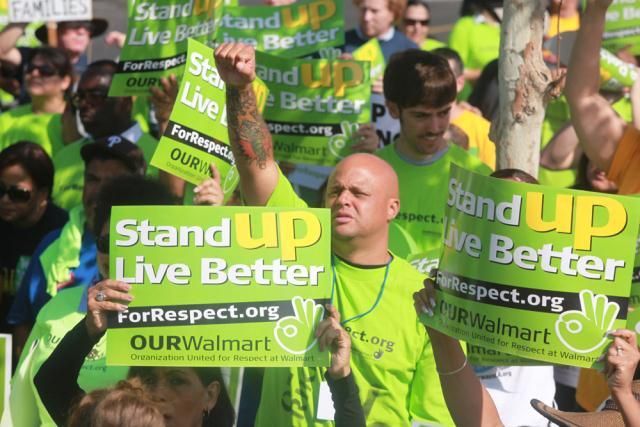
Actions against the employment practices of Wal-Mart happened in three locations in the state this past Friday after Thanksgiving — known as “Black Friday”.

Activists from Occupy NH, Occupy Seacoast, the I.W.W. union and Occupy North Country set up protests, handed out flyers and in one instance, reportedly clashed with local police.

In Manchester participant Mark Provost said, “People were generally positive, honking their horns, waving their fists in solidarity, the jig is up, people know what is going on.”

In Somersworth, NH

In Somersworth Occupy the Seacoast held a protest outside the store in the morning, according to David Holt, “9 put of 10 people that reacted to us when we were outside were positive, gave us the thumbs up or honked and waved in support.”  David said that the group also went inside Wal-Mart with their signs, “We walked thru the Walmart with our signs and the management tried to herd us out, they called the police but we were gone before they showed up.”

When they were outside David said, “One cop pulled over in a cruiser and rolled down the window and we weren’t sure what he would say but he said he was behind us 100%.” Of the numbers of people in Occupy David said, “We had a wide range of people that had never come to an occupy event before, one of the people event printed up pamphlets and handed them out about what Walmart does.”

Some reported that an individual had a clash with the police in Littleton, but that person has asked not to speak to the press, so no further information is available at this time.

More about the action in Somersworth from the Foster’s Daily Democrat: Demonstrators in Somersworth Call for Changes at Wal-Mart

Tagged , , , , , , ,

Somerville Mass Restaurant Owner Won’t Pay His Help

As detailed in the Boston Occupier, members of various groups such as the Boston I.W.W. and Centro Presente have continued to picket and make noise at a local restaurant, Diva because the owners, One World Cuisine have refused  have refused to pay their laborer’s due wages.

The picket goes on and those interested in joining to help fight for the cause should contact the Boston I.W.W. for more information.  The picket goes on everyday.


Tagged , , , ,

The Hand That Feeds You

If you live in America and shop for your food, services and other goods in the mainstream market, then you have probably been served or helped by a low-wage worker.  If you don’t work in the low-wage world, then more than likely you have the convenience of not having to consider the sacrifice that these people make to serve your needs.

From the retail worker checking out your goods on a weekend or late in an evening, checking out your last minute the holiday eve, the person who is there to punch in the amount of your fuel at the last minute before rushing to your relative’s house for a day of relaxation and celebration. The person who hands you your sliced deli meats after you get out of work, the one who hands you a cappuccino.  Get the point?

While you, middle class person that you are, have put in your time in a regular schedule, the same shift every week, the same pay that allows you to purchase a house, a new car, finance for the kids college, yes that gives you some semblance of a future to hope for a sanity for today based on some measure of predictability, there exists an entire economy of people toiling and struggling to make ends meet, who end up on the bottom of the social ladder to serve your interests, who have no ability to negotiate anything; if they want the job they will be on the job when appointed to do so — mostly in service to your desires.

Its awfully convenient to be able to run into the toy-store two hours before official Christmas Eve to get that last toy, to rush into the convenience or grocery store to pick up a bottle of wine or something you forgot for the dinner celebration.  Its awfully convenient that someone will serve you fried eggs at 3 o’clock in the morning on a Saturday after a long night of partying with your friends, or who will be there in the brisk am on Christmas day to make sure the gas pumps are on so you can drive out of town.

Its all awfully convenient.  But at what price? Most people assume that with the degree of labor or sacrifice given, the employee has room to negotiate and bargain for better wages and working conditions; that the employee who works on a holiday, a late-night or on weekends has chosen to do so, thus we can believe in our minds that there really was no sacrifice at all.

But the fact is that more and more unskilled work is unregulated by an agency of the worker.  Bereft of union representation and the power of organization amongst themselves, most low-wage workers toil in silent rage that soon stifles down to surrender and a sense of complete powerlessness.

Nothing reminds a low-wage worker more of their position in our current economic system than the snotty, hurried middle class shopper who will complain and threaten one’s job over an imagined slight or trivial inconvenience.  Nothing reminds a low-wage worker more of their economic position than the sneer of their peers and others when one mentions working at a retail establishment or the old “You want fries with that?”.  Because of course, no one wants to be a servant and no one wants to be on the end of the social ladder.

It never really is a surprise to anyone either that jobs open to women who don’t have a college education are predominantly in the retail and service industries that pay pitifully low wages.  While non-college educated men can still regularly count on trade work which often has some level of social respect (construction) and/or union representation, most female dominant jobs do not offer union representation, good wages, benefits or even a modicum of social respect.  Instead, women and all too often, people of color of both sexes, ex-felons (even if their felony was non-violent or minor) or those with disabilities are relegated to work that often does not take into account their full potential, nor give them a chance to realize their full potential to contribute to society.  Next time you assume your convenience store clerk has maximized all their opportunities and has reached their apex, think again.

Which is why workers on all levels must stand up to support the fair representation of low-wage workers, so that hopefully the term ‘low-wage’ is one reserved for the history books and not as a relegation to poverty for millions of Americans in this country.  Which is why all middle class people, who have good jobs, who have the ability to make change in their lives and to assist change in others’ lives must step up to do so.

The following demands should be made and the middle class must be willing to step up and make clear that they can and will make the sacrifice necessary to see to it that workers are treated fairly — and more importantly, will help to demand that the plutocracy that has arisen out of the hierarchy of work in our society be gone forever!

People should demand the following as the very basic of worker’s justice:

1.  That workers be allowed the day off on major and religious holidays to spend time with their families and in their communities.

2.  That all workers be granted health insurance and life insurance benefits.

3.  That workers with families be given a regular weekly schedule that is predictable and allows them to adjust their family lives around their work.

4.  That workers be given affordable childcare — paid either by meaningful state/federal subsidies and/or with a tax on the employer.

5.  That doling out jobs and positions by gender or race identification cease immediately.

6.  That wages be pegged to a basic needs tested standard of living measure.

As a worker, especially if you do better than a low-wage worker who serves your needs:

1. Be aware of the sacrifice made economically for your low prices — that it all too often comes from the worker, not the company owners.

2. Chose to consume less and to shop during reasonable times of the day – be the proof that worker’s don’t need to occupy a store at times when most people are at home with their families.

3.  Break down human commodification by treating all workers as your equal.  No one has more value as a person than you.  Recognize your privilege.

4.  Speak out about worker justice that you understand; make an effort to learn more.

5. Support worker actions for justice.

6.  Learn to shop before holidays; spend time at home with your family and share this value with your family and friends.  Stay home on large marketed shopping days such as “Black Friday” or the day after New Year’s, do not shop stores that make their employees work on holidays or long nights or weekends.

For more reading on this topic:

Improving the Situation for Low-Wage Workers…

One in Four Workers Will be in Low-Wage Jobs…

Low Paying Jobs are Here to Stay

Down and Out

Sustainable Scheduling

Tagged , , , , ,

Hostess and the Private Welfare State

From the online magazine Jacobin, Peter Frause makes a very good case for the closing of the Hostess plant.  The hype around the closing, as can be expected in an anti-union, anti-worker environment, has been trumpeted by the shareholders and top brass of the company and willingly repeated by the mainstream media, as a boondoggle created by a greedy, selfish union, but the facts tell a different story:

Hostess Brands, maker of the Twinkie, announced its liquidation today. This provoked a wave of now-more-than-everism, as both liberals and conservatives rushed to use the company’s failure as a testament to their longstanding hobbyhorses.

To the Right, of course, the end of Hostess is just another great opportunity to bash unions. Although perhaps it’s a sign of progress that even Fox News decided to soft-pedal this line, talking up the conciliatory position of the Teamsters while blaming the recalcitrance of the Bakery, Confectionary, Tobacco Workers and Grain Millers union for the closure. The idea that this is all about greedy unions is idiotic beyond belief, but sadly something we apparently still have to talk about. So if you don’t believe me you can go read Sarah Jaffe or Diana Reese.

A line I’m seeing from liberals, meanwhile, is that this is another case of private equity vulture capitalism ruining the American dream. Hostess Brands was under the control of a couple of hedge funds, as is the style these days. And so one line of argument is that Hostess could have been a perfectly sustainable company with good paying jobs, if only those short-sighted PE guys hadn’t showed up to loot it. A typical example of the genre is this from Laura Clawson at Daily Kos. Mark Price puts it more pithily on Twitter: “Private equity runs up debt, takes out fees and investment in capital goods declines leading to cost disadvantages.”
Read more : Hostess and the Private Welfare State

Tagged , , ,

British Unions Shut Down London With Strikes – Over 700,000 March

Image from Washington Post online slideshow

Nearly 800,000 union workers in Britain converged in London on yesterday to demand that the government end its austerity measures.  Similar to other unrest in Spain, Portugal and Greece and across the Atlantic in the US last year, Britian’s workers demand an end to the distribution re arrangement policies dubbed “austerity measures” by the press and politicians.

In favor of the conglomeration of capital among elite global finance and banking interests worldwide, government worldwide have proposed cutting public social safety nets.  The obvious effort to turn the world’s workers into pools of low-wage labor has met with resistance across America and Europe and now Brit workers take their turn to be heard.  In the rally labor leaders call for a general strike.  In addition, as Real News reports, London and other EU countries have November 14th in their sights for a continent wide day of action against austerity.

The Real News has posted a video and report:

Tagged , , , , , , , , ,

China Caught Using Child Labor in FoxConn Ipod Factory

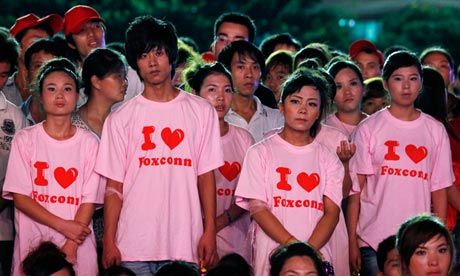
From the Guardian: Foxconn workers at a rally in the southern Chinese township of Longhau following a series of suicides among employees in 2010. Photograph: Bobby Yip/Reuters

In yet another exposure of the abuses of labor by Chinese plants owned by Taiwanese FoxConn company, this time in the use of students as young as fourteen duped into an ‘intern’ program.  Apparently the company had partnered with schools to provide child labor to the plants disguised as ‘interns’ but who were in fact laboring to produce widely popular Ipod products.

This proves once again that with the uncontrolled capitalist the past has no lessons to teach it, that the ethical barriers of humanity come crashing down in the face of profit.

From the Guardian:

Taiwan‘s Foxconn, the world’s largest contract electronics maker, has admitted using student interns as young as 14 in a Chinese factory.

The case is in breach of national law and raises further questions about its intern programme.

Employment rights activists in China have accused Foxconn and other big employers in the country of using young student interns as a cheap source of labour for production lines, where it is difficult to attract adult workers to lower-paid jobs.

Foxconn, the trading name of Taiwan’s Hon Hai Precision Industry, said it had found that some interns at a factory in Yantai, in the north-eastern Shandong province, were under the legal working age of 16. It did not say how many were underage.

“Our investigation has shown that the interns in question, who ranged in age from 14 to 16, had worked in that campus for approximately three weeks,” the company said.

Read the rest of the story in The Guardian.

A Worker Looks In From the Outside of the ‘Labor Community’

With the latest focus on actions across the country by Wal-Mart workers, many middle class people who have the privilege of not having to work a low wage job announce their solidarity with the workers.  But their focus is narrow and their solidarity rings hollow.  Until a smaller more active union stepped up to support some of the workers who have had the courage to step up, Wal-Mart workers were and (still remain largely) the butt of classist jokes, derisive comments and dismissal by most Americans.

In fact most low-wage work has the stigma in this country of being work occupied by lower educated, slower witted persons who by their lack of the exceptional talent of their middle class betters, have failed to advance economically.  This classist attitude rings hollow in the face of the fact that as the American job pool shrinks, more and more people are forced into working low-wage jobs.  Jobs traditionally shut-off from the traditional unions.  Like a self-serving circle of hell, low-wage workers get stuck in a system where their poverty and desperation feeds an inability and fear to agitate for better wages and working conditions.  Short working hours and low hourly pay that leads to poverty existence squeezes the reserves of workers who lack the flexibility to move to other, better paying work.  Armchair libertarians and the like love to argue ad infitnitum that all workers have mobility to “take their labor else where”.  Such fantasies serve only to blame the worker, leaving better paid workers, the employer and government policies that enable working poverty off the hook.

Sorely missing from the popular perception and focus of the Wal-Mart workers’ action is the acknowledgement that similar workers struggle everyday, unnoticed and unrepresented.  The theme in American politics reflects the tacit willingness of Americans to be separated by class distinctions with signage and slogans that cry out the lame theme, “Protecting the Middle Class”, as if there exists a fear of associating with the ‘unwashed’ and the invisible class — including day laborers and those who languish on unemployment that washes them into the fast growing river of workers struggling to make ends meet with barely crumbs.

Does the American ruling class consist of middle class workers? Are not all workers struggling the same? It appears that instead of seeking to embrace all workers, the traditional labor unions have made the strategic decision to “grow” their dwindling movement only among those that fit their aged and concrete-clad vision.  All workers share the same basic struggles.  As traditional unions beg and work hard to gain support in their struggles to defend collective bargaining rights, where are these unions to defend the millions of workers who don’t work for the most hated retail chain in America?

And also, when will the American “middle class” realize that their never-ending thirst for cheap goods, cheap services and ‘lower prices’ comes at the price of people’s livelihood and standard of living?  Is it necessary to have a Wal-Mart in every town in America? Or a K-Mart? Or a Home Depot?  Has the spread of the corporate conglomerate retail market led to better wages and increased living conditions, or has it created a silent, suppressed, isolated and ever-growing sub-class? While there is much to applaud in the efforts of the Wal-Mart workers those smaller unions that have come out in support of them and other workers, the focus needs to widen to all workers.  The time has come for realization that, as the I.W.W. adage coined nearly a century ago, an injury to one is an injury to all— all workers must come together, ready to represent themselves at the table of labor in solidarity with all labor as One Big Union, united in the fight against the scourge of corporate global capitalism.

From artist Mike Flugennak: http://sinkers.org/stage/

Unfortunately the labor unions presently making up less 12% of the population naturally, have continued their isolation from many workers.  Workers in low wage jobs that larger unions have decided long ago not to organize have suffer from the  lack of union representation.  Exploitation of low wage workers has increased as the economic depression increases the labor pool and emboldens employers.  Some union organizers claim that the old ways of organizing do not work as jobs in lower wage fields tend to have a large turn-over, tend to offer little incentive for workers to remain and thus such a fluid membership base leads to instability and inability to organize long term.

This is disputable when one considers that the largest proportion of the workforce with the most direct exposure to the public is the low wage worker, whether in service jobs, healthcare or retail.  They provide the opportunity to larger trade unions to increase support for and understanding of the struggle to keep legal protected rights such as collective bargaining and (although diminishing and very limited today), the right to strike.  In exchange, formerly neglected workers should justly expect some support for their cause, where such has been historically lacking.

Diminished representation has weakened support for the union movement nationally.  As workers feel further and further distant from what many perceive as weak, disaffected or out of touch union representation, frustration within the ranks increases. Many members complain bitterly of lack of rank and file participation in meetings, apathy among members and even many members who enjoy the benefits of their union job while supporting exactly the opposite in political ideology and public policy, hypocritically assisting those who wish to undo the union and keep more workers out while benefiting from union members themselves. Ironically, union leadership and members do nothing to stop this inside sabotage while more and more workers linger on the outside looking in, unable to find a slot in increasingly unavailable union work.

Also membership reduces as well as the cost of carrying a card and paying dues while unemployed becomes prohibitive.  Unions have shrunk not only due to assaults on worker’s rights to organize and act for their betterment, but also due to attrition as a result of the dwindling union protection. Started by Ronald Reagan, the Republican and ‘New Democrats’ have unraveled protection for worker expression with only barely audible squeaks from union leadership. Sold down the river on the idea that some kind of gentleman’s agreement exists between labor and big business that they must continue to protect, big labor unions have chosen to bargain with the devil than to reach back and lend a hand to their brother and sister workers who could offer strength in their effort to finally resist big business’ assaults on labor.

The labor movement cannot survive in its current state. Dwindling membership rates and even more diminished actual power when one considers participation rates and support in current unions, has a ripple effect on all workers everywhere.  As John O’Reilly points out here, the larger unions smirk and snub workers they consider beneath them at their peril.  Only with all workers united together to fight the nihilistic and dehumanizing forces of corporate capitalism will workers succeed and together bring the living standards of all workers to enable peaceful, dignified existence.

John O’Reilly on how the labor movement talks about itself and how he interprets it as a member and organizer of the IWW.

I’ve been thinking recently about the way that the labor movement sees itself and talks about itself. Labor movement activists often talk about labor as a kind of community, a place where individuals can reach across differences and speak to each other based on a shared connection to their unions and unionism more generally. There are big, well-funded internal publications that the large unions produce which help move this discourse. But there are also independent voices which participate in this discourse. I can think of Labor Notes as an example that I’m most familiar with.

Labor Notes and magazines, blogs, or other publications like it have this particular way of speaking about the labor movement and the changes that it needs to implement that I’ve always had a lot of trouble connecting with. I like Labor Notes, I think its a useful piece that praises rank-and-file struggles and shows how the bosses and the business unions are strong and powerful but also have weaknesses. It’s the kind of publication that shows that working people can have independent publications that highlight our stories of success and explain why and when we fail with a good analysis (usually).

But I’ve always had trouble connecting with the language that LN and similar publications use to talk about the labor movement. There’s a positioning of “inside and against” that I’ve always been unable to connect with. The discourse often goes “we are the labor movement, we need to do better, we need to get better leadership and democratize our unions, we need to organize the unorganized.” I like all the reclaiming of the labor movement narrative, that’s a great step I think. Saying that “we,” being rank-and-file workers, are the labor movement and that unions are not just the union leaders, is really important. But to me as an IWW organizer, I’ve never felt part of some community of labor.

Read more: Outside the House of Labor, by Jack O’Reilly, IWW organizer, originally published in Labor Notes.

Tagged , , , , , , , , , ,

Vet Speaks Out to End the War, Begin the Revolution

Resistance.

The vet in the video below gets it right, to end the war we must end hypocrisy, racism, jealousy, greed, capitalism and its sorry brother, corporatism.  None can be separate and the none of them can exist without the other.  Greed begets war, the need for rationalization begets racism, dehumanization, fear of the unknown, misinformation begets the ignorance necessary for a population to do the bidding of a few and to die and kill for it.