Category Archives: Uncategorized

Farmers and Growers Still Battle Corporate Seed Producers Including Monsanto

Farmer holding seeds Monsanto case

We have looked everywhere for an articles explaining the corporatization and “enclosure” as the writer below aptly puts it, of our food supply by controlling and patently seed production.  Here we have a few and some updates. In the midwest farmers have been harassed by lawsuits and threats from private goon squads with questionable or outright bogus claims by Monsanto and other seed companies that they’ve been illegally using their patented seeds.  What is behind the lawsuits (which usually bankrupt farmers completely or have them settling and agreeing to gag orders) is the effort of these seed companies to completely destroy the roots of natural agricultural production by eliminating the practice of saving seed or hybridizing seed on the farm.  By effectively banning pure fertile seed production the corporations hope to create a complete dependency on corporately factory produced seed that produces plants that are either sterile or produce non-viable seed.  Thus the farmer will have to return every year to the “company store” to purchase seed, creating a dependency not only on the seed companies but also on banking and finance.  Banking and finance already has had a huge hand in the corporatization of farming practices as the pressure to produce larger yields to feed huge interest and debt grows every year.

Not only does this article look at the issue but also highlights how some are fighting back:

Making Sense

Seeds of Change

Corporate Power, Grassroots Resistance, and the Battle Over the Food System

BY ELIZABETH FRASER AND ANURADHA MITTAL | March/April 2015

Over a decade ago, Dollars & Sense published the article “Genetic Engineering and the Privatization of Seeds,” by Anuradha Mittal and Peter Rossett, on genetic modification and its impact on the world food system (March/April 2001). In it, the authors asked, “will biotechnology feed the world?” while providing an overview of the landscape of corporate control, widening inequality, private property claims, and growing farmers’ resistance around the world. This article acts as a follow-up, highlighting some of the key developments in recent years.

For most of history, farmers have had control over their seeds: saving, sharing, and replanting them with freedom. Developments in the course of the 20th century, however, have greatly eroded this autonomy. Legal changes, ranging from the Plant Variety Protection Act (1970) in the United States to the World Trade Organization’s Agreement on Trade-Related Aspects of Intellectual Property Rights (TRIPS), have systematically eroded farmers’ rights to save seeds for future use. By the end of 2012, Monsanto had sued 410 farmers and 56 small farm businesses in the United States for patent infringement, winning over $23 million in settlements. Here, we describe some of the key developments further intensifying corporate control over the food system. It is not, however, all bleak news. Civil society groups are using everything from grassroots protest to open-source licensing to ensure that the enclosure and privatization of seeds comes to an end.

Corporations Have Consolidated Their Control of Seeds and Agrochemicals

In 2011, just four transnational agri-businesses—Monsanto, Dupont Pioneer, Syngenta, and Vilmorin (Groupe Limagrain)—controlled 58% of the commercial seed market. Four—Syngenta, Bayer CropScience, BASF, and Dow AgroSciences—controlled 62% of agrochemicals worldwide. The top six companies controlled 75% of all private plant breeding research, 60% of commercial seed sales, and 76% of the global agrochemical market. This consolidation of power has been aided by a large string of mergers and acquisitions, leading the Canada-based Action Group on Erosion, Technology and Concentration (ETC Group) to conclude that “there just aren’t many seed companies left to buy.”

The World Bank, too, has played a role in this increased consolidation. In 2014, a report from the Oakland Institute provided details on the World Bank’s efforts to open African markets to private seed companies. (Full disclosure: The authors of this article both work at the Oakland Institute.) The report, titled “The World Bank’s Bad Business with Seed and Fertilizer in African Agriculture,” paints a stark picture of the possible consequences of these actions: removing farmers’ rights to save seeds and implementing intellectual property claims over seeds does not improve food security, but rather undermines farmers’ autonomy and further increases profits for the existing seed oligopoly.

Supposed Benefits of Genetically Modified (GM) Seeds Have Not Materialized

Two arguments often put forward in favor of GM seeds are the need to feed the world’s burgeoning population and the potential for these new seeds to reduce overall pesticide use. Neither of these claims promulgated by industry have proved true. Globally, we are currently producing more than enough food to adequately feed our population. However, that food isn’t being distributed fairly, and malnutrition remains staggering—805 million people worldwide. As the Canadian Biodiversity Action Network reminds us in its report “Will GM Crops Feed the World?” hunger is not usually a result of low food production, but rather a result of poverty. This points to a greater need to address issues of inequality, distribution, and access.

Arguments that genetically modified crops could reduce overall agrochemical use also remain unfounded, with the rise of herbicide-resistant weeds requiring more and more chemical cocktails for the GM crops to remain productive. A report from Food and Water Watch, “Superweeds: How Biotech Crops Bolster the Pesticide Industry,” notes that herbicide use on GM crops in the United States did initially fall in the late 1990s; however, once resistance in GM crops to the herbicide glyphosate (marketed by Monsanto under the trade name “RoundUp”) developed, total herbicide use skyrocketed, leading to greater net herbicide use over time.

Read the rest of the story: Seeds of Change

May 16, 1934

Strike!

Sarah Springer's avatarToday in Labor History

Scan from original

When employers refuse to recognize their union, members of the Minneapolis General Drivers and Helpers Union Local 574 of the International Brotherhood of Teamsters go on strike, bringing trucking operations in the city to a halt. Despite a concerted and violent effort by employers, the police, and military, the strike ended successfully and was a turning point in Minneapolis labor history.

View original post

May 15, 1919

More evidence of the power of strikes!

Sarah Springer's avatarToday in Labor History

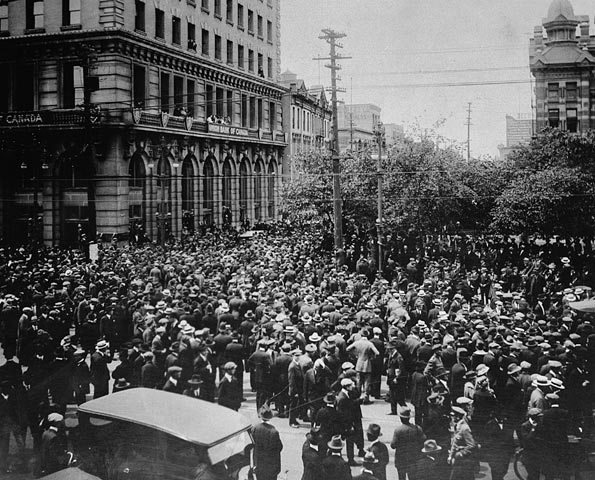
WinnipegGeneralStrikeA general strike called by the Winnipeg Trades and Labour Council brings out 30,000 workers – half of whom were not even union members – in support of the city’s building and metal trade workers, on strike over wages and working conditions. For six weeks, the city came to a halt.

View original post

Governing Under the Influence Activists Meet Lindsey Graham in Manchester

Activists with the group Governing Under the Influence met with long-time South Carolina Republican Lindsey Graham who was doing a “walk and talk” in Manchester.  Graham is making his presence known in Manchester as he has hung out his shingle as a presidential contender for the 2016 election.

The GUI group posted some pictures of their efforts to talk to Graham and also follow him with signs to put Graham on the spot about his cozy relationship with corporate power.  As quoted from activist, Kat Pheanis:

Went for a stroll down Elm St. with U.S. Senator Lindsey Graham [Kat linked to his Facebook campaign page, we’d prefer people see the wiki for a more complete history — also see our links at the bottom of this article for more about Graham] this morning. He seems like a charming fellow…. if you don’t take into account the millions he accepts from energy companies, law firms, and military industrial companies like Boeing, not to mention his political stance against gays and women, and his legislation for the XL pipeline (paid for by energy lobbyists), modifying of mortgage bankruptcy laws (paid for by real estate lobbyists), continuing tax subsidies for corporations (especially oil) while cutting funding for social programs and public schools, harsher sentencing for juveniles who break the law (paid for by law firms and private prisons), his constant push for a Constitutional amendment banning same-sex marriage and making abortion a federal crime, et cetera…

Jeb Bush should be coming to Concord next Thursday, perhaps we should all pay him a visit as well…

Kat Pheanis in Manchester follows Senator Lindsey Graham with a sign to make folks aware of the influence of corporate money in our political system.

Will Thomas, retired history teacher, Vietnam Vet and member of Veterans for Peace caught Senator Graham’s ear and this is what he said he told him:

I asked if he knew of the Brandeis quote- “You can either have a democracy or rule by the wealthy but you can’t have both.” So, I said I was concerned about the corrupting influence of money in our political system and asked would he support overturning Citizens United! Yes, he knew the quote, and he said, re: Citizens United – “we’re working on it.” I followed him into the restaurant but he went on his “meet and greet” and that was it!

Will Thomas catches Senator Graham for a moment.

More pictures:

Want to get involved and meet politicians? Find out how you can become a bird-dogger or just help out, click Governing Under the Influence. 

For some objective information about Lindsey Graham (we did the work of sifting through the political posturing and postulating) here’s some links:

Top Ten Problems in South Carolina Lindsey Graham Should Worry About More Than Benghazi
Rachel Maddow Hits Lindsey Graham for Listing African American Population Among Problems…
Graham’s Voting Record: Project Vote Smart

When They Say Liberty, They Don’t Mean Liberty for You

NARAL has an excellent video out that highlights the hypocrisy of the gun-nut/liberty contingent.  The point is clear; when they say “protect our liberty”, when they say “government encroachment on our rights” they aren’t referring to women.

They aren’t referring to the right of a woman to have any liberty to choose what she does with her body.  They aren’t referring to the right of a woman to choose whether she’ll be a mother.  Despite the fact that science has long since put that right into women’s hands and within reach of women’s daily lives, there’s an entire faction of people that work tirelessly to take that freedom of choice; what they like to call “liberty” out of her hands.  They work tirelessly to make the ability of a woman to determine the direction of her life and her future solely her own decision an impossibility.

While they bleat on and on about government interference in their lives, they work to increase government interference in women’s lives and in the most demeaning and invasive ways they can.

Again, remember, when they shout about liberty, they don’t mean liberty for you.

[Note also the comments from the gun-lobby’s flying monkeys, the gun comparison really hits a chord.  Unfortunately they are painfully tin-eared.]

Barbarians at the gates: authoritarianism and the assault on public education

sanjay perera's avatarPhilosophers for Change

 barbkaf0

by Henry A. Giroux

In 2015 both the US Senate and House of Representatives will be controlled by the Republican Party, one of the most extremist political parties in US history.[1] Coupled with the empty centrism of the Democratic Party, their ascendency does not bode well for public education or a host of other important social issues. Nor does it bode well for democracy. If we conjured up George Orwell and his fear of state surveillance, Hannah Arendt and her claim that thoughtlessness was the foundation of totalitarianism, and Franz Kafka whose characters embodied the death of agency and the “helplessness of the living,”[2] it would be difficult for these dystopian works of literary and philosophical imagination to compete with the material realization of the assault on public education and public values in the United States at the beginning of the 21st century.

These are dangerous times. Compromise and…

View original post 4,714 more words

April 25, 1969

Sarah Springer's avatarToday in Labor History

hospitalstrike-main photo_500x500The governor of South Carolina declares a state of emergency in Charleston and orders more than 100,000 state troopers and members of the National Guard to break a strike by predominantly African American Medical University Hospital workers seeking recognition for their union, Local 1199B of the Retail Drug and Hospital Employees. In the end, the employer promised to rehire the striking workers they had fired, abide by a newly established grievance process, and provide modest pay increases.

View original post

Action Calls from Bury Northern Pass

Action Items
 
1. Ask your City Councilor to advocate burial of Northern Pass in Concord.
Concord has appointed a sub-committee to study and make recommendations about Northern Pass to the full Council. It consists of Ward 8 Councilor Gail Matson, Ward 9 Councilor Candace Bouchard, Ward 10 Councilor Dan St. Hilaire, and at-large Councilor Mark Coen. The sub-committee could recommend a stance on Northern Pass to the larger Council, and sometime within the next 30 days, the full Council may decide what position to take on the project, including the request that it be buried through the City.
Contrary to the popular perception that the adverse visual effects of Northern Pass are confined to the North Country, Concord would face a greater visual impact than any other community on the proposed route. The line would run close to residences, schools, daycares as well.
If you live in Concord, please watch this short video and ask your Councilor to support undergrounding Northern Pass. This is an optional, for-profit transmission project that stands to make billions over its 40-year life; there is no reason Concord or anywhere else in NH should be permanently scarred for the profit of a Quebec crown corporation and Ever$ource shareholders. Northern Pass is not needed to keep the lights on; the regional regulator has not called for this line. If it is to be built at all, it should be buried. Share the link with you neighbors and ask them to act too. If you do not live in Concord but know people who do, please forward the link and ask them to contact their councilors soon.
You may also want to watch the AMC’s overview of visual impacts on Concord and Canterbury based on tower heights published by Northern Pass as of October 2013:
2. Ask NH conservation organizations to just say NO to NFWF-E$ grants. (Deadline for next round of applications is May 14.)
As you have heard, Ever$ource has made $3 million available for a “Partners” conservation grant program administered by the National Fish and Wildlife Foundation (nfwf.org). The initial grants centered on cottontail and trout habitat have been announced. In the next round of awards, $1 million will be handed out in grants ranging from $50,000 to $200,000 apiece. A minimum of $300,000 is earmarked for New Hampshire projects, with a special focus on high elevation habitat and Bicknell’s Thrush, a threatened species that breeds in the harsh upper ranges of our White Mountains as well as in a few other locations in northern New England.
Some NH conservation organizations have made internal decisions neither to apply for nor to accept these grants; others are worried that Ever$ource is attempting to divide the NH conservation community with the lure of grant money. Still others may be applying for NFWF-E$ grants, although we have not heard of any.
If you have connections to NH conservation organizations as a donor, member, or via some other relationship, please contact them and tell them you support their just saying NO to NFWF-Ever$ource money. The deadline for 2015 applications to NFWF is May 14.
3. Urge the NH Site Evaluation Committee to adopt new rules to protect the public interest.
A dedicated group of Northern Pass opponents and NH Wind Watch members has been working tirelessly to shape new “rules” (specific standards and criteria) that protect the public rather than only favor industry in the SEC siting process. The whole purpose of the SEC overhaul was to re-balance the process to give the people some say. To date, industry continues to dominate the rule making process. Please read the following LTE by Kris Pastoriza, which is being submitted to NH newspapers this weekend, and add your voice to the call for fairness in making new SEC rules. You must make specific recommendations, addressed to David Wiesner or Jane Murray (contact info following), such as the adoption of setbacks for transmission lines to prevent dwellings in the tower “fall zone” or the adoptions of wider areas of consideration for visual impacts.
Although it is possible that legislation will extend the deadline to conclude the rule-making process until November 1, the deadline as of now is July 1.
Time is running out to make changes to the rules that are at the heart of siting energy projects in NH.
To the residents of New Hampshire,
 
The New Hampshire Site Evaluation Committee, which is the permitting board for energy projects, is in the process of revising its siting criteria. Last year four public input groups engaged in extensive research and discussion on Orderly Development, Wildlife and Natural Communities, Aesthetics, and Health and Safety. In August they submitted siting recommendations to the SEC. Most of these recommendations were ignored in favor of recommendations submitted by energy corporations, and this whittling down of protections continues.
 
In a recent public meeting the Committee made a preliminary decision not to require any setbacks for transmission lines. This was the “standard” suggested by industry. Many states and countries require setbacks to keep dwellings outside the “fall zone” of towers as well as safe from levels of electromagnetic radiation that have been correlated with childhood leukemia. California, for example, requires that schools be at least 100’ from the edge of a right-of-way of a 115kV transmission line, such as that behind Profile School, Bethlehem. The public Health and Safety workgroup recommended such setbacks, but the SEC declined to set any criteria.
 
The Committee has also made preliminary decisions to limit the area considered for visual effects of transmission lines and wind turbines to that proposed by industry, to limit consideration of local zoning and master plans and to severely limit decommissioning requirements.
 
Throughout this Rulesmaking process the SEC has consistently ignored public input in favor of the suggestions of the industrial wind and transmission corporations. Two lawyers, representing Eversource/Northern Pass and Kinder-Morgan, are former SEC members, and have been intimately involved in the earlier public input groups as well as the ongoing Rules revisions.
 
The present SEC members are still unclear as to whether they will even require project developers to have legal control of their site and route before submitting an application the SEC.
 
Public comment is still being received. To see the Draft Rules go to:
 
 
The Rulesmaking docket is at:
 
 
Comments (with the subject line “Rulesmaking”) can be sent to: david.wiesner@puc.nh.gov or jane.murray@des.nh.gov
 
Kris Pastoriza
Easton, NH

Do Not Let State Legislators Put Rail Progress on Hold!

From @NHRTA:

The House recently removed $4 million from the Governor’s Capital Budget that was reserved for beginning the next phase in expanding passenger rail in New Hampshire. This Project Development stage would enable the state to fully examine the costs, benefits and potential funding sources needed to expand rail.

NHRTA understands that lawmakers need to consider fiscal constraints as they compile the next two-year NH state budget, however, like many other infrastructure projects, it is necessary to fund a process that allows for deeper examination. The expansion of passenger rail is no exception. Rail expansion offers tremendous promise that shouldn’t be dismissed.

We have a chance to restore that funding in the Senate. Here’s how you can help:

Contact the Senate Capital Budget Committee:

The Senate Capital Budget Committee is meeting this Wednesday, April 15 at 2:00 pm in State House room 100. We need you to turn out and testify in support of restoring all or a portion of the $4 million in Project Development funding!

If you are unable to attend, please contact the committee members:

Sen. Gary Daniels – Chair – Gary.Daniels@leg.state.nh.us – (603) 673-3065

Sen. David Boutin – Vice Chair – david.boutin@leg.state.nh.us – dboutin1465@comcast.net – (603) 203-5391

Sen. Jeanie Forrester – jeanie.forrester@leg.state.nh.us – jeanie@jeanieforrester.com – (603) 279-1459

Sen. Lou D’Allesandro – dalas@leg.state.nh.us – (603) 669-3494

Sen. Molly Kelly – molly.kelly@leg.state.nh.us – (603) 271-3207

Obama Calls For His Unicorn

From our friend Jan:


YES HE CAN!  Bitchez.