Tag Archives: workers

Wal-Mart Actions Around New Hampshire

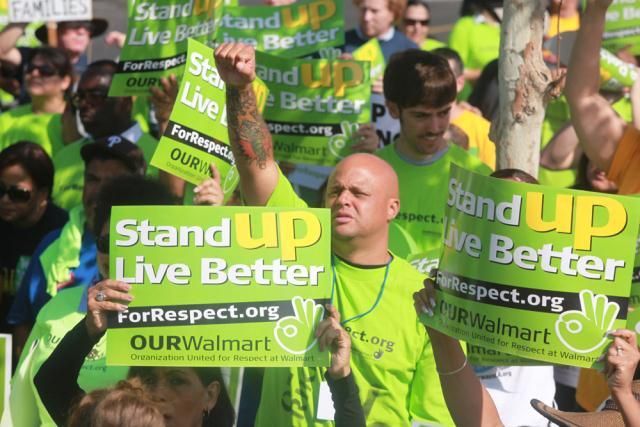
Protesters in Manchester on South Willow Street on Black Friday.

Actions against the employment practices of Wal-Mart happened in three locations in the state this past Friday after Thanksgiving — known as “Black Friday”.

Activists from Occupy NH, Occupy Seacoast, the I.W.W. union and Occupy North Country set up protests, handed out flyers and in one instance, reportedly clashed with local police.

In Manchester participant Mark Provost said, “People were generally positive, honking their horns, waving their fists in solidarity, the jig is up, people know what is going on.”

In Somersworth, NH

In Somersworth Occupy the Seacoast held a protest outside the store in the morning, according to David Holt, “9 put of 10 people that reacted to us when we were outside were positive, gave us the thumbs up or honked and waved in support.”  David said that the group also went inside Wal-Mart with their signs, “We walked thru the Walmart with our signs and the management tried to herd us out, they called the police but we were gone before they showed up.”

When they were outside David said, “One cop pulled over in a cruiser and rolled down the window and we weren’t sure what he would say but he said he was behind us 100%.” Of the numbers of people in Occupy David said, “We had a wide range of people that had never come to an occupy event before, one of the people event printed up pamphlets and handed them out about what Walmart does.”

Some reported that an individual had a clash with the police in Littleton, but that person has asked not to speak to the press, so no further information is available at this time.

More about the action in Somersworth from the Foster’s Daily Democrat: Demonstrators in Somersworth Call for Changes at Wal-Mart

Tagged , , , , , , ,

Somerville Mass Restaurant Owner Won’t Pay His Help

As detailed in the Boston Occupier, members of various groups such as the Boston I.W.W. and Centro Presente have continued to picket and make noise at a local restaurant, Diva because the owners, One World Cuisine have refused  have refused to pay their laborer’s due wages.

The picket goes on and those interested in joining to help fight for the cause should contact the Boston I.W.W. for more information.  The picket goes on everyday.


Tagged , , , ,

The Hand That Feeds You

If you live in America and shop for your food, services and other goods in the mainstream market, then you have probably been served or helped by a low-wage worker.  If you don’t work in the low-wage world, then more than likely you have the convenience of not having to consider the sacrifice that these people make to serve your needs.

From the retail worker checking out your goods on a weekend or late in an evening, checking out your last minute the holiday eve, the person who is there to punch in the amount of your fuel at the last minute before rushing to your relative’s house for a day of relaxation and celebration. The person who hands you your sliced deli meats after you get out of work, the one who hands you a cappuccino.  Get the point?

While you, middle class person that you are, have put in your time in a regular schedule, the same shift every week, the same pay that allows you to purchase a house, a new car, finance for the kids college, yes that gives you some semblance of a future to hope for a sanity for today based on some measure of predictability, there exists an entire economy of people toiling and struggling to make ends meet, who end up on the bottom of the social ladder to serve your interests, who have no ability to negotiate anything; if they want the job they will be on the job when appointed to do so — mostly in service to your desires.

Its awfully convenient to be able to run into the toy-store two hours before official Christmas Eve to get that last toy, to rush into the convenience or grocery store to pick up a bottle of wine or something you forgot for the dinner celebration.  Its awfully convenient that someone will serve you fried eggs at 3 o’clock in the morning on a Saturday after a long night of partying with your friends, or who will be there in the brisk am on Christmas day to make sure the gas pumps are on so you can drive out of town.

Its all awfully convenient.  But at what price? Most people assume that with the degree of labor or sacrifice given, the employee has room to negotiate and bargain for better wages and working conditions; that the employee who works on a holiday, a late-night or on weekends has chosen to do so, thus we can believe in our minds that there really was no sacrifice at all.

But the fact is that more and more unskilled work is unregulated by an agency of the worker.  Bereft of union representation and the power of organization amongst themselves, most low-wage workers toil in silent rage that soon stifles down to surrender and a sense of complete powerlessness.

Nothing reminds a low-wage worker more of their position in our current economic system than the snotty, hurried middle class shopper who will complain and threaten one’s job over an imagined slight or trivial inconvenience.  Nothing reminds a low-wage worker more of their economic position than the sneer of their peers and others when one mentions working at a retail establishment or the old “You want fries with that?”.  Because of course, no one wants to be a servant and no one wants to be on the end of the social ladder.

It never really is a surprise to anyone either that jobs open to women who don’t have a college education are predominantly in the retail and service industries that pay pitifully low wages.  While non-college educated men can still regularly count on trade work which often has some level of social respect (construction) and/or union representation, most female dominant jobs do not offer union representation, good wages, benefits or even a modicum of social respect.  Instead, women and all too often, people of color of both sexes, ex-felons (even if their felony was non-violent or minor) or those with disabilities are relegated to work that often does not take into account their full potential, nor give them a chance to realize their full potential to contribute to society.  Next time you assume your convenience store clerk has maximized all their opportunities and has reached their apex, think again.

Which is why workers on all levels must stand up to support the fair representation of low-wage workers, so that hopefully the term ‘low-wage’ is one reserved for the history books and not as a relegation to poverty for millions of Americans in this country.  Which is why all middle class people, who have good jobs, who have the ability to make change in their lives and to assist change in others’ lives must step up to do so.

The following demands should be made and the middle class must be willing to step up and make clear that they can and will make the sacrifice necessary to see to it that workers are treated fairly — and more importantly, will help to demand that the plutocracy that has arisen out of the hierarchy of work in our society be gone forever!

People should demand the following as the very basic of worker’s justice:

1.  That workers be allowed the day off on major and religious holidays to spend time with their families and in their communities.

2.  That all workers be granted health insurance and life insurance benefits.

3.  That workers with families be given a regular weekly schedule that is predictable and allows them to adjust their family lives around their work.

4.  That workers be given affordable childcare — paid either by meaningful state/federal subsidies and/or with a tax on the employer.

5.  That doling out jobs and positions by gender or race identification cease immediately.

6.  That wages be pegged to a basic needs tested standard of living measure.

As a worker, especially if you do better than a low-wage worker who serves your needs:

1. Be aware of the sacrifice made economically for your low prices — that it all too often comes from the worker, not the company owners.

2. Chose to consume less and to shop during reasonable times of the day – be the proof that worker’s don’t need to occupy a store at times when most people are at home with their families.

3.  Break down human commodification by treating all workers as your equal.  No one has more value as a person than you.  Recognize your privilege.

4.  Speak out about worker justice that you understand; make an effort to learn more.

5. Support worker actions for justice.

6.  Learn to shop before holidays; spend time at home with your family and share this value with your family and friends.  Stay home on large marketed shopping days such as “Black Friday” or the day after New Year’s, do not shop stores that make their employees work on holidays or long nights or weekends.

For more reading on this topic:

Improving the Situation for Low-Wage Workers…

One in Four Workers Will be in Low-Wage Jobs…

Low Paying Jobs are Here to Stay

Down and Out

Sustainable Scheduling

Tagged , , , , ,

British Unions Shut Down London With Strikes – Over 700,000 March

Image from Washington Post online slideshow

Nearly 800,000 union workers in Britain converged in London on yesterday to demand that the government end its austerity measures.  Similar to other unrest in Spain, Portugal and Greece and across the Atlantic in the US last year, Britian’s workers demand an end to the distribution re arrangement policies dubbed “austerity measures” by the press and politicians.

In favor of the conglomeration of capital among elite global finance and banking interests worldwide, government worldwide have proposed cutting public social safety nets.  The obvious effort to turn the world’s workers into pools of low-wage labor has met with resistance across America and Europe and now Brit workers take their turn to be heard.  In the rally labor leaders call for a general strike.  In addition, as Real News reports, London and other EU countries have November 14th in their sights for a continent wide day of action against austerity.

The Real News has posted a video and report:

Tagged , , , , , , , , ,

A Worker Looks In From the Outside of the ‘Labor Community’

With the latest focus on actions across the country by Wal-Mart workers, many middle class people who have the privilege of not having to work a low wage job announce their solidarity with the workers.  But their focus is narrow and their solidarity rings hollow.  Until a smaller more active union stepped up to support some of the workers who have had the courage to step up, Wal-Mart workers were and (still remain largely) the butt of classist jokes, derisive comments and dismissal by most Americans.

In fact most low-wage work has the stigma in this country of being work occupied by lower educated, slower witted persons who by their lack of the exceptional talent of their middle class betters, have failed to advance economically.  This classist attitude rings hollow in the face of the fact that as the American job pool shrinks, more and more people are forced into working low-wage jobs.  Jobs traditionally shut-off from the traditional unions.  Like a self-serving circle of hell, low-wage workers get stuck in a system where their poverty and desperation feeds an inability and fear to agitate for better wages and working conditions.  Short working hours and low hourly pay that leads to poverty existence squeezes the reserves of workers who lack the flexibility to move to other, better paying work.  Armchair libertarians and the like love to argue ad infitnitum that all workers have mobility to “take their labor else where”.  Such fantasies serve only to blame the worker, leaving better paid workers, the employer and government policies that enable working poverty off the hook.

Sorely missing from the popular perception and focus of the Wal-Mart workers’ action is the acknowledgement that similar workers struggle everyday, unnoticed and unrepresented.  The theme in American politics reflects the tacit willingness of Americans to be separated by class distinctions with signage and slogans that cry out the lame theme, “Protecting the Middle Class”, as if there exists a fear of associating with the ‘unwashed’ and the invisible class — including day laborers and those who languish on unemployment that washes them into the fast growing river of workers struggling to make ends meet with barely crumbs.

Does the American ruling class consist of middle class workers? Are not all workers struggling the same? It appears that instead of seeking to embrace all workers, the traditional labor unions have made the strategic decision to “grow” their dwindling movement only among those that fit their aged and concrete-clad vision.  All workers share the same basic struggles.  As traditional unions beg and work hard to gain support in their struggles to defend collective bargaining rights, where are these unions to defend the millions of workers who don’t work for the most hated retail chain in America?

And also, when will the American “middle class” realize that their never-ending thirst for cheap goods, cheap services and ‘lower prices’ comes at the price of people’s livelihood and standard of living?  Is it necessary to have a Wal-Mart in every town in America? Or a K-Mart? Or a Home Depot?  Has the spread of the corporate conglomerate retail market led to better wages and increased living conditions, or has it created a silent, suppressed, isolated and ever-growing sub-class? While there is much to applaud in the efforts of the Wal-Mart workers those smaller unions that have come out in support of them and other workers, the focus needs to widen to all workers.  The time has come for realization that, as the I.W.W. adage coined nearly a century ago, an injury to one is an injury to all— all workers must come together, ready to represent themselves at the table of labor in solidarity with all labor as One Big Union, united in the fight against the scourge of corporate global capitalism.

From artist Mike Flugennak: http://sinkers.org/stage/

Unfortunately the labor unions presently making up less 12% of the population naturally, have continued their isolation from many workers.  Workers in low wage jobs that larger unions have decided long ago not to organize have suffer from the  lack of union representation.  Exploitation of low wage workers has increased as the economic depression increases the labor pool and emboldens employers.  Some union organizers claim that the old ways of organizing do not work as jobs in lower wage fields tend to have a large turn-over, tend to offer little incentive for workers to remain and thus such a fluid membership base leads to instability and inability to organize long term.

This is disputable when one considers that the largest proportion of the workforce with the most direct exposure to the public is the low wage worker, whether in service jobs, healthcare or retail.  They provide the opportunity to larger trade unions to increase support for and understanding of the struggle to keep legal protected rights such as collective bargaining and (although diminishing and very limited today), the right to strike.  In exchange, formerly neglected workers should justly expect some support for their cause, where such has been historically lacking.

Diminished representation has weakened support for the union movement nationally.  As workers feel further and further distant from what many perceive as weak, disaffected or out of touch union representation, frustration within the ranks increases. Many members complain bitterly of lack of rank and file participation in meetings, apathy among members and even many members who enjoy the benefits of their union job while supporting exactly the opposite in political ideology and public policy, hypocritically assisting those who wish to undo the union and keep more workers out while benefiting from union members themselves. Ironically, union leadership and members do nothing to stop this inside sabotage while more and more workers linger on the outside looking in, unable to find a slot in increasingly unavailable union work.

Also membership reduces as well as the cost of carrying a card and paying dues while unemployed becomes prohibitive.  Unions have shrunk not only due to assaults on worker’s rights to organize and act for their betterment, but also due to attrition as a result of the dwindling union protection. Started by Ronald Reagan, the Republican and ‘New Democrats’ have unraveled protection for worker expression with only barely audible squeaks from union leadership. Sold down the river on the idea that some kind of gentleman’s agreement exists between labor and big business that they must continue to protect, big labor unions have chosen to bargain with the devil than to reach back and lend a hand to their brother and sister workers who could offer strength in their effort to finally resist big business’ assaults on labor.

The labor movement cannot survive in its current state. Dwindling membership rates and even more diminished actual power when one considers participation rates and support in current unions, has a ripple effect on all workers everywhere.  As John O’Reilly points out here, the larger unions smirk and snub workers they consider beneath them at their peril.  Only with all workers united together to fight the nihilistic and dehumanizing forces of corporate capitalism will workers succeed and together bring the living standards of all workers to enable peaceful, dignified existence.

John O’Reilly on how the labor movement talks about itself and how he interprets it as a member and organizer of the IWW.

I’ve been thinking recently about the way that the labor movement sees itself and talks about itself. Labor movement activists often talk about labor as a kind of community, a place where individuals can reach across differences and speak to each other based on a shared connection to their unions and unionism more generally. There are big, well-funded internal publications that the large unions produce which help move this discourse. But there are also independent voices which participate in this discourse. I can think of Labor Notes as an example that I’m most familiar with.

Labor Notes and magazines, blogs, or other publications like it have this particular way of speaking about the labor movement and the changes that it needs to implement that I’ve always had a lot of trouble connecting with. I like Labor Notes, I think its a useful piece that praises rank-and-file struggles and shows how the bosses and the business unions are strong and powerful but also have weaknesses. It’s the kind of publication that shows that working people can have independent publications that highlight our stories of success and explain why and when we fail with a good analysis (usually).

But I’ve always had trouble connecting with the language that LN and similar publications use to talk about the labor movement. There’s a positioning of “inside and against” that I’ve always been unable to connect with. The discourse often goes “we are the labor movement, we need to do better, we need to get better leadership and democratize our unions, we need to organize the unorganized.” I like all the reclaiming of the labor movement narrative, that’s a great step I think. Saying that “we,” being rank-and-file workers, are the labor movement and that unions are not just the union leaders, is really important. But to me as an IWW organizer, I’ve never felt part of some community of labor.

Read more: Outside the House of Labor, by Jack O’Reilly, IWW organizer, originally published in Labor Notes.

Tagged , , , , , , , , , ,