Category Archives: NH Politics

Three Progressive NH State House Candidates Worth a Closer Look

In the spirit of highlighting progressive action throughout the state, we will highlight the progressive candidates running for the New Hampshire State House.  While we do not endorse individual candidates, we will from time to time inform people of their choices so that they can have the most information possible when they go to the polls. The New Hampshire state legislature is one of the third largest legislative bodies in the world, consisting of 400 members from 103 districts in the state.

[Editor’s Note: We had hoped to highlight more candidates but ran short of time.  We do intend to highlight reps and senators in the state house in the coming legislative season, your tips and suggestions are greatly appreciated.  We also do not directly endorse any candidates for office but wish to seek out and highlight those candidates with progressive values.]

In America there exists just two parties that receive official recognition on the ballot.  The NH Democratic Party, which follows the national Democratic Party in philosophy and positions and the NH Republican Party (often called the Grand Old Party or GOP) which also follows the direction and philosophy of the national party, but has shown some dramatic shifts further toward the right since the election of Barack Obama, the first black man elected to the POTUS position.

In New Hampshire, if one does not necessarily wish to align entirely with either party, one can register as an ‘undeclared’ (or independent as most commonly referred by folks).  Voters can register themselves as independents which allow them to vote across party lines on the ballot.  Many feel this gives them the freedom to judge candidates individually separate from party ideology or frame.  Those running as any other affiliation besides Democrat or Republican must run as independents and to do so requires some wrangling through a requirement to get a certain number of signatures from folks who say they support your candidacy and your party being on the ballot.  The number of signatures and petitions is rather high, requires a lot of time and organization to collect.  Without an organized effort and long term planning, this requirement often cannot be met.

For those interested in the growth and development of the two political parties, we strongly recommend you research them, an understanding of the development of the two party system and the interests either one represents and their changes over the course of their existence makes for interesting reading and an important understanding of the origins of American power and how that effects major policy decisions and direction.

But that is not our focus here. Our focus here is to highlight the candidates and existing members of the NH State House of Representatives that have an ideology that more reflects a humanist and progressive view.  We want to highlight those individuals who have the courage to stand up for their beliefs and speak truth to power, despite the overwhelming pressure to do otherwise.  They are most often members of the Democratic Party, but this may not always be the case.

We have three prospective candidates to profile here, all who are committed to progressive values such as protecting the environment and undoing the insidious creep of corporate control in government such as ALEC and the forces that wish to undo all regulation and remove responsibility of large mega-corporations over our lives both locally and nationally.

Tim Smith, Hillsborough District 17, (Manchester, Wards 10-12)

Tim Smith knows full well the struggle of living on the edge.  Born in Massachusetts, his parents struggle to survive, living hand to mouth on low-wage laboring jobs throughout New England and as far away as Florida, moving to wherever the work was like many low-wage families must.

Tim says, “I know what its like to stand in a bread line.”  Tim says, “As I grew up and especially coming into my teen years I began to see the social contradictions in popular messages at the time and the world I was living in it, it was very confusing at the time.”

Relating the social changes that occurred in the Reagan administration and other Republican administrations, “I have had personal experience struggling with the effects of Republican policies.”

But he also looks back on his and reflects that through it all he managed to get an education on his own and obtain a good career.  Now employed in the info-tech field, Tim feels that he has long escaped the struggles of his childhood. Tim has earned a BS in Info-Tech Management from Kaplan University.

On what he sees as his role as a state rep, “The role of a state rep is very limited in scope, I have realistic expectations about what I can accomplish.” he says, but adds that he has strong progressive beliefs that he will uphold to the last, “I will have no problem taking the bully pulpit on issues that I firmly believe in.”

On revenues and taxation:  “As a progressive, I don’t expect equal outcomes, but equal opportunity.” he says, relating that the current system of revenue expenditure and acquisition does not favor equal opportunity. “We’re already the 49th lowest out of 50 states in spending in the country on social programs, there is nothing there to cut.”

When asked about taxation, “We need to reframe the entire discussion, government doesn’t have to be expensive in order to be efficient, and it doesn’t have to be large in order to be effective.”  Tim advocates looking all expenditure allocations and re-examing our priorities with how we use the money we have.

On the environment: “I’m not entirely sure about what we can do on a state level, but I will always provide opposition to federal encroachments on our environment.”

On the war and the military/industrial complex, in particular the militarization of police departments:  “There’s a really complex relationship under state and federal military build-up; the Governor has control over the National Guard and oversight as the state’s commander in chief.” On police build-ups of armaments, “There is no legitimate need for a police department to have a military infrastructure.”

On corporate control in democracy: “I am very concerned about how people are expected to sacrifice their personal privacy and surrender their rights to privacy in order to be able to purchase goods, even such as housing or services.  I will work hard to limit corporate prying into people’s lives.”

ALEC: “On ALEC I go by the old adage that sunlight is the best disinfectant and I think ALEC ties in with my strong interest in campaign finance reform.”

Medical Marijuana or decriminalization: “I don’t have an opinion either way since I don’t use pot and never have, but I would vote for medical marijuana based on a civil liberties issue.  I’m not interested though in allowing corporate take-over of distribution or growing, I’d want to see it remain a local issue for small users to be able to grow and have only for their personal use.”

On Prison Privatization: “I am totally opposed to privatization of prisons, there is really something very wrong with our justice system when we decide to hire out our justice system to the highest bidder, when private prisons have a clear incentive to keep their facilities full, we have a real problem.”

Tim has a website, Tim Smith, State Representative for District 17,  for further reading on his views.


Lucy C. Edwards, Rockingham, District 1

A true activist at heart, Lucy has put her words into action, both as an environmental activist and even standing with folks in Occupy here in NH.  Lucy grew up in a moderately conservative household, “My father was a surgeon at the local small hospital, we were middle class but by no means wealthy.”  Lucy says she feels fortunate that she’s been able to grow up in her family and had enormous respect for her father who was also a World War II veteran.  “I had a real grounding growing up in the post-war era.”

Lucy attended Bradford College and earned a BA in 1980 in Human Studies, which encompassed studying sociology and economics.  When living in Cleveland in the 80’s Lucy notes her that one epiphany time for her was meeting and forming an enduring friendship with feminist writer Carol Gilligan, who turned her onto liberal politics and feminism.  On her pursuit of higher education Lucy says, “I was really curious about the question of women, why do we end the way we are? Especially now after all this time?”

Lucy worked at a stock brokerage firm as an office administrator during from 1999-2010, “I was able to watch the rollercoaster ride, and was able to see what was happening, and did a lot of reading about economics.  It was really an educational experience to work there.”

In 2003 Lucy got involved in the Howard Dean campaign and became politically active from there, “I really learned a lot about how to organize from that campaign, they were great.” She had been elected as town selectwoman in Northwood shortly before that where she served for three years.  “I really was able to see how towns in this state struggle.”

For the last four years Lucy was a board member of the Bear Paw Regional Greenways, a local landtrust, “They began making wildlife corridors between Bear Brook State Park and Pawtuckaway, and expanded from there.  It is a very intensive, hands-on board.”

In 2009 Lucy also organized a group that founded the local farmer’s market in Northwood, “I just saw that as an extension of my belief in local sustainability, it makes sense to have a local market market for them to reach the people” and Lucy adds, “I wanted to buy local food for my family.”

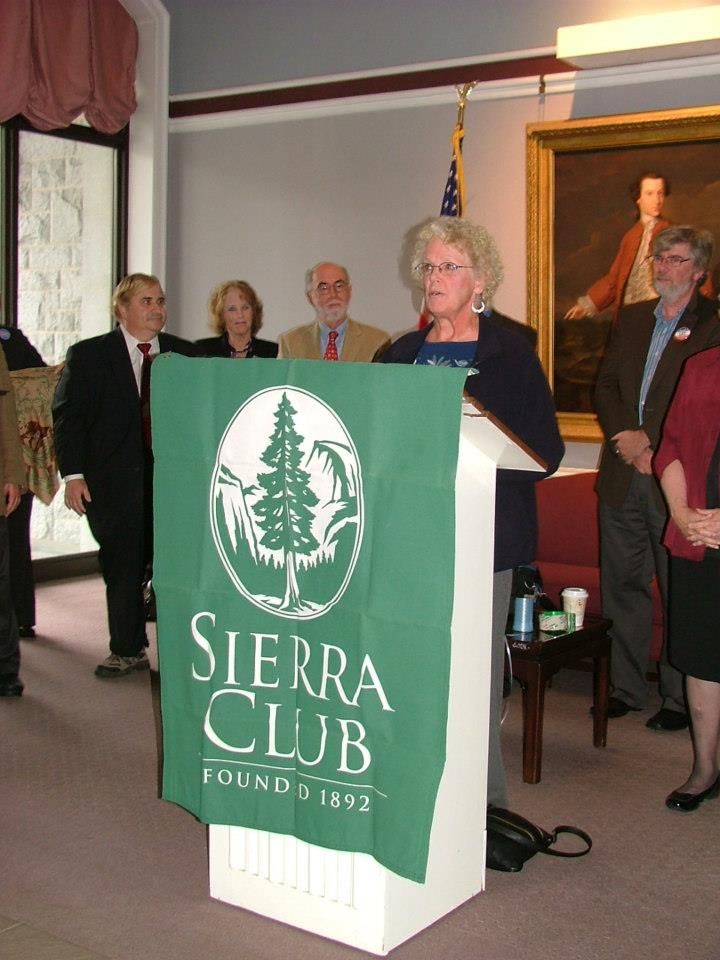
Lucy’s candidacy received the endorsement of the NH Sierra Club in October.

On marijuana legalization or decriminalization: “I think the war on drugs is a dreadful waste of money and human life. If we spent a pittance of what we spend on prisons, where most of the inmates have some sort of drug, alcohol and/or mental issues, on treatment, housing and other ameliorative measures, we’d all be a lot better off. I suspect we need to address the entire spectrum of the issue, but for now I certainly would support legalization of medical marijuana.”

Revenue and taxation:  Lucy reflects on her experience as Northwood selectwoman and the struggles over scarce funds, “It can really heated, pitting neighbor against neighbor over the crush of property taxes.”

“Schools get their money first, and then voters take out their frustration on the town budget. It’s hard to vote against education for our kids, but it is apparently easy to vote against health insurance or raises for town employees,” Lucy says, in stating how the limited revenue structure in the state leaves people afraid to raise revenue at all.

“Small towns are essentially run on volunteers, along with the state legislature.  This country has stopped growing legislatively for one hundred years,” she said, noting that the hundred dollar annual pay rate for representatives was voted in over one hundred years ago and has never been raised.

Lucy adds, “I think everything should be evaluated in terms of the long-term consequences, including fiscal policy.”

Of any larger issues Lucy says, “I realize I’d be a newbie and I’ll have plenty to learn.” she says, cautioning about getting too full of ideas about how much change she’ll be able to make.  But Lucy names her priorities without hesitation, “Environmental issues, campaign finance reform,  woman’s issues, education and children and families.”

Asked if she would protect a woman’s right to choose, Lucy answers in the affirmative and adds, “I’m very, very concerned about our families, particularly children and women.”

“I support education I think that how we prepare our children for the future is of vital importance.”

Lucy Edwards Campaign Facebook

Lucy C Edwards for State Representative

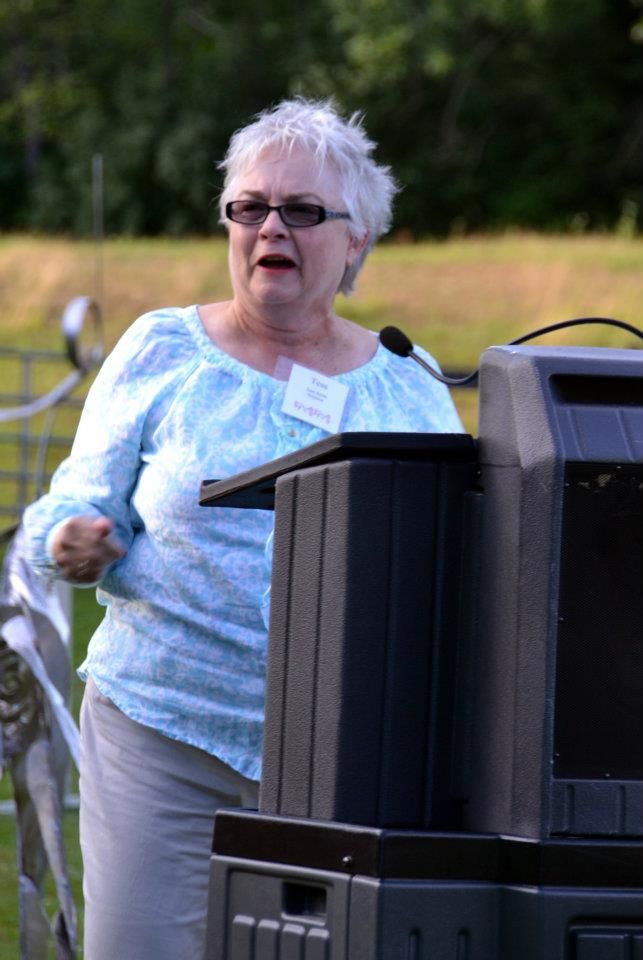
Tess Smith – Barnstead, Gilmanton and Alton, District 8 (Floaterial)

Tess is modest about her foray into public life and her accomplishments, “I really wasn’t involved in public life at all.” but she relates how she went to a rally last year to oppose Right to Work legislation at the house, “That was the day that the executive council voted to defund Planned Parenthood, I just couldn’t believe it.” She says she then had an epiphany and became engaged in the political scene from that point.

Tess has a strong background in customer service, sales and management and real estate and now owns a cottage industry employing four women who make handmade surgical masks for healthcare workers, “I am very proud of what we do, its a true cottage industry, the women are able to work at home, be with their families and earn some money, I basically give them a kit and they take it from there.”

On government regulation as a small business owner Tess relates, “I don’t find the government restrictive at all, everything is very clear and above board and I am able to do what I love.”

Tess earned an associate’s degree and also raised two children as a full time mother.  Growing up in Portsmouth, her mother was a stay-at-home mother and her father worked in the shoe industry, “We had good family values, I’m proud of my family and my extended family especially.  I know you don’t have to have a lot of money to have a good values.”

Tess thanks NH Citizen’s Alliance and other women in the local political scene in getting her to make the step to run for state rep. “I became involved with Citizen’s Alliance writing letters to the editor, bird-dogging candidates and they showed me the tools for organizing on the grassroots level.”

On key issues, such as the environment, Tess relates, “I grew up on the Seacoast and I’m concerned about how public lands are used, I think we need to preserve them for everyone’s appreciation but how to preserve them properly is a concern.” Tess also relates when asked about Northern Pass, “I’m very concerned about issues of eminent domain.”

She also named climate change, clean air and water as vital environmental concerns.

On campaign finance reform and ALEC: “I am very concerned about it, we need to get corporate interests out of our political interests.” Tess said that she would definitely be a watchdog on this issue.  She also admitted that as a progressive Democrat she probably won’t get solicited by ALEC, “Its such a Republican area and not really well known.”

Tess also states that she is morally anti-war and on taxation and revenue, “I follow the Jackie Cilley line; we need to put everything on the table; to use every tool in the arsenal to look at our funding issues statewide.”

On marijuana legalization/decriminalizaton: “Medical marjuana is a subject I know very little about. I would have to study that topic before I could make a decision.”

On women’s rights, “Its the part where we need to have to choose for ourselves.” she said on the issue of government intrusion into a woman’s right to choose.  She also mentioned the need for broader access to healthcare for everyone.

Update: Support Grows for CLF’s Fight to Secure a Fair Review of Northern Pass

From the Conversation Law Fund site regarding the DOE and its corrupt decision making process involved in approving the Northern Pass project.

Update: Support Grows for CLF’s Fight to Secure a Fair Review of Northern Pass

Two weeks ago, CLF exposed and brought to the public’s attention internal government documents showing that the Department of Energy (DOE) has illegally allowed the developer of the Northern Pass transmission project, Northern Pass Transmission LLC (NPT) to have significant and improper influence over the ongoing permitting process and environmental review of the project. After filing its concerns about the information with DOE, CLF issued a call to action, urging the public to join CLF in demanding that DOE replace the contractor team charged with preparing the crucial Environmental Impact Statement (EIS), which was handpicked by NPT, with a new, unbiased contractor or internal team with no conflict of interest.

We’re pleased to report that the responses – your responses – to the revelations and our call to action has been remarkable.

In the past two weeks, more than 300 members of the public (and counting) filed comments with DOE demanding replacement of the contractor team and a new commitment to a fair and open permitting process for Northern Pass. (You can take action yourself and file your own comment via this link.)

Yesterday, in a joint letter to DOE, a group of nine organizations representing New Hampshire’s conservation community and the grassroots opposition to Northern Pass, along with more than 60 individuals, expressed their deep concerns about the information exposed by CLF and called for a new EIS contractor with no conflict of interest. (Coverage on NHPR here.)

Read more on the CLF blog.

Tagged , , , ,

Don’t Have Insurance? Don’t Get Care! Says NH Congressman Guinta

Yes, he said it, but he didn’t just say that he believes hospitals should have the right to turn away patients, but he also re-frames the question by saying, ‘if you are 25 years old and you are choosing…” Yeah. choosing, because you know purchasing a health insurance policy is as easy as buying a pair of sneakers, amirite?

So typical of the Tea Bagger, wing-nut claim, people choose to be poor and choose to have low-wage jobs and choose to not purchase health insurance.  Sort of like the collection agent who calls and demands that you pay off that bill even if that means your lights get shut off and your car gets re-po’ed because, hey didn’t you choose to get sick or injured, didn’t you kid choose that fever?

Sure and didn’t you choose to live in a country where gigantic mega-companies can rule your life and decide whether you paid your fee to stay alive and healthy today? Well, did you?  Because if you didn’t, Guinta’s got news for you; get out and don’t let the revolving door slam you in your crippled, sickened ass, moocher! (and that means grandma too).

From ThinkProgress:

Republican Congressman Says Hospitals Should Be Allowed To Turn Away Patients Who Don’t Have Insurance

By Scott Keyes on Oct 18, 2012 at 4:50 pm

Rep. Frank Guinta (R-NH)

CONWAY, New Hampshire — Finding bipartisan agreement on any policy is a rarity these days, but lawmakers from both sides of the aisle have supported treating people who show up in the hospital, regardless of their ability to pay. Now, one Tea Party congressman is taking issue with that requirement.

Giving literal meaning to his state’s “Live Free Or Die” motto, Rep. Frank Guinta (R-NH) was asked at a debate Thursday about a hypothetical 25-year-old who needs treatment in the emergency room but doesn’t have health insurance. Guinta’s said he opposed the requirement that hospitals should have to treat people who come in without insurance. “If you are 25 years old and you are choosing not to purchase insurance with the expectation of trying to get it free from the ER at Memorial,” Guinta said, “that shouldn’t be the case”:

Continue reading at Think Progress where there is video as well.

Tagged , ,

From the Desk of Jackie Cilley: Important Information on Ballot Questions

From the desk of Jackie Cilley :

Election Alert for October 9, 2012

28 Days and Counting…..

 New Hampshire needs you – please be sure to vote on Tuesday, November 6.


Ballot Question 2 

O’Brien’s Excellent Adventure to the Colonial Era – Taking Back the Courts!

In an attempt to erase decades of statutory and judicial work on separation and balance of powers, the whiz-kids of the current legislature muscled through a constitutional amendment that will appear as Question 2 on your ballot as follows:

2. “Are you in favor of amending article 73-a of the second part of the constitution to read as follows: [Art.] 73-a [Supreme Court, Administration.] The chief justice of the supreme court shall be the administrative head of all the courts. The chief justice shall, with the concurrence of a majority of the supreme court justices, make rules governing the administration of all courts in the state and the practice and procedure to be followed in all such courts. The rules so promulgated shall have the force and effect of law. The legislature shall have a concurrent power to regulate the same matters by statute. In the event of a conflict between a statute and a court rule, the statute, if not otherwise contrary to this constitution, shall prevail over the rule.” (Passed by the N.H. House 242 Yes 96 No; Passed by State Senate 19 Yes 5 No) CACR 26             Yes                  No

Be Afraid, Be Very Afraid!

The O’Brien legislature has taken a number of actions with very dangerous consequences for our citizenry. Underfunding our court system has caused delays in our citizens’ ability to obtain justice. They have also created a competing mechanism, the Committee of Redress, that reviews court decisions filed by petitioners (without the bother of such little things as court procedures, equal protection for all parties, or even hearing the other side of a case). To date, the Committee of Redress has recommended the impeachment of four justices on virtually the sole testimony of a petitioner who claims to have been wronged (or otherwise simply didn’t like the verdict). The concept of due process seems hopelessly lost on this crowd.

Ballot Question 2 will give over to the legislature complete and final authority over our judicial system, turning it into little more than another political body. Although, as you can see from the question above, the ability to write rules will still reside with the judicial branch, the legislature will be able to concurrently change statutes relative to these rules and the latter will “shall prevail.”  Does anyone really doubt that a legislature wedded to the extreme ideology of the current one will fail to turn our courts into an extension of themselves?!

Scholars who argue for a well-functioning judiciary, one that functions objectively and in the pursuit of the rule of law, without undue influence of the political climate, cite the critical need for a clear separation of powers. G. Alan Tarr, professor at Rutgers University and a scholar in constitutional law, state constitutions and the courts and judicial process, puts forth four principals that should form the foundation of any reform of our judicial system. These include: judicial independence from political institutions, interest groups and the general public; judicial autonomy with the power to govern and manage its own affairs; effective delivery of judicial services with access for all citizens and expeditious administration of justice; and, accountable to the rule of law and to the people and their representatives (we already have a process in place when a justice violates his/her position in any way and that is the impeachment procedures). For more information on this topic, see G. Alan Tarr, The State Judicial Article, http://camlaw.rutgers.edu/statecon/judicial.pdf

Ballot Question 2 violates every one of these principles. The first two are self-evident. Violation of the remainder stems from the fact that by underfunding and interfering with the judicial process hobbles our court system’s ability to effectively deliver its services and makes it difficult to appropriately hold it accountable.

Nothing New Under the Sun

 For those who may have imagined that with the writing of the US Constitution, and subsequent state constitutions, the establishment of three branches of government was a settled matter, a reading of history on this topic immediately disabuses one of that notion. As it turns out, there has been a protracted battle between the legislative and judicial branches of government for decades and longer following independence.

New Hampshire’s own history in this regard is instructive of the desire of past legislatures to exert significant control over the judiciary. Our legislature once had a participatory role in dispensing of justice through an archaic device called the Committee of Redress (yes, similar to the one mentioned above!). This legislative body heard complaints by our citizens and ruled on those. It didn’t take long, however, for our forebears to recognize that there was a bit of a conflict of interest in having those who wrote the laws also interpret the laws and dispense with justice – not to mention write the laws to settle cases. It was a rather circuitous way of administering justice fraught with a host of problems for both public policy and justice. (Consider just one example of someone who has a complaint against the state, one that might result of in an injured party being awarded a judgment against the state. And, all of this being heard by the a unit of the same body that formulates a budget for the state.)

Even after the establishment of a separate judicial system, however, past New Hampshire legislatures grappled with the concept of a judiciary over which they had little control. Consequently, at least twice over the course of our history, “New Hampshire legislated out of office all justices of its supreme court by repealing the statute the created the tribunal and establishing another court in its place.” (G. Alan Tarr, “Contesting the Judicial Power in the Statest,” http://www.harvard-jlpp.com/wp-content/uploads/2012/03/TarrFinal.pdf

For those interested in an in-depth discussion of the tensions between legislatures and the judiciary, Tarr’s 19 page article on the topic provides a great overview of the topic.

Just Say No!

 If you want to defeat Question 2, you must cast a “No” vote. Passage requires two-thirds approval by those who vote on the Question. Please help to spread the word of the dangers of this constitutional amendment. Encourage your friends, family and neighbors to make plans now to vote and also to vote “no” on this question.

Update on Ballot Question 1:

Hold onto Your Seats – Here Comes the Money


As you may recall, the previous Election Alert covered Question 1, a constitutional amendment banning an income tax for “natural” persons and concerns analysts have expressed over the potential passage of this amendment. I warned about a last minute push for passage of Question 1. Sadly, almost immediately after the send button was hit on the Election Alert, the news broke that a new PAC has been set up to do precisely that.

The “No Income Tax” PAC is headed up by former gubernatorial candidate and former Executive of Cornerstone Policy Group, Kevin Smith. The PAC is chaired by three former Governors, Steve Merrill, John E. Sununu and Craig Benson.   The PAC can take unlimited amounts of contributions from individuals and organizations. You can count on this being a very well financed effort to get voters to approve the passage of this very dangerous constitutional amendment.

For some additional updated information on Question 1, visit the podcast of Attitude with Arnie, October 5, 2012, Hour 1 starting about 31 minutes in to hear the interview with Jeff McLynch of the NH Fiscal Policy Institute: http://www.nhnewsviewsblues.org/podcasts/Attitude_with_Arnie_Podcasts.xml Jeff responds to a number of questions about this ballot initiative that you may find of interest.

NOTE: Remember that it takes two-thirds of those who vote on the question for it to pass. If you want to defeat Question 1, you must vote “no” on it. Moreover, with the influx of influence and money to push for passage, it is now more important than ever that you spread the word about the pitfalls of this constitutional amendment and get your friends, family, neighbors and co-workers to the polls to vote on November 6.

 Voting Tip of the Day:

Unregistered voters may register to vote on General Election Day and will be allowed to vote in that election. If you wish to register before the General Election you can do so up until October 27. That is the last day to register until the General Election.

As mentioned in the last Election Alert, you will be asked to present a valid photo ID (see http://sos.nh.gov/ for list of acceptable forms of ID). NOTE: If you do not have a valid photo ID you will be permitted to vote after executing a “challenged voter affidavit.” 

Opinion Piece of the Day:

OP-ED COLUMNIST
Buying the Election?
Fred R. Conrad/The New York Times
By JOE NOCERA
Published: October 09, 2012

….Not all that long ago, the ability to partake of public financing was a sign that you had arrived as a serious candidate; today no candidate in his right mind would want to be so constrained….This election season, Mitt Romney and President Obama could end up spending more than $1 billion each. They seem to spend more time fund-raising than pressing the flesh with voters.

And that doesn’t even account for what’s truly different about this election: the rise of the “super PACs” and 501(c)4s, which are essentially a form of campaign money-laundering, allowing wealthy people to contribute millions toward supposedly “independent” spending on campaign advertising, polling and other expensive campaign goodies…

Although individual contributions to a particular candidate remains severely restricted – no more than $5,000 – the amount someone can pour into a super PAC is limitless. The means by which the country finances its campaigns is utterly broken. In a recent cover story in The Atlantic, James Bennet, the editor, traces how that happened. He focuses on a man named Jim Bopp Jr., a lawyer from Terre Haute, Ind., who has largely devoted his life to freeing the nation of campaign spending limits…What is astonishing is the way Bopp makes unlimited spending seem actually democratic. “Most people don’t even know who their congressman is,” Bopp tells Bennet. If there were more spending on campaigns, voters would be more educated about the candidates. The Supreme Court majority, meanwhile, has essentially said that, by definition, campaign spending that is independent of the candidate cannot be corrupting.

What we also know in the real world is that unlimited spending will not serve to enlighten voters. It will deaden them to political argument – as is happening in just about every swing state, where the ads are running with such frequency that people are tuning them out. Finally, we know from hard experience that the money that comes into politics has the potential to corrupt.

“This can’t be good for Democracy,” Bennet told me in an e-mail. It’s not.

For full article see: http://mobile.nytimes.com/2012/10/09/opinion/nocera-buying-the-election.xml

Tagged , , , ,

Northern Pass Proponents Say They Have 99% of Land – Numbers Disputed

Where’s the beef? NU stumbles through investor presentation today
Did NU say it will need a “new new Coos route” because of the Forest Society’s project to thwart the “new route”?
The Northern Pass portion of NU’s presentation to stock analysts today was notably lacking in substance, enigmatic on some occasions, and flat out wrong on others. The widely anticipated “new Coos route” announcement was not made. In fact, Leon Olivier, PSNH CEO, deferred it to the end of Q4, despite his earlier statement in July that NP would have the new route by the end of Q3. Another delay, in other words. And he pushed the 2016 project completion date back to 2017.
There was tricky math as well. Mr. Olivier claimed to have 99% of the lower 140 mile route sewn up. This literally cannot be true. NP does not have an approved route through the WMNF, roughly 7% of the lower 140 miles. If he meant 99% of the entire 180-200 mile route, the figures still do not add up. If the missing 1% (which surely is more) involves having to loop around the blocking parcels of the Trees Not Tower campaign, there’s a lot more mileage than Olivier is owning up to.
And Thomas May, CEO of NU, struggled to find words to answer a simple question about how filing alternative routes with the DOE would affect the timetable. He danced around until he seemed to say that NU will have “other preferable routes” to the current “new Coos route.” Will these be called the “new new Coos routes”?
 
“Okay. Question has to do with potential alternative — alternatives that we would have to file with DOE regarding Northern Pass, and how it may affect the schedule?
 
“Thomas J. May – Chief Executive Officer, President, Trustee and Member of Executive Committee
 
“Yes. If you recall, we did announce a route approximately 18 months a few years ago, and shall we say, we got a lot of feedback on that route. This new route will be the alternative to that previous route. We think this route is — it will be — it’s a good route. It will be more beneficial. It will — it is citable [siteable].We have other alternatives that we have looked at, and really — although there are different routes, you’re going to run into the same issues. Because if you have — we think what we’ve found is around a route that has the least impact on the environment, the least impact on the communities, but we will have other preferable routes. I wouldn’t speculate on what that would do to the overall cost of the project, the other routes or the timing of the gas flows at this point.”
The message to the opposition: keep on doing what we are doing, only more of it. Northern Pass appeared to be in considerable disarray today.
NHPR report
Northern Pass: Claims Progress On Route
By Chris Jensen
Despite opposition, the Northern Pass project is doing well, according to company officials.
During a conference call with industry analysts, officials from Northeast Utilities insisted they are happy with the progress they are making.
“I am pleased to say that we have about 99 percent of that 140-mile right-of-way right now either acquired or we have under agreement. The last essentially one percent we are working through the final details.”
That’s Lee Olivier, an official with Northeast Utilities, which is behind the Northern Pass hydro-electric project.
But the Northern Pass project does not have permission to use about 10 miles through the White Mountain National Forest, and that would be roughly 7 percent.
Nor did Olivier directly address progress on the route through Northern Coos.
A Northern Pass spokesman couldn’t immediately be reached for comment.
Northern Pass has been playing a kind of real-estate chess game with opponents.
Opponents of the project are trying to block a route in Northern Coos, using tactics such as conservation easements.
Oliver said the project still hopes to file that new route with the U.S. Department of Energy by the end of the year.
That filing will trigger a new series of public hearings before the Department of Energy which must still approve the project.
Comment:
Jim Dannis .
Olivier appears to have misstated the length of the Northern Pass lines as 140 miles rather than 180 miles. Of course, who knows the current length of the preferred route, seeing as it has not yet been announced! But let’s stay with the supposed facts on the table. So, NU’s mistake #1 was to misstate the route length.
Assuming Mr. Olivier of NU slipped up on the length of the Northern Pass transmission lines and meant to say “180” rather than “140”, he still made a material misstatement.
The preferred route runs through the WMNF. Northern Pass has absolutely nothing, zip, zero, nada, in terms of land rights for the majority of the 10 mile WMNF crossing. The only way they get to cross is if they obtain a brand new, discretionary, temporary permit from the US Forest Service. The standards applicable to a new transmission line like Northern Pass in the WMNF are exceptionally high and, in the view of many, impossible for Northern Pass to meet. Forgetting to mention the WMNF issues was mistake #2.
Let’s go further and assume Mr. Olivier messed up the route mileage and forgot about the details of the WMNF. He has still made yet another material misstatement. To say that only 1% of the route mileage is not yet obtained or contracted is to sweep under the rug the problems created by that 1% (if 1% is the right number!). For example, the Forest Society’s “Trees Not Towers” campaign involves blocking parcels along Northern Pass’s preferred route. Going around blocking parcels, if it is possible at all, would almost certainly require long, sweeping detours. This will multiply route mileage. Mistake #3: failing to explain the consequences of the remaining blockages.
One could go on and on, but the reader should get the point. A senior NU executive was apparently unable to explain clearly where Northern Pass stands with its preferred route. He made at least three material misstatements in just a few sentences. Hopefully the press will assist Mr. Olivier in clarifying the facts.
Getting your voice heard: how to write effective scoping comments
Venting at Northern Pass may be a good therapeutic exercise, but it won’t do anything to stop the project. Responsible Energy Action LLC (REAL) offers suggestions about how to get your voice heard in the regulatory process. It’s the only vote on the project you’ll have. Now is a good time to work up a substantive comment that the DOE cannot ignore.
the preceding from Trees not Towers
Tagged , ,

A Boycotter’s Guide to the 2012 Election

Matt Richards submits in answer to “The Protest of Nothing”,  an excellent survey of presidential candidates and a compelling argument explaining the Boycott rationale through Matt’s perspective.

I’m writing this on the eve of the first televised debate between Barack Obama and Mitt Romney, in response to Katie Talbert’s opinion piece, The Protest of Nothing: https://progressiveactionnh.wordpress.com/2012/09/16/the-protest-of-nothing.  There’s been a lot of buzz about an election boycott this year.  Over the past few months, the idea has been swirling around the internet, gaining some airtime on the podcast of Left-wing activist Cindy Sheehan, and drawing fierce criticism from icons such as Michael Moore and Noam Chomsky.  I’ve begun to notice how voting is considered a sacrosanct ritual among many Americans, especially progressives who still look toward the ballot box for social change.  As a result, many people have been asking me what I’ll be doing this November 6th.

There was something in Katie’s editorial that caught my attention.  She stated that “Democracy demands engagement for success.”  She seems to imply that both rebelling against the current system and engaging in democracy are two separate processes, both of which are important.  “Engaging in democracy” seems to be code for “voting and campaigning for candidates.”  It made me wonder—what is democracy?  How do you engage in democracy when the system set in place by the ruling corporate oligarchy seems completely undemocratic in nature?  How many votes does it take for democracy to suddenly activate?  Will it activate when 75% of the population votes?  When 100% of the population votes?  Or must we stop participating completely and attempt to build a system not controlled by the wealthy few?

So what is a young, anti-war anarchist to do?  Originally, I had just planned on rebutting some of the points in Katie’s essay.  Instead, I decided to review the full slate of choices this November, and evaluate what I feel are the pros and cons of each.  Without further ado, here it is:

Voting for Romney/Obama

PROS:

  • It only takes five minutes, and one of them will be President anyway
  • The Supreme Court
  • Voting for one of them might precipitate an economic collapse and make revolution come sooner

CONS:

  • Voting for the lesser of two evils is still voting for evil
  • Voting for Obama/Romney completely defeats the purpose of the Occupy Movement and Arab Spring

I would give more attention to why both Obama and Romney are awful choices for President, but Katie already did a good job of that in her essay.  I mean…does the world really need four more years of drones, Gitmo, indefinite detention centers, and huge bonuses for Wall St. executives?  In my opinion, any of those things alone is enough to deserve either of them a lifetime prison sentence.  But the non-delusional among us know that either Wall St. Candidate A or Wall St. Candidate B will be sitting in the Oval Office next January.  So should we just grit our teeth, hold our noses, and spend five minutes voting for the person who will be the least awful?  Should we, for five minutes, ignore the drone bombing in Northern Waziristan, and vote for whichever of the two has the least horrendous social policies?  The one who will select the least worst Supreme Court nominations?

Honestly, it’s hard to tell which of the two is the least evil, and I have no interest in trying to decide which: http://ivn.us/2012/07/17/100-ways-mitt-romney-is-just-like-barack-obama/.  The whole thing would be an exercise in futility.  Whenever I tell Democrats I’m considering boycotting, they warn me not voting would be a vote for Romney, and that it will be my fault when he’s elected.  Whenever I tell the few Republican I know that I’m considering boycotting, they warn me that my absence from the polling place will result in Obama getting re-elected.  The partisan divide in this country is fierce, and I start to see everyone’s true colors show come election season.  To be honest, I don’t think we’ve had two worse candidates running for President since the days of Andrew Jackson.

The most interesting reason I’ve heard for voting for the two is that under an Obama or a Romney presidency, living conditions will deteriorate so much that people will be forced to revolt against the government.  The advocates of this position, whom I will affectionately refer to as “anarcho-totalitarians” presumably believe that once enough people lose their homes, their food stamp benefits, their jobs, etc, there will be a revolution, and a much better system of government will suddenly appear.  Of course, much of this is satire.  There’s even a youtube video entitled “Revolutionaries for Romney”, endorsed by none other than Vermin Supreme himself: https://www.youtube.com/watch?v=MOf-g5UnIWo.  Satire or not, is there perhaps some merit to this?  Are we willing to vote for the worst candidate and cross our fingers that people will start revolting?  While it sounds somewhat appealing, I’m not interested in doing it.  I think Obama/Romney will do a good enough job making things awful without me “helping them” with my vote.

And of course, there’s the fact that a vote for a Wall St backed candidate completely undermines the objectives of the Occupy Movement.  Why would someone protest outside Goldman Sachs and Bank of America, then vote for the same candidates being funded by Goldman Sachs and Bank of America?  I sure as hell know I didn’t become an occupier so I could see a Romney or an Obama presidency.

Voting for Jill Stein

PROS:

  • Voting for her sends a message that we’re fed up with the two-party system
  • She’s on the ballot in 39 states, which is enough to (theoretically) win the electoral vote
  • If she gets 5% of the popular vote, the Green Party gets $20 million in federal funding next election

CONS:

  • She won’t win, and voting for her “takes votes away” from Obama/Romney
  • Protest votes do not “register dissent” the way we’d like them to
  • She’s a capitalist, and the Green Party is a capitalist/reformist party

And then there’s Jill Stein!  In the picture above, she and her running mate, Cheri Honkala, are being arrested for a foreclosure protest against Fannie Mae in Philadelphia.  Taking part in foreclosure actions and Occupy protests all over the country, Jill Stein has displayed a commendable level of courage, and certainly deserves her place as one of the forebears of the “Occupy Wall St” candidates.  I met her here in Manchester during Occupy the Primary, and she proved herself to be a very intelligent and articulate woman: http://www.youtube.com/watch?v=gbc4fCh3HVE.             Her campaign staff has been working tirelessly to get her ballot access in 39 states, a total of 447 electoral votes.

Why vote for Jill Stein?  Because it sends a message that people are fed up with the two-party system.  Her “New Green Deal Platform”, borrowing the memory of FDR, is appealing to a large section of progressives, and people who are fed up with the Democratic Party.  Many activists I respect and admire are voting for Jill.  They believe that registering their dissent in the polls is very important.

Why not vote for Jill?  We’ve all heard it.  Jill knows it herself.  She’s not going to win.  She’s somehow “taking votes away” from Obama.  But is that a reason for not voting for her?  I think it’s a terrible reason not to vote for her, because people not following their consciences is part of what has gotten the world into the huge mess it’s in right now.  In my view, there are much better reasons not to vote for the Stein ticket than “she can’t win”, because the implied alternative would be voting for Obama, something I have no interest in doing.

I doubt Jill is even trying to win the election.  Which brings us to the “main” pro of voting for her: if she gets 5% of the popular vote, the Green Party will receive $20 million in federal matching funding next year.  I actually tried to research this claim, and was able to find information about it here: http://www.fec.gov/press/bkgnd/fund.shtml.  Is this something that could possibly happen?  The last time a third party candidate got 5% of the vote was Ross Perot in the 90s, and the Reform Party dissolved by the next election—not a good omen for Jill.  In fact, Jill would have to get twice as many votes as Ralph Nader did in 2000 to pull it off.  But what if she does get the funding for the Green Party?  Would their $20 million in federal money give them the ability to compete against the billions of corporate dollars that will be funneled toward the Democratic and Republican candidates next election cycle?  Will we see the rise of a functional multi-party system in the United States?

If I were taking bets, I’d wager the odds are 100,000 to 1 that we’ll see our economic system collapse under the weight of its own greed and selfishness before we ever see a functional multi-party system in the US.   My main problem with Greens is their propensity to engage in magical thinking.  I cannot count the number of times I’ve heard the phrase, “But if EVERYONE voted for Jill Stein, the wars would end!  If EVERYONE was a Green, Wall St would be held accountable!”  It is this thinking, in part, which keeps people from realizing their own potential.  It convinces people the solution to their problems is as easy as pulling a lever.  Even in the million to one scenario Jill was elected President, what are the odds that she would end be able to “fix” a system designed by Wall Street.  Jill has too much integrity in her views and personal life; Washington, as it is now, has no place for her.  Why toss a good apple into a rotten barrel?

            There are those who would question whether Jill Stein is even a “good apple” at all.  I’ve heard the critique of several socialists that she has never come out in support of socialism.  That she merely wants to reform capitalism into something “less bad” while keeping the power structure that oppresses working class people and minorities intact.  While I certainly understand the criticism, I think she’s a good person and a good candidate.   I wish her all the best with her campaign, and if she does get federal funding, I hope the Green Party proves me wrong.

Voting for Gary Johnson

PROS:

  • He’s on every ballot except Michigan and Oklahoma, giving him more electoral access than Jill Stein
  • His views on abortion/the death penalty/gay marriage/the drug war are decent

CONS:

  • He’s a right-wing wackadoodle
  • He won’t win, and did terribly in the Republican primary

While Jill Stein has been busy courting the Left and disenchanted Obama voters, Gary Johnson’s attracted attention mostly from Libertarians and Recovering Republicans.  Libertarians of a bunch of stripes have been raving about him over Facebook.  Especially tonight, when he’s being “locked out” of the debate.  Unlike Jill, he’s never been a professional activist.  As a former governor of New Mexico, he’s a politician, and he’s familiar with the system he’s running for.   Some people think someone with experience runs a better campaign, but to me it just makes him untrustworthy.  I guess it’s just a matter of perspective.

His views aren’t going to be as attractive to progressives and those on the Left as Jill Stein, either.  He certainly has some good points: wanting to keep the government out of people’s uteruses, his opposition to the death penalty, his support of gay marriage, and his opposition of the drug war, to name a few.  But for many, including myself, those views are overshadowed by his typical right-wing rhetoric.  The worst of this, in my view, is his position on healthcare.  Remember Romney telling people they should just go to the emergency room when they’re sick?  I talked to Gary Johnson when he came to New Hampshire, and he actually told me, “When I was governor of New Mexico, no one died due to lack of health insurance.”  Talk about delusional!  There’s a difference between supporting a terrible policy and denying reality, and I definitely think it’s a line he’s crossed over.  I wasn’t left with the impression that he actually gives a shit about people who are suffering.

            The only thing that makes Gary Johnson a better choice than Jill Stein is that he’s on the ballot in more states.  I’ve actually heard friends tell me, “You need to vote for Gary Johnson, because he’s the only one with enough electoral votes to realistically win!”  In this way, some of Johnson’s supporters are just as delusional as Stein’s supporters.  Let’s be real, here: we will not see Jill Stein, nor Gary Johnson, in the White House this January.  The only reason to vote for either is out of moral conviction.  And since most of the left isn’t going to be morally compelled to vote for Gary Johnson, let’s move on.

Voting for Rosanne Barr/Peta Lindsay/Stewart Alexander

PROS:

  • They’re the only socialists on the ballot

CONS:

  • Voting for them is “divisive” and takes votes away from Jill Stein
  • They might not have the popular appeal Jill Stein does
  • Voting for them is still participating in capitalist elections

The socialist candidates are the most paradoxical among the field this year.  They want to “Build a Party of the Working Class”, but do it within a system they consider to be a “dictatorship of the bourgeoisie”, or, as I’d put it, “the dictatorship of the 1%.”  They want to have a working class revolution, but do it within a ballot box which is counter-revolutionary.  Or at least that’s what it would seem at first glance.

Peta Lindsay of the Party for Socialism and Liberation is appealing because she only wants to use the election as a gimmick to get the message of socialist revolution out to the general public.  She is under no illusions that she will win.  She is only on the ballot in 13 state, and, perhaps most illuminating, she’s only 28, and therefore ineligible for the Presidency under the current constitution.  And the platform she wants to get out there is a pretty stellar platform: http://www.pslweb.org/votepsl/2012/media-coverage/media-lindsay-globe-gazette.html.  Likewise, Roseanne Barr is simply trying to use her celebrity to get the message of drug decriminalization, socialism, and feminism out to the general public.  Her platform might not be as cohesive, but I think she has a much better chance of getting it out to the people than Peta.  (There’s no way the mainstream media will cover Peta, but they’ve already given a bit of attention to Roseanne.)

The most hilarious thing about the two of their candidacies and Stewart’s candidacy are the ire they’ve drawn from certain Jill Stein supporters.  I have seen them accused of “dividing the progressive vote” in a time where it’s absolutely crucial to vote for the Green Party.  The irony, of course, is that this is the exact rhetoric Obama supporters tend to aim at people voting Green.

My conclusion is that the Peta/Roseanne/Alexander tickets are not tickets to vote for, but tickets to lend moral support to.  They don’t want people voting for them; they want people to help them get their message out.  That’s definitely something I’d be willing to help them do.

Writing In Ron Paul

PROS:

  • Ummmm…he’s kind of anti-war?

CONS:

  • Everything else about him is awful
  • He’s not even running as a third party/independent candidate

I wouldn’t even bring this up if a whole lot of people weren’t planning on doing it anyway.  In 2008, Ron Paul received 41,905 votes in states where write-in votes were counted.  Based on how many of my Facebook friends are voting for him instead of Gary Johnson, I imagine that number will be ten times as high this year.  So why are people so enchanted with this Texas Congressman?  Because of his anti-war rhetoric.  Because he said he would bring American soldiers home “as soon as he can get the boats there.”  Even though he voted for the Authorization of the Use of Military Force which got us into Afghanistan.  Even though he said he wouldn’t hold Obama accountable for his war crimes.  And even though some of his top campaign contributors are military contractors Northrop Grumman, Boeing, and Lockheed Martin (I shit you not): http://www.opensecrets.org/pres08/contrib.php?cid=N00005906.  Let’s face it: Ron Paul is one of the slimiest, weaseliest, pandering-est politicans this side of the Rocky Mountains.  You don’t stay in office for over 30 years unless you’re willing to compromise your integrity over and over again while putting on your good guy face to the general public.  I call it like I see it.

And since he’s not even running, we might as well get over him.  Moving on.

Writing in Vermin Supreme

PROS:

  • He’s hilarious, and is appealing to more than just third party candidates
  • He gets why he’s running
  • He’s the only legit Anarchist on the ballot
  • Voting for him sends a message that we’re fed up with the entire election system
  • Free ponies! Okay, maybe not…but he did give me free long johns.

CONS:

  • He’s not on the ballot in any state
  • Voting for him still counts as “participating” in the system
  • Americans are too stupid to get satire

You have to have been living under a rock for the past year if you’ve never heard of this zany, over-the-top satirical candidate who promises free ponies for every American.  The king of meme, Vermin Supreme gained millions of youtube views when he glitterbombed anti-gay Democrat Randall Terry at the Lesser-Known Democratic Candidates forum, transforming a rather mundane event into a media spectacle.  A perennial candidate since 1988, Vermin has perfecting campaigning into a performance art.  This Democratic primary, he got more votes than ever before, scoring a good 833 votes in the race against Barack Obama.  More importantly, he’s probably generated more press than Jill Stein or even Roseanne Barr.  He has a weapon other third party candidates don’t that connects him with the average, everyday American: his super-satirical style of humor.

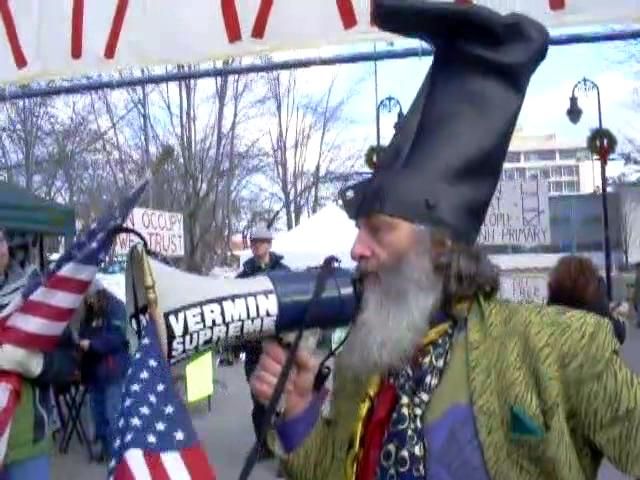
If Jill Stein is the “Occupy Wall St candidate”, Vermin Supreme is the Occupy Wall St. God.  As the above picture can attest to, Vermin Supreme has been to more Occupy Wall St rallies than any other candidate.  Vermin lives, breathes, and sleeps Occupy.  In my view, he really captures the spirit of the movement.  And he’s the only candidate who’s a legit anarchist: if you dig under the exterior sarcastic despotism, you’ll quickly find the creamy revolutionary filling inside.

The main criticism I’ve seen of Vermin’s campaign is that he’s “not taking it seriously.”  Which is like telling Jonathan Swift that eating babies is gross and he should stop telling people to do it.  Like the comedy of Dave Chappelle, Vermin’s complete mockery of the political process might fly over a lot of people’s heads.  I like to think Americans are smarter than they are, but all my experience has proved this to be false; the only ones who laugh at the cruelty of life or the cruelty of the electoral system are the ones wise enough to get the joke.  Regardless, given that he’s not on the ballot in any state, if you cast a ballot for Vermin this election cycle, rest assured it will make no difference whether you place it in the ballot box or burn it.

Or, in the immortal words of Vermin, “A vote for me is a vote completely thrown away.”

Vote for Nobody/Leave Presidential Slot Blank but Vote Locally

PROS:

  • Local elections are much more important than the Presidential election
  • You can vote on things you want, while still showing disapproval of the system

CONS:

  • You’re still not completely withdrawing from the system you acknowledge as illegitimate
  • There might not be any independents running locally
  • If you live in a state with electronic voting machines, they might “fill in” your empty Presidential spot for you. (I have not found evidence confirming this, but if someone finds any, please let me know.)

This option is one of my personal favorites.  Curiously enough, most of the criticism I’ve seen of election boycotters is that they are “Letting Obama/Romney win” by not voting.  Which means it’s the presidential election, the one that’s most controlled by corporate money, the one where our votes matter the least, that people tend to value the most.  What I appreciated the most about Katie’s editorial is that it wasn’t the Presidential elections she told people they should “get engaged” in—no, she focused the battle happening in state legislatures across the country.  I can certainly see why people find value in local politics; I don’t think we have a whole lot of influence in any part of this electoral system, but if enough effort was put into it, I bet people could certainly make a dent in local politics if they really wanted to.  The presidential elections are a totally lost cause, but when it comes to the down ticket, why not have your cake and eat it too?  Why not leave the presidential slot blank in protest or “Vote for Nobody” while voting for initiatives and local candidates that are important?

The main problem with this strategy is when there are no local, independent candidates to throw your support behind.  I actually went to a progressive “state legislator training session” in Concord, and told the trainers I was considering running for state house or senate sometime in the distant future.  When I told them I would never run as a Democrat or a Republican, I was all but laughed out of the room!  The fact is, the two party system not only has a stranglehold over the federal elections, but based on the way the rules are written, they often dominate local elections all over the country as well.  The last time I voted for mayor, I voted for the one Independent, Glenn Ouellette, and he got 2% of the vote.  While I admire those who want to change that and run as independent or third party candidates in local politics, I feel like my time and energy is best spent elsewhere.  And since I don’t imagine any third party candidates are going to throw their hats into the ring in the next few months, why not go the full way and boycott the whole damn charade?

Boycotting the Elections

PROS:

  • It’s the most “revolutionary” of the options, in that it rejects the whole system
  • Shows solidarity with people boycotting elections worldwide
  • Shows solidarity with indigenous communities struggling against a Colonial Power
  • It feels freeing and relieving

CONS:

  • “If you don’t vote, you have no right to complain!”
  • Boycotters are mistaken for apathetic; it sends the wrong message
  • It may not be appealing to minorities and marginalized people
  • There aren’t enough people doing it; it won’t catch on until Third Parties/celebrities publicly join in a boycott
  • There are better things to boycott than elections

So, we’ve finally come to the crown jewel of the controversy: the election boycott.  The crass, boisterous, in-your-face election boycott which makes no compromises and offers no apologies for itself.  It’s beautiful the way a castration is beautiful; it takes all we’ve been taught as a culture about democracy, throws it bloodied to the dirt, and spits on it.  Some will indeed call it “The Protest of Nothing”.  I don’t blame them.  Really, there are too many things to protest these days, and it’s easy for The Protest of Everything to look like the Protest of Nothing to the uninitiated.    The biggest myth about the boycott is that it takes no courage to perform—boycotting is not for wimps.  There are few things more frightening than unshackling yourself from the illusion of hope and learning to trust your own abilities.  And yes, the election boycott throws the baby out with the bathwater, but this presupposes the bathwater is morphine, and the baby was a battery in the Matrix, and that maybe we’ll build a bridge over our failures before the floodgates of cataclysm close over humanity.

I hyperbolize.  But my point remains the same: the boycott’s not for everyone.  That being said, there are plenty of good reasons to boycott.  The first being the solidarity it shows with groups of revolutionaries around the world who are fighting tyranny by boycotting their countries’ elections.  From Egypt to Mexico, there is a growing movement of people boycotting all over the planet: http://electionboycott2012.org/election-boycotts-around-the-world-and-now-in-the-us-too/.  I’ve heard the argument that those societies are very different front ours; that people in the United States have much more voice in their government than people in “third world countries”.  The truth is quite the contrary.  We are the model for tyranny everywhere: there are few undemocratic governments in the world that the United States has not had some hand in bolstering.  Furthermore, there is more corporate cash poisoning our system of government than in any other country.  We are living in a society where dollars equal votes.  Also, there is no military empire larger than ours; to oppose the elections is to oppose the military interests attached to the system.  Dr. King once said his government is the largest purveyor of violence on the planet.  Not much has changed since then.

United States imperialism doesn’t only affect other countries, though.  Most people who argue that citizens are “obligated to vote” tend to forget the fact that the United States government is still a colonial power.  They tend to forget that those most hurt by upholding the current system are people living on reservations, the indigenous community who lost their homes, their language, their families, their history, their environment, and everything they had.  The boycott has gained some traction among some members of the indigenous community, who wish not to uphold a colonial power, and instead wish to choose their leader according to traditional custom.  This is most organized in Mexico, where two indigenous communities, the Nahua and the Purepecha, have decided to boycott the elections: http://www.grass-roots-press.com/2011/09/30/indigenous-communities-boycott-elections/.  I propose that, in solidarity with these communities, the Boycott the Election movement ought to change its name to the “Decolonize the Elections” movement.

Now, on to the negatives of boycotting.  The first thing I always hear from people opposing the boycott, usually Obama or Romney voters, is that “If you don’t vote, you have no right to complain!”  Just like “Support Our Troops” this is a mindless piece of propaganda without much substance.  It’s effective because it doesn’t mean anything.  I believe that every person, whether they voted for Obama or McCain or Cynthia Mckinney or no one at all, has the right to complain about the corrupt and morally bankrupt system they didn’t build.  Moreover, they have the right to try to change it or destroy it in the best way they see possible.  No one should be silenced for expressing their victimization.  I would go on about this point, but I think the late George Carlin satirically refutes this point more eloquently than I ever could: http://www.youtube.com/watch?v=xIraCchPDhk.

The next point of opposition I always encounter is that not voting makes you seem apathetic.  This is indeed a serious image problem.  Luckily, it’s a problem with a very simple remedy.  If people see you participating in society on days other than election day, they’ll realize you do care about what happens.  If you can show that you understand the issues the country is facing, it will buck their preconception.  If they see you helping your neighbor instead of spending all day in front of your TV (I realize I’m condemning myself), they won’t think you’re a heartless, apathetic dolt.  We all must become leaders in our community.  We all must help each other and gain allies wherever we can.

Of all the points of opposition to the boycott, the one that troubles me the most is the issue that it doesn’t speak to the concerns of minorities.  That because so many people of color, women, and immigrants fought hard for their right to vote, and still are, this is a tactic that really doesn’t speak to them.  As a person who is male and looks mostly white, I benefit from those privileges, and feel an obligation to confront the ingrained bigotry around me.  I don’t want to see the election boycott become like social movements of the past; we’ve all heard stories about the women’s suffrage movement excluding black people, the civil rights movement excluding gay people, the gay liberation movement excluding trans people, and so on.  I’m afraid of history repeating itself.  And I’ve seen a lot to worry me about the ilk I’m associating with—I actually saw an election boycotter tell a critic that he was “playing the race card” when he argued that the movement wouldn’t be appealing to black people.  This is clearly a problem that needs to be confronted.

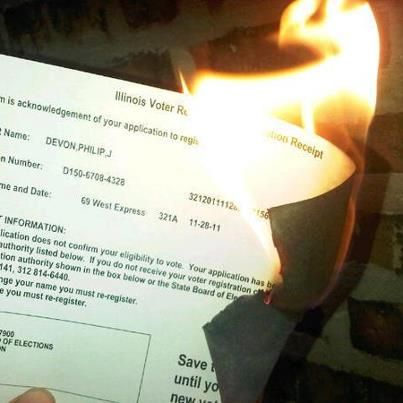
So, is this election boycott really the movement of angry white men and young white libertarians living with their parents?  I don’t know.  It’s too soon to tell.  In Chicago, there was already a counter-protest to the burning of voter registration cards where an elderly gentlemen said that by burning their cards, they were helping voter suppression efforts and contributing to the disenfranchisement of “colored voters”: http://www.examiner.com/article/occupiers-burn-their-voter-registration-cards-protest.  While I don’t see how burning your own registration card can “disenfranchise” anyone, it’s a sign that the boycott may not have a message that’s appealing to minorities by and large.  But, hell…I’m not sure yet that the election boycott is appealing to most people, anyway.  And if history tells us anything, women, immigrants and people of color have often been leaders of boycotting efforts.  Emma Goldman was famous for standing against the suffragettes and stating that participating in capitalist elections did not further equality for women, because it did not take class order into to count.  W.E.B Dubois also gave a speech about why he refused to vote: http://www.blackeconomicdevelopment.com/why-i-wont-vote-by-web-du-bois-the-nation-20-october-1956/.  Perhaps we will see it catch on the more disenfranchised communities become, just as we’ve seen with indigenous groups.

The next criticism of the boycott is one I often level against it myself: it’s not big enough yet.  The election boycott isn’t really a movement, it’s a tactic which is of little value when it comes to changing the system.  The “Boycott the Presidential election” event page on Facebook has 772 attendees, which is more than nothing, but still isn’t really putting a dent in removing the government’s popular legitimacy.  I think in order for the boycott to gain traction, one of two things needs to happen: third parties need build a coalition to boycott the election, and/or A-list celebrities need to endorse the boycott.  I think the Party for Socialism and Liberation is likely to call for an election boycott way sooner than the Green Party; the Greens are still too engaged in magical thinking that they have the ability to eventually change the system.

Lastly, there’s the assertion of critics that it is much more important to take other direct action than boycott the election.  I can’t say I disagree.  Boycotting is just one tool in a toolbox of many methods to achieve a peaceful revolution: http://www.aeinstein.org/organizations103a.html.  It’s much more important to democratize your workplace to strike.  It’s much more important to boycott corporations which engage in unethical business practices throughout the world, or take your money out of banks.  I think the most necessary action of disengagement, championed by Cindy Sheehan, is to stop paying Income taxes if at all possible.  Income taxes go to pay for wars throughout the world.  When I hear about someone boycotting the election, then I hear that person is still paying taxes and has not even attempted to stop paying, I take it as a huge sign of hypocrisy.  If everyone in the country didn’t vote, it might not change the system, because the system does not require our votes to operate.  But if everyone in the country stopped paying taxes and redirected the money to worthy causes, we’d see a more peaceful, democratic society in place much sooner.

———————————————————————————————————————

So what will I be doing this November?  Right now, my plan is not only to boycott, but to Decolonize the 2012 Elections.  I probably won’t be putting much effort into actively organizing theater surrounding it, because there are projects much more worthy of my time.  What I do know is, I will be going to the polls, refusing to show my ID in solidarity with those whose rights are being oppressed, then getting my ballot.  I don’t know what I will do with the ballot afterwards…perhaps I will burn it, perhaps I will put it in a bottle and sent it adrift to sea, or perhaps I will turn it into a paper boot hat in honor of Vermin Supreme.  Your guess is as good as mine.

Do I know that I’m making the right decision?  No.  I only know that I feel the most free I’ve ever felt in my life.  I know that my conscience is telling me to do this, and my conscience rarely leads me astray.  Maybe the Green Party will manage to establish a presence in the future.  Maybe the US will see the rise of a multiparty system.  I think it’s very unlikely.  But I’m always willing to be proven wrong.

Matthew Richards is a life-long resident of Manchester, and was active in Occupy NH. As assistant director of New Hampshire Pridefest, he took part in organizing the first Pride event in New Hampshire after a decade long hiatus. He’s been performing regularly at poetry open mics throughout New England for the past three years, and competed in the 2011 National Poetry Slam as part of the Slam Free or Die team. His upcoming collection of poetry, tentatively titled ‘Revolution is a Ruthless Boxcar’, will highlight his experiences in the Occupy Movement.
Tagged , , , , , , , , , , , ,

Get A Job and Make Some Change!

What Does Democracy Look Like?

From Mark Fernald via email

Grassroots Solutions ((www.grassrootssolutions.com), a national
political field organization, is looking for dedicated individuals to
join its New Hampshire Democratic Canvass Team 2012 and go
door-to-door to talk with New Hampshire voters in Manchester and other
areas in New Hampshire about the upcoming election.

Maybe you are a student with no afternoon classes, a parent whose
children are off to college, or someone who works the night shift in
your current job but would like to earn extra money. If you are at
least 18 years old and enjoy talking with people about important
issues that affect their lives and the lives of their families and
community, then we are interested in hearing from you.

This is a fantastic opportunity for someone looking to gain experience
in the world of politics. It is a fast paced and dynamic job in a
Presidential election year.

The pay is $12.00 an hour and you have the potential to gross over
$2,500 between now and the November election. You will be paid either
by check or direct deposit every two weeks.

Bilingual English/Spanish would be an advantage. Experience on a
political or issue advocacy campaign would be great, but if you don’t
have any, we will train. This is a temporary, full-time job (3-7 days
a week).

You and your canvass partner will be expected to travel by car to
neighborhoods assigned to you each day, walk door to door, engage in a
conversation with voters, and record the results of your conversation
in an iPod mobile app. Professionalism is a must, as is the ability
and willingness to talk with a diverse group of people.

Accuracy, attention to detail, and honesty in reporting the results of
your day’s work are essential. Previous campaign or advocacy work
experience would be a plus, as would experience using computers and
devices such as iPods. Training will be provided.

The position starts immediately and continues through the end of
October. We work 7 days a week. Most shifts are around 6 ½ hours long
— 5 ½ hours of which are spent talking to voters — in the afternoon
and early evening. You and your canvass partner will meet with other
canvass teams as a group at the beginning of your shift, and will get
back together at the end of your shift to record your data.

It would be great if you could work every day, but we know that’s not
always possible. We do, however, expect you to commit to work at least
three full days per week.

If you are interested, please apply online at
http://www.formstack.com/forms/grs2012-nhrecruiting

No emailed resumes, please! You will be given the opportunity to
attach one during the online application process.

Thank you and we look forward to hearing from you!

The New Hampshire Canvass Team

Tagged , , , ,

Wake the F**K Up! Get Plugged In!

Kick Some Today!

Nothing more needs be said:

Want to get involved in your state? Need a job for a bit while doing the right thing?

Progressive Change Campaign is looking to hook people up with campaigns across the country, they need a wide range of skills and abilities, what talent do you have to offer?

Locally, if you live in New Hampshire paid canvassing positions are open, contact the following:

In the Manchester/southern New Hampshire area: contact Grassroots Solutions.  Grassroots Solutions is hiring employees full or part-time and running a full seven days, with pay at $12/hour. To apply, please fill out their online form.

Citizen’s Alliance – NH is also looking for part-time canvassers for Nashua and phone bankers out of their Concord office, paying $13/hour.  Click here – Jobs

Or statewide contact America Votes through jwhite@americavotes.org

If you don’t hear from anyone or get satisfaction, send us a note and we’ll help get you plugged in!

Are you an organizer looking for more support? Need some ideas for more effective campaigns? Interested in networking with other organizers nationwide? Interested in online training resources? The New Organizing Institute has the tools you’ve been looking for!

And now, on a final note:

Tagged , , ,

Incomplete Democracy = No Democracy

Just Kidding!

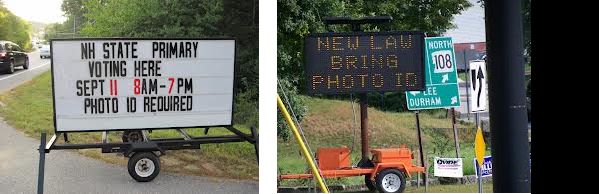
Today the editorial brain trust at the Union Leader decided to weigh in on the Voter ID law and its “practice run” during the primary.  For those who didn’t vote in the New Hampshire primary or don’t live in New Hampshire, its worth pointing out that although the law won’t go into effect until the general election in November, the legislature decided to mandate a practice run at the polls.  Yes, of course you’re thinking, “what a wonderful idea let’s practice all laws out first!”  then if you are stopped, arrested or ticketed the cop can tell you, “Oh geez, just kidding, now watch out in November!”

Dispensing with all the other problems with that issue, one wonders how many people might get the idea that the law really already is in effect and thus abide accordingly.  I mean, I guess it would be up to the goodwill of those empowered with enforcement to give up the gag before the damage is done right?  One wonders when exactly that might occur? After said individual absent an ID walks out of the polls? Its their fault they can’t hear the “Oh shucks, just kidding!” all the way from the parking lot?

Well, basically the Union Leader chooses to overlook that problem, while of course having to make the odd construction that Democrats were protesting the Voter ID law by refusing to give up their ID’s, that oh wait! really isn’t a law yet.  Bet that’s a first.  But its all good right? No one lost their voting privileges that day right?

Nope not at all, unless you talked to people who went to the polls, who were confronted with the patently illegal signage that wards had no business posting that led people to believe that the law was in fact in effect.  Nope not all unless you talk to the people who knowing their rights, refused to produce an ID and were not given the Voter Challenge Affidavit until after they had surrendered their ID.  Funny thing, guess the workers at the polls need some more training, including those poll watchers.

But, it seems clear by testimony from those who experienced the denial of their voting privileges unless they provided satisfactory proof of ID, they had reason to believe they weren’t voting.  So, let’s take your average citizen who works full time, probably has a family to care for and has about a one hour window that they carved out for a week or more to be able to perform their democratic duty.   Is it reasonable to assume this individual would in good faith turn around and say, “Oh, let me call my boss and see if I can more time off to get my ID I left at home/work/in the car.”  or, “Let me see if the person who gave me a ride here will be available to shuttle me around to the DMV, fill out a form, stand in line for an hour and then go back?”

Or, the person who says, “You know what, I knew voting was stupid, I’m going home.”

Or the person who, in the case of one person in Manchester who has a strong Spanish accent, of being further humiliated by having to answer to the question, “Where are you from?” So much for that old folksy New Hampshire.  Let’s just dispel that right now.  Manchester is a city, just like Nashua and Portsmouth.  There aren’t docile dairy cows roaming between white clapboard farmhouses or farmers with red and black checkered hunting caps leaning on fences saying “Ahyup!”.  Unlike the charmed sentiment of the editor, New Hampshire has had its influx of newcomers, of which many who don’t fit the New Hampshire ideal citizen, aren’t exactly given the welcome mat and a pint of New Hampshire maple syrup.  But of course these folks mostly settle in the larger communities and their participation in the polls just might change some things up old Concord way.

Never mind that the other segment of voters that the those at the Union Leader editorial board and Keepers of All That is White and Right in New Hampshire also probably only fret about property taxes in the sense that they know they are paying too much and there’s a small segment of large landowners not paying their fair share.  They’d probably vote Democratic, just a hunch, but since that conversation has only occurred on a meaningful basis within the Democratic party, one might safely conclude that.

Much better to keep those folks home and why wait until November when the Voter ID law becomes an actual law, how about have a practice run, heck what could it hurt if this election some folks don’t turn up or go home without getting to exercise their right to perform the most important civic duty in the nation.

In the accompanying report on how the practice run went, it is explained that those who did in fact challenge the law will be chased down by mail, then if there’s a letter sent back they’ll send agents out we assume to track these people down and the Secretary of State’s office will pour over each and every affidavit to verify whether the voter exists or not.  Looks like the Secretary of State’s office will be hiring folks pretty soon.  Amazing how that works; legislation that grows government comes from an administration that claims to do just the opposite.  Guess the work will be done by special little Fairies for Freedom, to find those practically non-existent fraudulent voters.

But what about the people who walked away from the polls unable to vote? What does that do to our election?  Uh-oh, thinking too much.  In the Union Leader/Republican world those little people don’t matter and the results.  We just gotta live with it, because dammit, there are brown people, poor people, aged, students and disabled folks who we know vote overwhelmingly Democrat and who cares if they stay home?

Of course the richest misunderstanding of the law is encapsulated by the editorial writer’s comment, “Well, the constitution gives qualified voters the right to vote.” Yup, that’s right and there’s nothing in the constitution about presenting an ID.  More than likely the framers never envisioned a system would develop in which certain individuals would work and live in this country and not be eligible to vote — oh wait! We tried that too didn’t we? How did that work out?

One has to wonder, with all the fervor that never seems to end about “qualifying” voters, what exactly is the motive?  Could it be that not only a threat exists from the millions of truly “qualified” citizens actually exercising their right to vote enmasse, what would happen if those who fall between the cracks of citizenship, living, working and contributing to businesses and the economy, like the many that work in Manchester, Nashua and elsewhere in the state starting suddenly voting? Yes, its a scary thought indeed.

Tagged , , , ,

The Protest of Nothing

Burning a registration card, circulated on Facebook with great enthusiasm.

Michael Moore states the case, bluntly and eloquently why although Obama may have disappointed most of us on the left, the fatalism of sitting out the vote this time makes no sense.  Moore’s point underscores the fact that we need to use every tool in the box this time, which reminds me of a post I recently  saw on Facebook  showing someone burning a voter registration card.  Like a 1920’s Dadaist’s wet dream; the Protest of Nothing.

In the 60’s, young men burned their draft cards. Draft cards mandated by law that men had to go to war to suffer unimaginable horrors or death, wherein refusal warranted direct jail time. Burning draft cards represented an exercise of the belief that no state supersedes the laws of humanity and that justice is suborned when citizens refuse to stand up.  Refusal to participate in the draft constituted an act of civil disobedience that represented not simply an individual “choice” but a popular mandate that society take a deeper look at the machinery of capitalist oppression.

On the other hand, what act of oppression does burning a voter card represent again?  Let’s break this down to the simplest terms possible.  Democracy demands participation.  Like an engine; the machine parts cannot move without the force of energy pushing against them.  Thus, democracy will not activate without the forces of the citizens pushing against one idea or another; creating the tension that spurns beneficial social structure.   So basically if one group wants effective change with the existing system, engaging with that system is mandatory.

Our culture is replete with demands to doubt the “system”, to feel disengaged and uncounted.  Mass media inundates people with the message that consumption equals democratic participation and that celebration of nationalistic barbarism equals patriotic service.  We as a culture are told repeatedly that watching a news program, engaging in conversations on the internet, all equal democratic participation.  The drive to consume is also pushed as a patriotic duty (remember Bush the Younger extolling people to get happy and go shopping when gas prices rose?) and the result of longer times engaged in making money to survive and pro-war hyper nationalism do not serve the interests of democracy.

They do though serve the interests of the owners of production, of the marketers and sellers of the machinery of war and endless meaningless junk that serves to distract the electorate.  If one feels satisfied talking on Facebook or watching the latest reports on CNN, then what else is there to do? Who’s got the time anyway?

While protests and other acts of defiance against unjust laws or systems have their place, we cannot discount the easiest process available in this country; the voting booth.  The anti-Obama forces proved this in 2010 when across the country people came out to elect far-right state legislatures as an act of protest against the election of a black president.  Even with a large number of people standing down in 2008, Obama’s message, that the right loves to sneer at, the message of “Hope and Change” caused a momentous move in this country.  —- people stood up and said they wanted change and expressed it through the voting booth. Now, whether Obama stood acted on those promises certainly is another issue and one that requires voter awareness and engagement for critical action.

Many alternative candidates and parties exist within our democracy, many theories, not all of them coming from the pro-plutocracy right wing.  But knowing about alternative parties and candidates requires engagement within the process.  It requires the effort to research the issues, talk to people about the issues, take the time to attend meetings and most of all, support those issues and candidates at the voting booth.

What is the plan with those who refuse to engage? Do they have a larger message or have they completely capitulated all their decision making capacity to those who will get up and engage with the process on all fronts?  Most importantly, do those who step in the vacuum have our best interests at heart?  Would it have been smarter to keep moving forward, no matter how slow, instead of allowing us to slip back ten steps?  While there exists an argument for deconstruction, within a social system where the free press, the voting booth and free speech remain, there exists the possibility for transformation through reformation.

What’s really astounding with those who refuse to vote as some form of protest is the apparent failure to understand that one can in fact participate in democracy, rebel against the present system, protest, engage and go and vote for the best candidate offered all at the same time!  It appears as though the right has this concept down pretty well; theocrats, outright fascists and plutocrats who express nothing but contempt for the democratic process know full well that participation within is their best hope of shaping this country into their dream state.  So far, they’ve been going at a pretty good clip forward thanks to low voter participation rates.

Democracy demands engagement for success.  Opting out is not an option; you’ve got skin in the game whether you like it or not.  Might as well go pull that lever.  If you want to change or overthrow it, better to study it and to whatever extent possible, move within it and outside it.  Only then can one begin to have some understanding of the system in order to fashion a better one.

Also, as Michael Moore points out, there’s no lack of justifiable anger to meet out to both political parties, but there is no reason to let the truck slide off the cliff and disintegrate into a burned heap.  What have you to work with then?  Nihilism was never considered a way to get anywhere but to nothing.  If nothing came out of doing nothing this election or any election cycle, then we’d have nothing to worry about.  Obama has been no prize for those seeking justice; Gitmo, drone attacks, his appeal of the court’s over-ruling the NDAA indefinite detentions.  His shameless refusal to use the bully pulpit and the Democrat’s own contradictory hold on power that often undermines the very values they claim to support; none of that should go unnoticed.

But to sit out and hand the reins over the the mad kings of the GOP just makes no sense.   The platform offered by the Republican party threatens to put working people into a tailspin faster than anything since the days before the New Deal or possibly even the days before the Civil War.  They threaten with their deep cuts in basic social programs, which are social welfare programs — not entitlements, because they are based on the idea that the social welfare is everyone’s welfare.  In a just society  there is no parsing of social well being and health, there is no judgment of who is entitled to not starve, who is entitled to not die a long, slow death by preventable disease. While most of America goes on with their lives, content to watch the political process as if they were viewers of some show they have no real connection to.  The GOP and often the Democrats as well, serve the interests of global capital and imperial power while using their corporate owned media to deceive and disarm the public and keep them away from the voting booth in every way possible.

So is burning a voter registration card an act of defiance against this oppressive corporate state?  No.  By committing an act that breaks no laws and requires no great courage to perform, sends no message to the public except that some people have no problem dropping out and leaving the hard work to others and leaves open a giant hole that others who have the money and will make the time, will eagerly fill.

Tagged , , , ,