Monthly Archives: May 2015

France’s refusal to pay Haiti reparations is a symptom of an even wider issue

The fear of discussing reparations at all in America seems shared by other European countries.

Media Diversified's avatarMedia Diversified

by Halimat Shode

Last Tuesday, President Hollande arrived in Haiti – the first French president to make an official visit since Haiti’s independence – and declared that France had a ‘moral debt’ to the Caribbean country. Yet his declaration avoided any mention of the debt that France has enforced on Haiti since 1825, and which has crippled Haiti economically for almost 200 years.

Haiti became the world’s first black republic in 1804 after a slave revolt and a gruelling twelve-year war with the French. However, they were isolated from the international community for 21 years following their independence. To gain recognition from the international community, they were forced to negotiate an unfair, unbalanced settlement with France in 1825 which involved compensating French plantation owners for their loss of ‘property’, including slaves – in other words, paying France for having enslaved and oppressed them for centuries. Haiti did not finish paying…

View original post 376 more words

Tagged , ,

Well That Didn’t Take Long

Newly elected state rep Yvonne Dean-Bailey from Rockingham District 32, who squeaked by in her win against Maureen Mann, told her buddies at the conservative whiner rag Campus Reform for persecuted junior wingnuts nationwide that she suffered ill treatment on the campaign trail, “At my own college conservatives were alienated and when I ran for office the majority of the attacks from the left were based on my gender and age,” Dean-Bailey said…

Well, you know the old saying “If you can’t take the heat get out of the kitchen.”

Campus Reform described Dean-Bailey as a “campus correspondent’.  Dean-Bailey also liked to describe herself as a journalist, basing this of course on her experience with the Campus Reform website.  The writer also stated, “Dean-Bailey has extensive political experience…” and named the campaigns she’s volunteered on, an extensive list no doubt, but she’s 19 years old.  How many months were packed into about two years of life?

Oh wait, there we go, making a point of her age.

Which brings us back to her assertions about the campaign.  If any issues were made about Dean-Bailey’s age this writer can assert for certain that none came from Maureen Mann nor would any have been condoned by her campaign.  When I did the interview with her in April when asked to discuss her opponent and her age and inexperience, Mann was adamant that her campaign not “go there”.  Mann knew the issues well enough and knew her district and the state well enough to have a wealth of information to work on without personal attacks.

Dean-Bailey has no experience, no wealth of information or knowledge to draw on.  She’ll be yet another ill informed tool stuck to the extremist mix of libertarian and tea party dogma and most likely taking direction from others most of the time.  We’ll be watching.

Tagged ,

The Sting of Rejection – Frank Guinta’s Public Shaming

Protesters at a Frank Guinta fundraiser chide him over his FEC investigation

Protesters from the Take Down Guinta campaign, 2012.

Sign Petition Calling on Guinta to Resign!

There’s no sting worse in politics than when your own party bites you on your soft-spot and right now Frank Guinta must be feeling some serious sting.  But of course, baby-face Frankie can’t say he didn’t bring it on himself.  Burdened with the load of his investigation by the Federal Election Commission and the embarrassment of his constant insistence on innocence, the GOP and their chorus, most notably the Union Leader, have broken their silence and come out demanding Guinta resign.

First, let’s not forget that this investigation more than likely occurred because of the pressure from good progressive activism such as CREDO supported Take Down Guinta campaign in 2012.  Activists have long asked why Frank Guinta had a sudden dump of $355,000 in his political action fund during the 2010 election for the first congressional seat.  At that time Guinta had refused to disclose the source of that money and other funds he “loaned” his election campaign as Jon Hopwood explains in a 2012 article on Guinta for the Examiner,

The loan, the terms of which Guinta refused to disclose during the campaign, triggered an FEC investigation.

That campaign loan was the reason Guinta was named one of the 10 most corrupt politicians in Congress, according to Citizens for Responsibility and Ethics in Washington (CREW). CREW cited Guinta as he had “fudged the numbers and cooked the books to buy a seat in Congress.”

The organization reported that Guinta had given his campaign loans of $100,000 and $245,000 despite having a $72,000 annual salary as mayor of Manchester and a relatively modest investment portfolio. Guinta made the loans without liquidating any assets.

And on the story goes with Guinta weaving a web of lies for years while the FEC slowly investigated his claims.  Now apparently Guinta has settled with the FEC.  We’re sure he hopes to move on in his political career and Frank’s wrongdoings will dissolve into the ether of the short American psyche.  That might be so but we’re thinking the GOP and their supporters may have other ideas.  Calls for him to resign have arisen from nearly every political corner:

Union Leader Editorial staff called for Guinta’s resignation Guinta Must Go and the refrain was repeated earily this week when Joe McQuaid publisher placed on the editorial page:


Ouch, that must hurt!

and Foster’s reports that the big boys aren’t happy either, Boehner Doesn’t Defend Guinta Over Contributions.  Then the Concord Monitor weighs in, To Best Serve the State, Guinta Must Step Down.

Oh yes and even the guys back home in the state house aren’t too thrilled about Frankie either, with House Speaker and long-time Republican Shawn Jasper observing, “I believe it would be in the best interests of the people of the first congressional district if he step down from his position in the United States Congress.”

Jeb Bradley, State Senate majority leader chimed in to the chorus telling the NY Times, “I think he’s on a really small island,” Mr. Bradley said. “I think the charges are serious and disturbing and at some point he needs to think about doing what’s better for New Hampshire than himself.”

NH’s largest television news station WMUR said they caught Kelly Ayotte on the phone, “Senator Ayotte, who is expected to face a tough re-election battle next year, has said she told Mr. Guinta by phone that he should step down. “This is a decision he needs to make, but if I were in his position, that’s what I would do.”

But unfortunately, the NH Republican Executive Committee chose to stand by Guinta, ignoring the cries for his resignation saying in a statement released to the press 3 days ago and reported by WMUR,

But the party executive committee, after speaking with Guinta by telephone for about a half-hour on Monday night, parted ways with the four top elected officials. It unanimously adopted a statement that did not call for Guinta’s resignation but instead said that he has acknowledged mistakes, “takes responsibility for them and is taking actions required by the Federal Election Commission.”

“Unless further information comes to light, the executive committee of the New Hampshire Republican State Committee will take no further action,” the committee said.

Frankie went on the tube to blather on about how he was humbled by the committee’s support and he’ll work on making things right, yeah yeah.

The fact remains that citizens of congressional district 1 in New Hampshire are stuck with a hollow man for their representative.  Apparently Frankie has no threshold of shame that would cause him to want to resign and live out of the public spotlight.

But that doesn’t mean people can’t fight back.  NH Labor News has put together a petition for citizens of the state to register their disgust that a criminal and a liar can stay in office to represent them in Washington.  Check out the petition and add your signature!

Petition: Congressman Guinta Should Resign Over FEC Violations

Tagged , , , , , , , ,

Farmers and Growers Still Battle Corporate Seed Producers Including Monsanto

Farmer holding seeds Monsanto case

We have looked everywhere for an articles explaining the corporatization and “enclosure” as the writer below aptly puts it, of our food supply by controlling and patently seed production.  Here we have a few and some updates. In the midwest farmers have been harassed by lawsuits and threats from private goon squads with questionable or outright bogus claims by Monsanto and other seed companies that they’ve been illegally using their patented seeds.  What is behind the lawsuits (which usually bankrupt farmers completely or have them settling and agreeing to gag orders) is the effort of these seed companies to completely destroy the roots of natural agricultural production by eliminating the practice of saving seed or hybridizing seed on the farm.  By effectively banning pure fertile seed production the corporations hope to create a complete dependency on corporately factory produced seed that produces plants that are either sterile or produce non-viable seed.  Thus the farmer will have to return every year to the “company store” to purchase seed, creating a dependency not only on the seed companies but also on banking and finance.  Banking and finance already has had a huge hand in the corporatization of farming practices as the pressure to produce larger yields to feed huge interest and debt grows every year.

Not only does this article look at the issue but also highlights how some are fighting back:

Making Sense

Seeds of Change

Corporate Power, Grassroots Resistance, and the Battle Over the Food System

BY ELIZABETH FRASER AND ANURADHA MITTAL | March/April 2015

Over a decade ago, Dollars & Sense published the article “Genetic Engineering and the Privatization of Seeds,” by Anuradha Mittal and Peter Rossett, on genetic modification and its impact on the world food system (March/April 2001). In it, the authors asked, “will biotechnology feed the world?” while providing an overview of the landscape of corporate control, widening inequality, private property claims, and growing farmers’ resistance around the world. This article acts as a follow-up, highlighting some of the key developments in recent years.

For most of history, farmers have had control over their seeds: saving, sharing, and replanting them with freedom. Developments in the course of the 20th century, however, have greatly eroded this autonomy. Legal changes, ranging from the Plant Variety Protection Act (1970) in the United States to the World Trade Organization’s Agreement on Trade-Related Aspects of Intellectual Property Rights (TRIPS), have systematically eroded farmers’ rights to save seeds for future use. By the end of 2012, Monsanto had sued 410 farmers and 56 small farm businesses in the United States for patent infringement, winning over $23 million in settlements. Here, we describe some of the key developments further intensifying corporate control over the food system. It is not, however, all bleak news. Civil society groups are using everything from grassroots protest to open-source licensing to ensure that the enclosure and privatization of seeds comes to an end.

Corporations Have Consolidated Their Control of Seeds and Agrochemicals

In 2011, just four transnational agri-businesses—Monsanto, Dupont Pioneer, Syngenta, and Vilmorin (Groupe Limagrain)—controlled 58% of the commercial seed market. Four—Syngenta, Bayer CropScience, BASF, and Dow AgroSciences—controlled 62% of agrochemicals worldwide. The top six companies controlled 75% of all private plant breeding research, 60% of commercial seed sales, and 76% of the global agrochemical market. This consolidation of power has been aided by a large string of mergers and acquisitions, leading the Canada-based Action Group on Erosion, Technology and Concentration (ETC Group) to conclude that “there just aren’t many seed companies left to buy.”

The World Bank, too, has played a role in this increased consolidation. In 2014, a report from the Oakland Institute provided details on the World Bank’s efforts to open African markets to private seed companies. (Full disclosure: The authors of this article both work at the Oakland Institute.) The report, titled “The World Bank’s Bad Business with Seed and Fertilizer in African Agriculture,” paints a stark picture of the possible consequences of these actions: removing farmers’ rights to save seeds and implementing intellectual property claims over seeds does not improve food security, but rather undermines farmers’ autonomy and further increases profits for the existing seed oligopoly.

Supposed Benefits of Genetically Modified (GM) Seeds Have Not Materialized

Two arguments often put forward in favor of GM seeds are the need to feed the world’s burgeoning population and the potential for these new seeds to reduce overall pesticide use. Neither of these claims promulgated by industry have proved true. Globally, we are currently producing more than enough food to adequately feed our population. However, that food isn’t being distributed fairly, and malnutrition remains staggering—805 million people worldwide. As the Canadian Biodiversity Action Network reminds us in its report “Will GM Crops Feed the World?” hunger is not usually a result of low food production, but rather a result of poverty. This points to a greater need to address issues of inequality, distribution, and access.

Arguments that genetically modified crops could reduce overall agrochemical use also remain unfounded, with the rise of herbicide-resistant weeds requiring more and more chemical cocktails for the GM crops to remain productive. A report from Food and Water Watch, “Superweeds: How Biotech Crops Bolster the Pesticide Industry,” notes that herbicide use on GM crops in the United States did initially fall in the late 1990s; however, once resistance in GM crops to the herbicide glyphosate (marketed by Monsanto under the trade name “RoundUp”) developed, total herbicide use skyrocketed, leading to greater net herbicide use over time.

Read the rest of the story: Seeds of Change

Liberatarians Shown Once Again to be a White Boy Bigot Club

h/t susanthebruce

Two police brutality surveillance and reporting groups have officially distanced themselves from the libertarian-based Cop Block.  Reported by the Austin based Peaceful Streets Project, the groups say that they find the bigotry and overwhelming white male privilege among Cop Block leadership to be problematic and unresolvable.

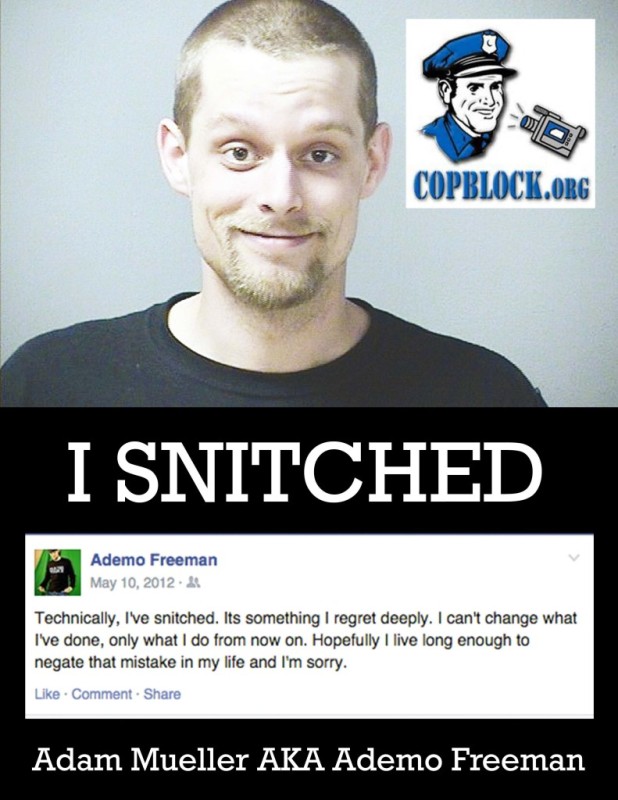
In particular, as quoted below and in the statements from WeCopWatch and Anti-Media, key players in the New Hampshire libertarian, Free State Project group are named, in particular the founder of Cop Block Adam Mueller of Manchester (aka Ademo Freeman) and Chris Cantwell who moved to Keene to be a part of the Free Keene libertarian commune in Keene, New Hampshire.

Adam Mueller came to New Hampshire sometime around 2010 and started Cop Block, as a fellow from the Koch Brothers funded anarchy-capitalist training school, The Institute for Humane Studies based at George Mason University.  With Koch money in hand, Adam founded a group to harass Manchester’s city police, in particular with a juvenile incident of “chalking” the city police department building and putting up a stink when arrested.  His arrest for resisting arrest called attention to the anarcho-capitalist call to annihilate the “police state” and also made Mueller a small-time folk hero.  For awhile he had a web page with his letters from the Valley Street Jail posted by friends to further his martyrdom. [Editor’s Note: anyone can search the internet for more information, we prefer to not promote their pages here]

Cop Block attracted a lot of press and negative attention in Manchester during 2010 from their antics.  Many Manchester residents and the police department who have worked hard to undo years of bad relations between the police and the Manchester community had mixed feelings about Cop Block and its bent on pushing libertarian ideology and not confronting deeper social issues.  The disassociation of the Cop Block group was inevitable as the foundation of the libertarian ideology is one based on the denial of systemic oppression of any sort.  Libertarians believe that one’s failures in life or society can only be explained by one’s own personal failures.  Therefore libertarians consistently claim that the calling out of racism, sexism or other bigotries has no root in reality.  Libertarians only recognize “state based” oppression.  They target their critique most sharply on institutions founded to address social oppression and systemic inequality claiming that this in and of itself causes oppression and thus should be deconstructed.

Naturally the outcome of such a worldview would be that an organization such Cop Block would eventually be called out to be a fraud on its face.  Cop Block and its founding member with Koch Brothers financial support, has demonstrated the key weaknesses within anarcho-capitalism and libertarianism in that they believe the only really oppressed groups are white males whose hegemony of the existing social system is being challenged by “special interest groups”.  Thus its no wonder that as the article below describes, Cop Block supporters and founders would be silent on the core issues of police brutality; systemic racism and classism.  Its also no wonder that Cop Block founders and supporters would promote and display open and shameless contempt against women and non-white peoples.

This distancing shows a real developing maturity and growth among cop-watch groups across the country and also their committment to fighting the systemic social problems that cause police brutality and increased militarization.

WeCopwatch and Anti-Media distance themselves from Cop Block

Cop Block is a largely libertarian police accountability organization that was an initial supporter of the Peaceful Streets Project. From the beginning, many members of Cop Block (especially Pete Eyre) supported the Peaceful Streets Project. Their initial support was very helpful in allowing us to spread awareness of our efforts to take on police abuse, corruption, crime, and misconduct in Austin and in select other cities. However, in the past few years both the Peaceful Streets Project and Cop Block have changed in some pretty remarkable ways.

First, the Peaceful Streets Project was started with a vision of helping to bring about a society free of state-sponsored institutionalized violence. Never were we about making friends with the police, nor were we very concerned about non-state violence. Although some of the lead organizers wanted to, as an organization we deliberately shied away from many of the social factors that help feed aggressive and violent policing, as well as the social factors that helped feed violence in the streets. In particular, we avoided issues of race and gender. Our willingness to stand up to the police state while ignoring racism and misogyny allowed many unsavory people to rally around us. Many of those people; who were eager to focus on DUI checkpoints, marijuana laws, and SWAT raids; surprised us when they inexplicably but vigorously rallied behind white people who killed unarmed black people. This became most obvious in their rabid support of George Zimmerman who killed Trayvon Martin in 2012.

By 2013, Antonio Buehler began to acknowledge more and more what co-founders Harold Gray, John Bush, and especially Kaja Tretjak had been concerned about when it came to non-state forms of oppression. Buehler used his position of relative influence to begin speaking out about issues of race and gender, and soon found that many of the followers of Peaceful Streets Project were attacking him. Many supporters encouraged him to disregard these issues in order to keep harmony among police accountability activists, but Buehler had come to recognize that opposition to only state oppression, and not the social oppression that helps fuel the ability of the state to harm people, was a fool’s errand. The police are a problem only to the extent that the structures and hierarchies in our society allow them to be.

Things came to a head later in 2013 when Bush called out a homophobic facebook post, and then Buehler called out some racist and sexist facebook posts. This brought out vicious attacks from many who were at the intersection of some or all of the following groups: Cop Block, anarchocapitalists, Men’s Rights Movement, and Neoconfederates. One semi-popular libertarian blogger named Christopher Cantwell led the charge against the “White Knight,” “Social Justice Warriors” who dared to take offense at overt forms of bigotry. Soon, Buehler had hundreds of racist and sexist people attacking him for taking a stand against racism and sexism. Buehler responded by disassociating with everyone who was willing to associate with Cantwell, and this included Cop Block founder Ademo Freeman and many other members of Cop Block. Buehler was also forced to sever ties with people who had set up Peaceful Street Project facebook pages in various parts of the country.

Since then, the Peaceful Streets Project has gone to great lengths to acknowledge how bigotry helps fuel oppression, and how we (as a largely white male group) can use our privilege to help undermine that oppression. We have sought out other groups that better reflect the populations being most abused by police (such as the Austin Justice Coalition) so that we can ally with them and support them in the struggle. Further, we are much more proactive in calling out bigoted behavior within our group, as we recognize that wonderful contributors had left the Peaceful Streets Project in the early years because it had previously been an unsafe space for them.

Cop Block, however, seems to be going in the opposite direction. Instead of calling out bigotry in the ranks, they have tended to ignore it. While Cop Block claims that as a decentralized organization they cannot control the actions of their members, they do allow unilateral decisions if those decisions are made by the founder, Freeman. Further, while they claim they cannot do much of anything about the bigots in their ranks, as libertarians and anarchists they know very well the power of ostracism. Instead of ostracizing the bigots, they choose to embrace bigots such as Cantwell. And while they may try to claim that they don’t concern themselves with social oppression, and only state oppression, many members of Cop Block became silent when it came to the killings of Michael Brown and Freddie Gray, and they instead focused all of their outrage on people who rioted or looted in response to police executing unarmed people.

In recent days it has come to our attention that Ademo Freeman has gone completely off the rails. There is plenty of information circulating on the web about some extraordinarily disgusting behavior that has personally harmed individuals who did not seek to harm him, that we will not rehash here. WeCopwatch and Anti-Media, both of who were collaborating with Cop Block, have publicly distanced themselves from the organization. We commend them for doing so. Fighting the police state and holding police accountable cannot be done if we don’t hold each other accountable, first. We hope that other groups will do the same, and that the many decent people in Cop Block will push the bigots out of the organization.

At Peaceful Streets Project we are less concerned about what happens on the internet than we are what happens in the street. We look forward to continuing to engage in direct action tactics that will help change the culture of society. We look forward to continuing to partner with organizations who want to end the police state – and who are willing to be smart enough to strike out against all forms of oppression that stand in the way.

And yes, we also distance ourselves from Cop Block.

WeCopwatch statement: http://wecopwatch.org/wecopwatch-cuts-ties-with-copblock-org/
Anti-Media statement: http://theantimedia.org/behind-our-decision-to-leave-cop-block/

Tagged , , , , , , ,

Something Was Missing at the Senate Budget Hearings

State Rep and former gubernatorial candidate Jackie Cilley speaks her mind:
from NH Business Review

Jackie Cilley. Marland Cartoons

On May 6, the NH Senate held more than five hours of budget hearings. For several hours, I listened to one citizen after another plead for funding for a host of our state’s needs. Through it all, there was a nagging feeling that something was missing.

Representatives Hall was filled to capacity, as was the House gallery, the anteroom and the corridor outside. Some attendees were escorted to the State House cafeteria to wait for room to open up in the House chamber. More than 1,000 citizens are estimated to have turned out for the hearing.

Yet there was something missing.

Like so many parents of developmentally disabled children, one mother beseeched the committee to reinstate the thin safety net that provides for someone to care for her child while she works each day. These parents pay property and other taxes and save the state tens of thousands, if not millions, of dollars by not turning these adult children over to state care.

But there was something missing.

Folks from chambers of commerce and tourism-related businesses asked for restoration of state tourism promotional dollars, noting a 9-1 return on every dollar invested in promoting an industry accounting for more than 34 million visits and $4.5 billion in spending.

There were students from New Hampshire colleges including the student president of Keene State College who has seen friends drop out due to tuition costs and escalating debt. “I love New Hampshire. I want to stay here and contribute, but my college debt and the lack of affordability of living here will likely result in my leaving when I graduate.”

Many sported neon green T-shirts with the chalk outline of a body on the front bearing the number 321, the number of those who had died in the past year from drug overdoses. They entreated the committee to restore funding for drug and alcohol treatment and prevention to save lives.

Dozens of seniors asked the committee to save ServiceLink, a coordinating agency for seniors, and to restore funding for Meals on Wheels. If cuts result in the need for nursing home care, we currently could not accommodate them with the existing county nursing home structures.

Then I realized what was missing.

In all the hours of testimony, I had not heard one person who stood up and asked for cuts to the budget; not one who implored the committee to tighten our collective belt and eliminate any of the programs being discussed. Not one person demanded fee and tax cuts.

Of the more than 800 signatures on sign-in sheets, 10 were in favor of the budget and the remainder in opposition. Where does the outcry to slash these programs come from? As one woman said to the Senate committee, “We heard loud and clear from the House: You don’t matter to us, your children don’t matter to us. Will you tell us the same thing?”

Is that really what we want to tell the citizens of our state – the vulnerable, our students, seniors, tourism businesses, the homeless – you don’t matter to us. Is that truly the best we can do?

Tagged , ,

Remembering Malcolm X

The legendary leader of the rise of black power in the 20th century would have been 90 years old today had he not been gunned down by three members of the Nation of Islam, he was just 39 years old.

Read more about Malcolm X’s life and legacy at the site dedicated to his memory: Malcolm X.com

Some quotes from Malcolm X:

“I’m for truth, no matter who tells it. I’m for justice, no matter who it’s for or against.”

“A man who stands for nothing will fall for anything.”

“Nobody can give you freedom. Nobody can give you equality or justice or anything. If you’re a man, you take it.”

“You don’t have to be a man to fight for freedom. All you have to do is to be an intelligent human being.”

“Despite my firm convictions, I have always been a man who tries to face facts, and to accept the reality of life as new experience and new knowledge unfolds. I have always kept an open mind, a flexibility that must go hand in hand with every form of the intelligent search for truth.”

“There is no better than adversity. Every defeat, every heartbreak, every loss, contains its own seed, its own lesson on how to improve your performance the next time.”

“I have more respect for a man who lets me know where he stands, even if he’s wrong. Than the one who comes up like an angel and is nothing but a devil.”

“You’re not supposed to be so blind with patriotism that you can’t face reality. Wrong is wrong, no matter who says it.”

“If you are in a country that is progressive, the woman is progressive. If you’re in a country that reflects the consciousness toward the importance of education, it’s because the woman is aware of the importance of education. But in every backward country you’ll find the women are backward, and in every country where education is not stressed it’s because the women don’t have education.”

“I believe in a religion that believes in freedom. Any time I have to accept a religion that won’t let me fight a battle for my people, I say to hell with that religion.”

– Malcolm X aka El Hajj Malik El Shabazz (born May 19th, 1925)

h/t Reg Clark

Tagged ,

Cornel West: Why Malcolm X Still Speaks Truth to Power

From Smithsonian online
by Cornel West

Fifty years after his death, Malcolm X remains a towering figure whose passionate writings have enduring resonance.


Malcolm X was music in motion. He was jazz in motion, and, of course, jazz is improvisation, swing and the blues. Malcolm had all three of those things. He could be lyrical and funny and, in the next moment, he’d shift and be serious and push you against the wall. The way he spoke had a swing to it, had a rhythm to it. It was a call and response with the audience that you get with jazz musicians. And he was the blues. Blues is associated with catastrophe. From the very beginning, from slavery to Jim Crow, that sense of catastrophe, of urgency, of needing to get it out, to cry out, to shout, somehow allowed that fire inside of his bones to be pressed with power and with vision. He never lost that.

 The button bearing an image of Malcolm X—created after his death as an act of commemoration—is in the Smithsonian National Museum of American History, a talisman of his loss. 

Let me talk about that loss. Just before he was shot in New York on February 21, 1965, Malcolm was setting up his own mosque. He was a Sunni Muslim leader. When we think what it means to be a revolutionary Muslim in this day, when people are looking for ways Islam can be compatible with democracy, his assassination robbed us of that. He could have been a model of what it means to be a revolutionary Muslim, in the way in which Martin Luther King Jr. became a revolutionary Christian.

It’s a fascinating development that could have taken place, and both perspectives could have begun to overlap.  In fact, Malcolm was a Muslim but he invoked Hebrew prophets, Isaiah, Amos. He invoked Jesus, emphasizing that perspective of looking at the world from below, echoing the 25th chapter of Matthew: What you do for the least of these—the prisoner, the poor, the stranger, the widow, the fatherless, the motherless, the weak, the vulnerable—has lasting value. 
Read more: http://www.smithsonianmag.com/history/why-malcolm-x-still-speaks-truth-power-180953976/#LQe4ChZEixhpgsqR.99
Give the gift of Smithsonian magazine for only $12! http://bit.ly/1cGUiGv
Follow us: @SmithsonianMag on Twitter

image: http://thumbs.media.smithsonianmag.com//embedly/index.jpg.300x0_q85_upscale.jpg

Preview thumbnail for video 'Black Prophetic Fire

Black Prophetic Fire

In an accessible, conversational format, Cornel West, with distinguished scholar Christa Buschendorf, provides a fresh perspective on six revolutionary African American leaders: Frederick Douglass, W. E. B. Du Bois, Martin Luther King Jr., Ella Baker, Malcolm X, and Ida B. Wells.

h/t Reg Clark


Tagged , , ,

Paterson Silk Strike, May 19 1913

h/t: Jeffrey Perry

102 years ago, on May 19, 1913, Hubert Harrison spoke at a major rally for the Paterson Silk Strikers at the Botto House in Haledon, NJ. Other speakers that day included “Big Bill” Haywood, Patrick Quinlan, Frederick Sumner Boyd, and Elizabeth Gurley Flynn.

Also for more on the strike see Spartucus Educational: The Paterson Silk Strike of 1913

The Botto House later became the “American Labor Museum,” in part because of the large and important meetings held there during the strike.

Elizabeth Gurley Flynn speaking to strikers during the Paterson Silk Strike

The Paterson “Evening News” described Harrison as “very bitter in his denunciations of the New York newspaper writers” and reported that he “commenced a tirade upon one of the writers in particular, and called him a — dirty dog.”

The anti-strike “Evening News” added that “his comparisons were very blasphemous and not fit for . . . the papers to re-print”

Co-agitator Flynn, however, defended him saying that “he tells plain facts and the bosses don’t like them.”

(Drawn from Jeffrey B. Perry, “Hubert Harrison: The Voice of Harlem Radicalism, 1883-1918” (Columbia University Press)

For articles, audios, and videos by and about Hubert Harrison see http://www.jeffreybperry.net/_center__font_size__3__font_co…

For comments from scholars and activists on “Hubert Harrison: The Voice of Harlem Radicalism, 1883-1918” (Columbia University Press) see http://www.jeffreybperry.net/disc.htm and see http://www.jeffreybperry.net/_center__font_size__3__font_co…

For a video of a Slide Presentation/Talk on Hubert Harrison see https://www.youtube.com/watch?v=heBKm1ytd5Q

Children working looms in mills in Paterson, NJ. From OutStory: The Paterson Silk Strike

Tagged , , , ,