In France Hollande tells Plutocrats to Pay Up

So France now offers the world a vision of the hope of the fall of global corporatocracy.  The people have spoken and overwhelmingly and enthusiastically embraced socialist Hollande for President, having had enough of the capitalist boot licking of Sarkozy and his participation in the increasingly crushing pressure of global capitalists on the last vestiges of government for the common good.

Unfortunately most Americans know very little about this revolutionary act on the part of France’s people as the corporate press is quick to pass over such news.  With little critical mass over the masses, so to speak, the real story gets buried between the Kardashians and fluffy puppies.

But, a bright light shall shine out of the darkness and on September 27th, news ran over the internet such as this post from Addicting Info that summarized the news of Hollande rolling out a reversal on capitalist created impoverishment:

France Tells Austerity ‘Go To Hell’

September 28, 2012

By


Across Europe, the failure of austerity is clear. However with the weakness of the Eurozone’s de-centralized government apparent, France took upon itself a very different path to rectifying its financial woes. Instead of cutting services, punishing its population for the excesses of the élite, France has taken a page out of history, and taking the old tactic of raising its taxes.

The new tax rates top off at 75% of income earned over $1 million euro (approximately $1.3 million USD) for individuals. Some economists are quick to proclaim that such a tax rate would cause the economic conditions to become worse and that it sends a message that France does not like the rich and is not open for business.

This of course is nonsense. France, like many nations, has a tax penalty for taking money out of the country. France also utilizes a value added tax on goods going into the country. This means if a business decides on moving, to say Africa, to avoid the higher taxes, it would find any of its goods at a severe penalty when they returned to sell their goods and services to one of the largest economies in the world. Any business which decides on not selling to the market, of course, is being stupid. They are doing the metaphorical cutting off of their nose to spite their face. Every business can be replaced, so if a market is there, a company will come to fill it.

Instead of being anti-business or anti-rich, it is instead very pro-business. Now a business cannot waste its resources in supporting overpriced leisure-rich. Instead, the businesses which for invest in expansion, in its customers, and in its employees will find themselves rewarded. This becomes a very business friendly environment, companies which work in France will be very pro-growth. This will in turn expand their owners fortunes and overall wealth.

This is not a record for taxes, the United States once sported a 94% income tax rate. What this is, however, is a rejection of the Chicago and Austrian school of economics which have dominated the world for the past 40 years, and an embrace of the American school of economics, a school which has been sorely missing from the austerity debate.

But it all seemed too good as they say and as typical, all one need to do is wait for the wakes to break the shore line from the rock falling into the muddy, still waters of capitalist propaganda.  Today, October 7th, the Huffington Post runs (a willing servant of the corporate class, despite its ruse of being left leaning) an article on Hollande and his socialist agenda run with the usual requisite capitalist outlook.

Quick to assert that Hollande’s policies of taxing the rich and daring the corporatists to play chicken with him has failed after only a few whole days of real time, the Huffie-Post writers beat the drum.  In this paragraph they claim that France has had it with Hollande and his economic plan, after not making change in three days:

But the freefall in his popularity ratings shows that many erstwhile supporters are already asking whether he has a plan at all, as his inexperienced ruling coalition is buffeted by events rather than shaping them.

Then in the next few paragraphs we hear from “Stephane Rozes, head of political consultancy Cap” who then goes onto characterize France’s social safety net as “generous welfare state and high level of labour protection.”

Of course, those silly silly French with their lattes, red wine and protectionist trade policies.  You know the country is just on the brink of disaster, the streets teeming with welfare queens and labor thugs running around in berets, eating government issued Crème brûlée and quoting Proudhon or hiding in dark alleys with guillotines and singing the Internationale, waiting to beat up poor capitalists trying so hard to suck the labor out of everyone and give back nothing make the economic system work for just plutocrats everyone.

But we digress..what deserves attention the most is the paucity of critical information regarding France and Hollande. Reuters refers to Stephanie Rozes of the consultancy Cap or CAP.  Since many news organizations use Reuters as their resource, the story with his quote has been repeatedly dozens, if not hundreds of times in the US press without further analysis.  This scrap about Rozes was dug up after extensive plowing through French language news publications.  Apparently he’s quoted quite a bit, but one might make the assessment that “advises companies” places him firmly in the pro-capitalist camp.  Which one could logically infer would not jump to approve Hollande’s refusal to coddle plutocrats and capitalist speculators.

The former director general of the CSA polling institute, now head of the Cap (analysis and perspectives), which primarily advises companies, communities or states such as Monaco or African countries, confirms: “I work with Francis on the fundamental issue of the country.

In May before Hollande’s President’s chair had a chance to be warmed, Timothy Geithner, commenting on the apparent but rarely spoken fact that impatience with economic policy can be self defeating.  But then Geithner’s comments are followed quickly by

New York TImes, May: Change in Paris may Better Suit the US

“If every time economic growth disappoints, governments are forced to cut spending or raise taxes immediately to make up for the impact of weaker growth on deficits, this would risk a self-reinforcing negative spiral of growth-killing austerity,” Treasury Secretary Timothy F. Geithner told a Congressional committee in March, comments echoed since then in his statements at many international forums.

But the article was quick to add correction to Geithner’s statements by adding commentary from an a senior fellow of a think-tank that carries a heavy industry representation on its board.

“The administration hopes, in broad terms, that this election will change the conversation,” said Edwin M. Truman, a senior fellow at the Peter G. Peterson Institute for International Economics. “In principle, you’d be saying, ‘Don’t tighten your belt!’ to the countries with the scope to do so,” Mr. Truman said.

Indeed, possibly the US and France has more belt tightening room than many other countries, the question of course is what group within these countries should do the belt tightening.  Their silence on that speaks volumes.

Opinion article in Financial Times of May 14, 2012 : What to Expect from Francois Hollande

First, France’s future depends on delivering all three of growth, social inclusiveness and budgetary discipline. No one element can be achieved without the other two. Without a belief among the French that burdens are shared, it is hard to elicit the necessary sacrifices to achieve budgetary discipline. In turn, fiscal discipline should allow the government to conduct more expansive fiscal policies to boost growth if demand is depressed. Fiscal reform and spending cuts will also allow France to fund investments that support growth.

Make no mistake “fiscal reform and spending cuts” meaning deep cuts in social programs that benefit the public.  The capitalist speculator cannot suffer a little without making sure the rest of the world does too, even though the rest of the world has already suffered much more and far longer.  A call for the plutocrats and corporatist to pay their fair share gets reduced to ‘sharing the burden’ so to speak.  Exactly its time for the ones who created the current condition to step up and pay for it.  The proletariat has paid enough.

The Economist in September : France’s Economy: The Performance Gap

The end of the early shift, and workers at the Peugeot car factory at Aulnay-sous-Bois, near Paris, are streaming out through the turnstiles. The anger is raw; the disappointment crushing. In July, when the company announced that the plant, which employs 3,000 workers, was to close, President François Hollande loudly branded the decision “unacceptable”. Two months and an official report later, his government has now accepted its fate. “Hollande said that he would look after us,” says Samir Lasri, who has worked on the production line for 12 years: “Now we regret voting for him.”

The decision by Peugeot-PSA, a loss-making carmaker, to shut its factory at Aulnay, the first closure of a French car plant for 20 years, and to shed 8,000 jobs across the country has rocked France. It has become an emblem both of the country’s competitiveness problem and of the new Socialist government’s relative powerlessness, despite its promises, to stop private-sector restructuring. Tough as it is for the workers concerned, the planned closure may have had at least one beneficial effect: to jolt the country into recognising that France is losing competitiveness and that the government needs to do something about it.

Of course the key problem is that the glue that kept all developed countries together; trade that supported higher labor rates has collapsed.  Pressure from global companies that can force “competitiveness” by cheap labor extraction coupled with lower regulation in new hosting countries, has caused the current crisis.  Lower labor rates and lax regulation have become the new markers for competitiveness.  Which begs the question, can any socialist system exist when surrounded by unregulated capitalism?

Bloomberg in May: Merkel Rejects Stimulus in Challenge to Hollande’s Growth Plans

German Chancellor Angela Merkel rejected government stimulus as the way to spur economic growth in Europe, setting up a clash with French President-elect Francois Hollande before he’s even taken office.

In her first response to Hollande’s victory in yesterday’s French election, Merkel rejected a return to the “huge” stimulus programs following the financial crisis in favor of business-friendly economic changes. She and Hollande will talk “very openly” about the form of growth to pursue, a discussion now taking place across Europe and “to which the new French president will bring his own accents.”

Germany, the center of the banking community in the EU fell in line, demonstrating its preference for recovery from the capitalist/banker point of view; let the market regulate itself.  Promoting “business friendly” recovery certainly comes from the pro-capitalist library of euphemisms   Bankers and capitalist will not let go of the trajectory that business looks out for the national and global interests, even when clear evidence exists to the contrary.

Then finally we get to the meat of the issue: but we have to get to the French press to get it:
From France 24, from October 9th: Hollande Unveils Two Year Plan, Billions in New Taxes

French President François Hollande pledged on Sunday to honour his campaign promise of a 75 percent income tax on wealthy individuals as he unveiled a two-year economic recovery plan featuring strict budget targets and 20 billion euros in new taxes.

Well there you have it, what the mainstream global press will not say, Hollande shall follow through on his promise to put the squeeze equally on the plutocrat class as well as the working, who have already suffered job losses and other devastation of what has become essentially, Prime Minister Merkel’s efforts at constructing the EU into the miniature domain of bankers and casino capitalists.

With Greece, Portugal and Spain beaten nearly to its knees, global capitalists have turned their attention to reigning into and destroying socialists all over the EU.  The upstart France as usual must turn her head otherwise and lead the charge against the take-over.

While certainly this constitutes a simpler analysis, the distillation remains the same; the global capitalists have made their intent clear.  They wish to crush the power of labor in some portions of the EU to turn them into their own speculator’s dream market to exploit to produce goods to sell to the wealthier, plutocrats, protected by government support of speculative monetary and economic policy which feeds the global uppers.  In addition, as long as the middle classes in countries remain intoxicated with cheap goods, gross consumption that exceeds need and short-term gratification, the money will roll in.

Tagged ,

Venezualians Say Yes to Six More Years of Socialism — and the US Corporate Spin Machine Shall work in Overdrive

Before the read one erudite commenter on the Post page is worth pasting here:

10:28 AM EDT

Eureka! Have we lost South America? No, because we never OWNED South America contrary to decades of US foreign policy. Venezuela has 100 years worth of oil? And isn’t playing patty-cake with Uncle Sam? Be careful-the US has overthrown duly-elected governments for less. The rabid right demonizes Chavez in typical knee-jerk fashion because he’s (pardon the profanity) a socialist. He must have stole the election they will say. But maybe the people LIKE that 43 per cent of the state budget goes for social programs. Maybe they like that unemployment went down from 20+ per cent to less than 7 per cent. Maybe they like that 22 public universities were built in the past 10 years. Maybe they like that teachers have gone from 65,000 to 350,000 and illiteracy has been eradicated. Maybe people LIKE for the wealth of the nation to benefit the citizens of that nation instead of a tiny group of economic royalty. Best wishes to Venezuela and South America.

We couldn’t have said it better.  With 80% of the population turning out, Chavez must have been using his Super-Socialist mind control skillz.

From the Washington Post:

, Published: October 7

CARACAS, Venezuela — Fighting for his political life, President Hugo Chavez overcame a vigorous challenge by Henrique Capriles in Sunday’s presidential election, receiving another six-year term that will give the populist firebrand the opportunity to complete the consolidation of what he calls 21st century socialism in one of the world’s great oil powers.The victory, announced by the National Electoral Council late Sunday, gave Chavez the win with 54.4 percent of the vote, while Capriles took 44.9 percent. In winning his fourth presidential election since 1998, Chavez captured just over 7.4 million votes to 6.1 million for his adversary, turning back what had been a determined battle by Capriles, a 40-year-old former governor.Read the rest: Hugo Chavez Beat Enrique Capriles in Venezuela’s Presidential Election

Tagged , , ,

Northern Pass Proponents Say They Have 99% of Land – Numbers Disputed

Where’s the beef? NU stumbles through investor presentation today
Did NU say it will need a “new new Coos route” because of the Forest Society’s project to thwart the “new route”?
The Northern Pass portion of NU’s presentation to stock analysts today was notably lacking in substance, enigmatic on some occasions, and flat out wrong on others. The widely anticipated “new Coos route” announcement was not made. In fact, Leon Olivier, PSNH CEO, deferred it to the end of Q4, despite his earlier statement in July that NP would have the new route by the end of Q3. Another delay, in other words. And he pushed the 2016 project completion date back to 2017.
There was tricky math as well. Mr. Olivier claimed to have 99% of the lower 140 mile route sewn up. This literally cannot be true. NP does not have an approved route through the WMNF, roughly 7% of the lower 140 miles. If he meant 99% of the entire 180-200 mile route, the figures still do not add up. If the missing 1% (which surely is more) involves having to loop around the blocking parcels of the Trees Not Tower campaign, there’s a lot more mileage than Olivier is owning up to.
And Thomas May, CEO of NU, struggled to find words to answer a simple question about how filing alternative routes with the DOE would affect the timetable. He danced around until he seemed to say that NU will have “other preferable routes” to the current “new Coos route.” Will these be called the “new new Coos routes”?
 
“Okay. Question has to do with potential alternative — alternatives that we would have to file with DOE regarding Northern Pass, and how it may affect the schedule?
 
“Thomas J. May – Chief Executive Officer, President, Trustee and Member of Executive Committee
 
“Yes. If you recall, we did announce a route approximately 18 months a few years ago, and shall we say, we got a lot of feedback on that route. This new route will be the alternative to that previous route. We think this route is — it will be — it’s a good route. It will be more beneficial. It will — it is citable [siteable].We have other alternatives that we have looked at, and really — although there are different routes, you’re going to run into the same issues. Because if you have — we think what we’ve found is around a route that has the least impact on the environment, the least impact on the communities, but we will have other preferable routes. I wouldn’t speculate on what that would do to the overall cost of the project, the other routes or the timing of the gas flows at this point.”
The message to the opposition: keep on doing what we are doing, only more of it. Northern Pass appeared to be in considerable disarray today.
NHPR report
Northern Pass: Claims Progress On Route
By Chris Jensen
Despite opposition, the Northern Pass project is doing well, according to company officials.
During a conference call with industry analysts, officials from Northeast Utilities insisted they are happy with the progress they are making.
“I am pleased to say that we have about 99 percent of that 140-mile right-of-way right now either acquired or we have under agreement. The last essentially one percent we are working through the final details.”
That’s Lee Olivier, an official with Northeast Utilities, which is behind the Northern Pass hydro-electric project.
But the Northern Pass project does not have permission to use about 10 miles through the White Mountain National Forest, and that would be roughly 7 percent.
Nor did Olivier directly address progress on the route through Northern Coos.
A Northern Pass spokesman couldn’t immediately be reached for comment.
Northern Pass has been playing a kind of real-estate chess game with opponents.
Opponents of the project are trying to block a route in Northern Coos, using tactics such as conservation easements.
Oliver said the project still hopes to file that new route with the U.S. Department of Energy by the end of the year.
That filing will trigger a new series of public hearings before the Department of Energy which must still approve the project.
Comment:
Jim Dannis .
Olivier appears to have misstated the length of the Northern Pass lines as 140 miles rather than 180 miles. Of course, who knows the current length of the preferred route, seeing as it has not yet been announced! But let’s stay with the supposed facts on the table. So, NU’s mistake #1 was to misstate the route length.
Assuming Mr. Olivier of NU slipped up on the length of the Northern Pass transmission lines and meant to say “180” rather than “140”, he still made a material misstatement.
The preferred route runs through the WMNF. Northern Pass has absolutely nothing, zip, zero, nada, in terms of land rights for the majority of the 10 mile WMNF crossing. The only way they get to cross is if they obtain a brand new, discretionary, temporary permit from the US Forest Service. The standards applicable to a new transmission line like Northern Pass in the WMNF are exceptionally high and, in the view of many, impossible for Northern Pass to meet. Forgetting to mention the WMNF issues was mistake #2.
Let’s go further and assume Mr. Olivier messed up the route mileage and forgot about the details of the WMNF. He has still made yet another material misstatement. To say that only 1% of the route mileage is not yet obtained or contracted is to sweep under the rug the problems created by that 1% (if 1% is the right number!). For example, the Forest Society’s “Trees Not Towers” campaign involves blocking parcels along Northern Pass’s preferred route. Going around blocking parcels, if it is possible at all, would almost certainly require long, sweeping detours. This will multiply route mileage. Mistake #3: failing to explain the consequences of the remaining blockages.
One could go on and on, but the reader should get the point. A senior NU executive was apparently unable to explain clearly where Northern Pass stands with its preferred route. He made at least three material misstatements in just a few sentences. Hopefully the press will assist Mr. Olivier in clarifying the facts.
Getting your voice heard: how to write effective scoping comments
Venting at Northern Pass may be a good therapeutic exercise, but it won’t do anything to stop the project. Responsible Energy Action LLC (REAL) offers suggestions about how to get your voice heard in the regulatory process. It’s the only vote on the project you’ll have. Now is a good time to work up a substantive comment that the DOE cannot ignore.
the preceding from Trees not Towers
Tagged , ,

raemd95's avatarmykeystrokes.com

This is for Vanessa in South Florida.

She emailed me a few days ago after spotting a bumper sticker that read: 2012 Don’t Re-Nig. “Honestly,” she wrote, “I don’t know how to process my outrage, so I’m handing it off to you. I know that President Obama’s race has always been an issue to many people, and perhaps I live a relatively sheltered life in Democratic-leaning Broward County, but I’m still stunned by the sentiment. I’m even more stunned, naive though that may be, by the fact that some people believe it’s appropriate to flaunt that sentiment — and that it’s not a source of shame.”

Vanessa, I’m afraid I’m not nearly as shocked as you. After all, the sentiment that bumper sticker expresses has been part of the Obama narrative since before he took office.

Some of us grapple with a sense of racial and cultural dislocation, the jolting…

View original post 529 more words

The Confirmation Files's avatarTheConfirmationFiles

Demonstrators wearing helmets and gas masks and armed with sticks clashed with police in the Greek capital Wednesday, as a general strike was held to protest the government’s austerity drive.

Riot police fought with the protesters wearing the black clothes favored by anarchist groups for 45 minutes in the central Syntagma Square, letting off tear gas in an attempt to disperse the crowd.

The demonstrators let off flares and a tent in the center of the square advertising an air show was set on fire.

More from NBC News’ Andy Eckardt

Posted by Libergirl

View original post

A Boycotter’s Guide to the 2012 Election

Matt Richards submits in answer to “The Protest of Nothing”,  an excellent survey of presidential candidates and a compelling argument explaining the Boycott rationale through Matt’s perspective.

I’m writing this on the eve of the first televised debate between Barack Obama and Mitt Romney, in response to Katie Talbert’s opinion piece, The Protest of Nothing: https://progressiveactionnh.wordpress.com/2012/09/16/the-protest-of-nothing.  There’s been a lot of buzz about an election boycott this year.  Over the past few months, the idea has been swirling around the internet, gaining some airtime on the podcast of Left-wing activist Cindy Sheehan, and drawing fierce criticism from icons such as Michael Moore and Noam Chomsky.  I’ve begun to notice how voting is considered a sacrosanct ritual among many Americans, especially progressives who still look toward the ballot box for social change.  As a result, many people have been asking me what I’ll be doing this November 6th.

There was something in Katie’s editorial that caught my attention.  She stated that “Democracy demands engagement for success.”  She seems to imply that both rebelling against the current system and engaging in democracy are two separate processes, both of which are important.  “Engaging in democracy” seems to be code for “voting and campaigning for candidates.”  It made me wonder—what is democracy?  How do you engage in democracy when the system set in place by the ruling corporate oligarchy seems completely undemocratic in nature?  How many votes does it take for democracy to suddenly activate?  Will it activate when 75% of the population votes?  When 100% of the population votes?  Or must we stop participating completely and attempt to build a system not controlled by the wealthy few?

So what is a young, anti-war anarchist to do?  Originally, I had just planned on rebutting some of the points in Katie’s essay.  Instead, I decided to review the full slate of choices this November, and evaluate what I feel are the pros and cons of each.  Without further ado, here it is:

Voting for Romney/Obama

PROS:

  • It only takes five minutes, and one of them will be President anyway
  • The Supreme Court
  • Voting for one of them might precipitate an economic collapse and make revolution come sooner

CONS:

  • Voting for the lesser of two evils is still voting for evil
  • Voting for Obama/Romney completely defeats the purpose of the Occupy Movement and Arab Spring

I would give more attention to why both Obama and Romney are awful choices for President, but Katie already did a good job of that in her essay.  I mean…does the world really need four more years of drones, Gitmo, indefinite detention centers, and huge bonuses for Wall St. executives?  In my opinion, any of those things alone is enough to deserve either of them a lifetime prison sentence.  But the non-delusional among us know that either Wall St. Candidate A or Wall St. Candidate B will be sitting in the Oval Office next January.  So should we just grit our teeth, hold our noses, and spend five minutes voting for the person who will be the least awful?  Should we, for five minutes, ignore the drone bombing in Northern Waziristan, and vote for whichever of the two has the least horrendous social policies?  The one who will select the least worst Supreme Court nominations?

Honestly, it’s hard to tell which of the two is the least evil, and I have no interest in trying to decide which: http://ivn.us/2012/07/17/100-ways-mitt-romney-is-just-like-barack-obama/.  The whole thing would be an exercise in futility.  Whenever I tell Democrats I’m considering boycotting, they warn me not voting would be a vote for Romney, and that it will be my fault when he’s elected.  Whenever I tell the few Republican I know that I’m considering boycotting, they warn me that my absence from the polling place will result in Obama getting re-elected.  The partisan divide in this country is fierce, and I start to see everyone’s true colors show come election season.  To be honest, I don’t think we’ve had two worse candidates running for President since the days of Andrew Jackson.

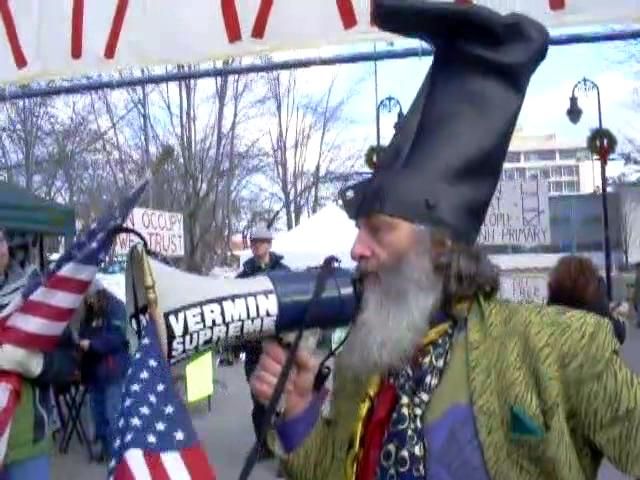
The most interesting reason I’ve heard for voting for the two is that under an Obama or a Romney presidency, living conditions will deteriorate so much that people will be forced to revolt against the government.  The advocates of this position, whom I will affectionately refer to as “anarcho-totalitarians” presumably believe that once enough people lose their homes, their food stamp benefits, their jobs, etc, there will be a revolution, and a much better system of government will suddenly appear.  Of course, much of this is satire.  There’s even a youtube video entitled “Revolutionaries for Romney”, endorsed by none other than Vermin Supreme himself: https://www.youtube.com/watch?v=MOf-g5UnIWo.  Satire or not, is there perhaps some merit to this?  Are we willing to vote for the worst candidate and cross our fingers that people will start revolting?  While it sounds somewhat appealing, I’m not interested in doing it.  I think Obama/Romney will do a good enough job making things awful without me “helping them” with my vote.

And of course, there’s the fact that a vote for a Wall St backed candidate completely undermines the objectives of the Occupy Movement.  Why would someone protest outside Goldman Sachs and Bank of America, then vote for the same candidates being funded by Goldman Sachs and Bank of America?  I sure as hell know I didn’t become an occupier so I could see a Romney or an Obama presidency.

Voting for Jill Stein

PROS:

  • Voting for her sends a message that we’re fed up with the two-party system
  • She’s on the ballot in 39 states, which is enough to (theoretically) win the electoral vote
  • If she gets 5% of the popular vote, the Green Party gets $20 million in federal funding next election

CONS:

  • She won’t win, and voting for her “takes votes away” from Obama/Romney
  • Protest votes do not “register dissent” the way we’d like them to
  • She’s a capitalist, and the Green Party is a capitalist/reformist party

And then there’s Jill Stein!  In the picture above, she and her running mate, Cheri Honkala, are being arrested for a foreclosure protest against Fannie Mae in Philadelphia.  Taking part in foreclosure actions and Occupy protests all over the country, Jill Stein has displayed a commendable level of courage, and certainly deserves her place as one of the forebears of the “Occupy Wall St” candidates.  I met her here in Manchester during Occupy the Primary, and she proved herself to be a very intelligent and articulate woman: http://www.youtube.com/watch?v=gbc4fCh3HVE.             Her campaign staff has been working tirelessly to get her ballot access in 39 states, a total of 447 electoral votes.

Why vote for Jill Stein?  Because it sends a message that people are fed up with the two-party system.  Her “New Green Deal Platform”, borrowing the memory of FDR, is appealing to a large section of progressives, and people who are fed up with the Democratic Party.  Many activists I respect and admire are voting for Jill.  They believe that registering their dissent in the polls is very important.

Why not vote for Jill?  We’ve all heard it.  Jill knows it herself.  She’s not going to win.  She’s somehow “taking votes away” from Obama.  But is that a reason for not voting for her?  I think it’s a terrible reason not to vote for her, because people not following their consciences is part of what has gotten the world into the huge mess it’s in right now.  In my view, there are much better reasons not to vote for the Stein ticket than “she can’t win”, because the implied alternative would be voting for Obama, something I have no interest in doing.

I doubt Jill is even trying to win the election.  Which brings us to the “main” pro of voting for her: if she gets 5% of the popular vote, the Green Party will receive $20 million in federal matching funding next year.  I actually tried to research this claim, and was able to find information about it here: http://www.fec.gov/press/bkgnd/fund.shtml.  Is this something that could possibly happen?  The last time a third party candidate got 5% of the vote was Ross Perot in the 90s, and the Reform Party dissolved by the next election—not a good omen for Jill.  In fact, Jill would have to get twice as many votes as Ralph Nader did in 2000 to pull it off.  But what if she does get the funding for the Green Party?  Would their $20 million in federal money give them the ability to compete against the billions of corporate dollars that will be funneled toward the Democratic and Republican candidates next election cycle?  Will we see the rise of a functional multi-party system in the United States?

If I were taking bets, I’d wager the odds are 100,000 to 1 that we’ll see our economic system collapse under the weight of its own greed and selfishness before we ever see a functional multi-party system in the US.   My main problem with Greens is their propensity to engage in magical thinking.  I cannot count the number of times I’ve heard the phrase, “But if EVERYONE voted for Jill Stein, the wars would end!  If EVERYONE was a Green, Wall St would be held accountable!”  It is this thinking, in part, which keeps people from realizing their own potential.  It convinces people the solution to their problems is as easy as pulling a lever.  Even in the million to one scenario Jill was elected President, what are the odds that she would end be able to “fix” a system designed by Wall Street.  Jill has too much integrity in her views and personal life; Washington, as it is now, has no place for her.  Why toss a good apple into a rotten barrel?

            There are those who would question whether Jill Stein is even a “good apple” at all.  I’ve heard the critique of several socialists that she has never come out in support of socialism.  That she merely wants to reform capitalism into something “less bad” while keeping the power structure that oppresses working class people and minorities intact.  While I certainly understand the criticism, I think she’s a good person and a good candidate.   I wish her all the best with her campaign, and if she does get federal funding, I hope the Green Party proves me wrong.

Voting for Gary Johnson

PROS:

  • He’s on every ballot except Michigan and Oklahoma, giving him more electoral access than Jill Stein
  • His views on abortion/the death penalty/gay marriage/the drug war are decent

CONS:

  • He’s a right-wing wackadoodle
  • He won’t win, and did terribly in the Republican primary

While Jill Stein has been busy courting the Left and disenchanted Obama voters, Gary Johnson’s attracted attention mostly from Libertarians and Recovering Republicans.  Libertarians of a bunch of stripes have been raving about him over Facebook.  Especially tonight, when he’s being “locked out” of the debate.  Unlike Jill, he’s never been a professional activist.  As a former governor of New Mexico, he’s a politician, and he’s familiar with the system he’s running for.   Some people think someone with experience runs a better campaign, but to me it just makes him untrustworthy.  I guess it’s just a matter of perspective.

His views aren’t going to be as attractive to progressives and those on the Left as Jill Stein, either.  He certainly has some good points: wanting to keep the government out of people’s uteruses, his opposition to the death penalty, his support of gay marriage, and his opposition of the drug war, to name a few.  But for many, including myself, those views are overshadowed by his typical right-wing rhetoric.  The worst of this, in my view, is his position on healthcare.  Remember Romney telling people they should just go to the emergency room when they’re sick?  I talked to Gary Johnson when he came to New Hampshire, and he actually told me, “When I was governor of New Mexico, no one died due to lack of health insurance.”  Talk about delusional!  There’s a difference between supporting a terrible policy and denying reality, and I definitely think it’s a line he’s crossed over.  I wasn’t left with the impression that he actually gives a shit about people who are suffering.

            The only thing that makes Gary Johnson a better choice than Jill Stein is that he’s on the ballot in more states.  I’ve actually heard friends tell me, “You need to vote for Gary Johnson, because he’s the only one with enough electoral votes to realistically win!”  In this way, some of Johnson’s supporters are just as delusional as Stein’s supporters.  Let’s be real, here: we will not see Jill Stein, nor Gary Johnson, in the White House this January.  The only reason to vote for either is out of moral conviction.  And since most of the left isn’t going to be morally compelled to vote for Gary Johnson, let’s move on.

Voting for Rosanne Barr/Peta Lindsay/Stewart Alexander

PROS:

  • They’re the only socialists on the ballot

CONS:

  • Voting for them is “divisive” and takes votes away from Jill Stein
  • They might not have the popular appeal Jill Stein does
  • Voting for them is still participating in capitalist elections

The socialist candidates are the most paradoxical among the field this year.  They want to “Build a Party of the Working Class”, but do it within a system they consider to be a “dictatorship of the bourgeoisie”, or, as I’d put it, “the dictatorship of the 1%.”  They want to have a working class revolution, but do it within a ballot box which is counter-revolutionary.  Or at least that’s what it would seem at first glance.

Peta Lindsay of the Party for Socialism and Liberation is appealing because she only wants to use the election as a gimmick to get the message of socialist revolution out to the general public.  She is under no illusions that she will win.  She is only on the ballot in 13 state, and, perhaps most illuminating, she’s only 28, and therefore ineligible for the Presidency under the current constitution.  And the platform she wants to get out there is a pretty stellar platform: http://www.pslweb.org/votepsl/2012/media-coverage/media-lindsay-globe-gazette.html.  Likewise, Roseanne Barr is simply trying to use her celebrity to get the message of drug decriminalization, socialism, and feminism out to the general public.  Her platform might not be as cohesive, but I think she has a much better chance of getting it out to the people than Peta.  (There’s no way the mainstream media will cover Peta, but they’ve already given a bit of attention to Roseanne.)

The most hilarious thing about the two of their candidacies and Stewart’s candidacy are the ire they’ve drawn from certain Jill Stein supporters.  I have seen them accused of “dividing the progressive vote” in a time where it’s absolutely crucial to vote for the Green Party.  The irony, of course, is that this is the exact rhetoric Obama supporters tend to aim at people voting Green.

My conclusion is that the Peta/Roseanne/Alexander tickets are not tickets to vote for, but tickets to lend moral support to.  They don’t want people voting for them; they want people to help them get their message out.  That’s definitely something I’d be willing to help them do.

Writing In Ron Paul

PROS:

  • Ummmm…he’s kind of anti-war?

CONS:

  • Everything else about him is awful
  • He’s not even running as a third party/independent candidate

I wouldn’t even bring this up if a whole lot of people weren’t planning on doing it anyway.  In 2008, Ron Paul received 41,905 votes in states where write-in votes were counted.  Based on how many of my Facebook friends are voting for him instead of Gary Johnson, I imagine that number will be ten times as high this year.  So why are people so enchanted with this Texas Congressman?  Because of his anti-war rhetoric.  Because he said he would bring American soldiers home “as soon as he can get the boats there.”  Even though he voted for the Authorization of the Use of Military Force which got us into Afghanistan.  Even though he said he wouldn’t hold Obama accountable for his war crimes.  And even though some of his top campaign contributors are military contractors Northrop Grumman, Boeing, and Lockheed Martin (I shit you not): http://www.opensecrets.org/pres08/contrib.php?cid=N00005906.  Let’s face it: Ron Paul is one of the slimiest, weaseliest, pandering-est politicans this side of the Rocky Mountains.  You don’t stay in office for over 30 years unless you’re willing to compromise your integrity over and over again while putting on your good guy face to the general public.  I call it like I see it.

And since he’s not even running, we might as well get over him.  Moving on.

Writing in Vermin Supreme

PROS:

  • He’s hilarious, and is appealing to more than just third party candidates
  • He gets why he’s running
  • He’s the only legit Anarchist on the ballot
  • Voting for him sends a message that we’re fed up with the entire election system
  • Free ponies! Okay, maybe not…but he did give me free long johns.

CONS:

  • He’s not on the ballot in any state
  • Voting for him still counts as “participating” in the system
  • Americans are too stupid to get satire

You have to have been living under a rock for the past year if you’ve never heard of this zany, over-the-top satirical candidate who promises free ponies for every American.  The king of meme, Vermin Supreme gained millions of youtube views when he glitterbombed anti-gay Democrat Randall Terry at the Lesser-Known Democratic Candidates forum, transforming a rather mundane event into a media spectacle.  A perennial candidate since 1988, Vermin has perfecting campaigning into a performance art.  This Democratic primary, he got more votes than ever before, scoring a good 833 votes in the race against Barack Obama.  More importantly, he’s probably generated more press than Jill Stein or even Roseanne Barr.  He has a weapon other third party candidates don’t that connects him with the average, everyday American: his super-satirical style of humor.

If Jill Stein is the “Occupy Wall St candidate”, Vermin Supreme is the Occupy Wall St. God.  As the above picture can attest to, Vermin Supreme has been to more Occupy Wall St rallies than any other candidate.  Vermin lives, breathes, and sleeps Occupy.  In my view, he really captures the spirit of the movement.  And he’s the only candidate who’s a legit anarchist: if you dig under the exterior sarcastic despotism, you’ll quickly find the creamy revolutionary filling inside.

The main criticism I’ve seen of Vermin’s campaign is that he’s “not taking it seriously.”  Which is like telling Jonathan Swift that eating babies is gross and he should stop telling people to do it.  Like the comedy of Dave Chappelle, Vermin’s complete mockery of the political process might fly over a lot of people’s heads.  I like to think Americans are smarter than they are, but all my experience has proved this to be false; the only ones who laugh at the cruelty of life or the cruelty of the electoral system are the ones wise enough to get the joke.  Regardless, given that he’s not on the ballot in any state, if you cast a ballot for Vermin this election cycle, rest assured it will make no difference whether you place it in the ballot box or burn it.

Or, in the immortal words of Vermin, “A vote for me is a vote completely thrown away.”

Vote for Nobody/Leave Presidential Slot Blank but Vote Locally

PROS:

  • Local elections are much more important than the Presidential election
  • You can vote on things you want, while still showing disapproval of the system

CONS:

  • You’re still not completely withdrawing from the system you acknowledge as illegitimate
  • There might not be any independents running locally
  • If you live in a state with electronic voting machines, they might “fill in” your empty Presidential spot for you. (I have not found evidence confirming this, but if someone finds any, please let me know.)

This option is one of my personal favorites.  Curiously enough, most of the criticism I’ve seen of election boycotters is that they are “Letting Obama/Romney win” by not voting.  Which means it’s the presidential election, the one that’s most controlled by corporate money, the one where our votes matter the least, that people tend to value the most.  What I appreciated the most about Katie’s editorial is that it wasn’t the Presidential elections she told people they should “get engaged” in—no, she focused the battle happening in state legislatures across the country.  I can certainly see why people find value in local politics; I don’t think we have a whole lot of influence in any part of this electoral system, but if enough effort was put into it, I bet people could certainly make a dent in local politics if they really wanted to.  The presidential elections are a totally lost cause, but when it comes to the down ticket, why not have your cake and eat it too?  Why not leave the presidential slot blank in protest or “Vote for Nobody” while voting for initiatives and local candidates that are important?

The main problem with this strategy is when there are no local, independent candidates to throw your support behind.  I actually went to a progressive “state legislator training session” in Concord, and told the trainers I was considering running for state house or senate sometime in the distant future.  When I told them I would never run as a Democrat or a Republican, I was all but laughed out of the room!  The fact is, the two party system not only has a stranglehold over the federal elections, but based on the way the rules are written, they often dominate local elections all over the country as well.  The last time I voted for mayor, I voted for the one Independent, Glenn Ouellette, and he got 2% of the vote.  While I admire those who want to change that and run as independent or third party candidates in local politics, I feel like my time and energy is best spent elsewhere.  And since I don’t imagine any third party candidates are going to throw their hats into the ring in the next few months, why not go the full way and boycott the whole damn charade?

Boycotting the Elections

PROS:

  • It’s the most “revolutionary” of the options, in that it rejects the whole system
  • Shows solidarity with people boycotting elections worldwide
  • Shows solidarity with indigenous communities struggling against a Colonial Power
  • It feels freeing and relieving

CONS:

  • “If you don’t vote, you have no right to complain!”
  • Boycotters are mistaken for apathetic; it sends the wrong message
  • It may not be appealing to minorities and marginalized people
  • There aren’t enough people doing it; it won’t catch on until Third Parties/celebrities publicly join in a boycott
  • There are better things to boycott than elections

So, we’ve finally come to the crown jewel of the controversy: the election boycott.  The crass, boisterous, in-your-face election boycott which makes no compromises and offers no apologies for itself.  It’s beautiful the way a castration is beautiful; it takes all we’ve been taught as a culture about democracy, throws it bloodied to the dirt, and spits on it.  Some will indeed call it “The Protest of Nothing”.  I don’t blame them.  Really, there are too many things to protest these days, and it’s easy for The Protest of Everything to look like the Protest of Nothing to the uninitiated.    The biggest myth about the boycott is that it takes no courage to perform—boycotting is not for wimps.  There are few things more frightening than unshackling yourself from the illusion of hope and learning to trust your own abilities.  And yes, the election boycott throws the baby out with the bathwater, but this presupposes the bathwater is morphine, and the baby was a battery in the Matrix, and that maybe we’ll build a bridge over our failures before the floodgates of cataclysm close over humanity.

I hyperbolize.  But my point remains the same: the boycott’s not for everyone.  That being said, there are plenty of good reasons to boycott.  The first being the solidarity it shows with groups of revolutionaries around the world who are fighting tyranny by boycotting their countries’ elections.  From Egypt to Mexico, there is a growing movement of people boycotting all over the planet: http://electionboycott2012.org/election-boycotts-around-the-world-and-now-in-the-us-too/.  I’ve heard the argument that those societies are very different front ours; that people in the United States have much more voice in their government than people in “third world countries”.  The truth is quite the contrary.  We are the model for tyranny everywhere: there are few undemocratic governments in the world that the United States has not had some hand in bolstering.  Furthermore, there is more corporate cash poisoning our system of government than in any other country.  We are living in a society where dollars equal votes.  Also, there is no military empire larger than ours; to oppose the elections is to oppose the military interests attached to the system.  Dr. King once said his government is the largest purveyor of violence on the planet.  Not much has changed since then.

United States imperialism doesn’t only affect other countries, though.  Most people who argue that citizens are “obligated to vote” tend to forget the fact that the United States government is still a colonial power.  They tend to forget that those most hurt by upholding the current system are people living on reservations, the indigenous community who lost their homes, their language, their families, their history, their environment, and everything they had.  The boycott has gained some traction among some members of the indigenous community, who wish not to uphold a colonial power, and instead wish to choose their leader according to traditional custom.  This is most organized in Mexico, where two indigenous communities, the Nahua and the Purepecha, have decided to boycott the elections: http://www.grass-roots-press.com/2011/09/30/indigenous-communities-boycott-elections/.  I propose that, in solidarity with these communities, the Boycott the Election movement ought to change its name to the “Decolonize the Elections” movement.

Now, on to the negatives of boycotting.  The first thing I always hear from people opposing the boycott, usually Obama or Romney voters, is that “If you don’t vote, you have no right to complain!”  Just like “Support Our Troops” this is a mindless piece of propaganda without much substance.  It’s effective because it doesn’t mean anything.  I believe that every person, whether they voted for Obama or McCain or Cynthia Mckinney or no one at all, has the right to complain about the corrupt and morally bankrupt system they didn’t build.  Moreover, they have the right to try to change it or destroy it in the best way they see possible.  No one should be silenced for expressing their victimization.  I would go on about this point, but I think the late George Carlin satirically refutes this point more eloquently than I ever could: http://www.youtube.com/watch?v=xIraCchPDhk.

The next point of opposition I always encounter is that not voting makes you seem apathetic.  This is indeed a serious image problem.  Luckily, it’s a problem with a very simple remedy.  If people see you participating in society on days other than election day, they’ll realize you do care about what happens.  If you can show that you understand the issues the country is facing, it will buck their preconception.  If they see you helping your neighbor instead of spending all day in front of your TV (I realize I’m condemning myself), they won’t think you’re a heartless, apathetic dolt.  We all must become leaders in our community.  We all must help each other and gain allies wherever we can.

Of all the points of opposition to the boycott, the one that troubles me the most is the issue that it doesn’t speak to the concerns of minorities.  That because so many people of color, women, and immigrants fought hard for their right to vote, and still are, this is a tactic that really doesn’t speak to them.  As a person who is male and looks mostly white, I benefit from those privileges, and feel an obligation to confront the ingrained bigotry around me.  I don’t want to see the election boycott become like social movements of the past; we’ve all heard stories about the women’s suffrage movement excluding black people, the civil rights movement excluding gay people, the gay liberation movement excluding trans people, and so on.  I’m afraid of history repeating itself.  And I’ve seen a lot to worry me about the ilk I’m associating with—I actually saw an election boycotter tell a critic that he was “playing the race card” when he argued that the movement wouldn’t be appealing to black people.  This is clearly a problem that needs to be confronted.

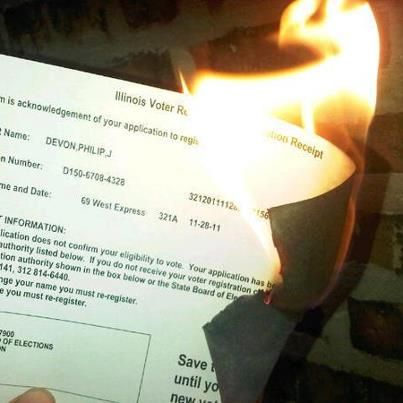
So, is this election boycott really the movement of angry white men and young white libertarians living with their parents?  I don’t know.  It’s too soon to tell.  In Chicago, there was already a counter-protest to the burning of voter registration cards where an elderly gentlemen said that by burning their cards, they were helping voter suppression efforts and contributing to the disenfranchisement of “colored voters”: http://www.examiner.com/article/occupiers-burn-their-voter-registration-cards-protest.  While I don’t see how burning your own registration card can “disenfranchise” anyone, it’s a sign that the boycott may not have a message that’s appealing to minorities by and large.  But, hell…I’m not sure yet that the election boycott is appealing to most people, anyway.  And if history tells us anything, women, immigrants and people of color have often been leaders of boycotting efforts.  Emma Goldman was famous for standing against the suffragettes and stating that participating in capitalist elections did not further equality for women, because it did not take class order into to count.  W.E.B Dubois also gave a speech about why he refused to vote: http://www.blackeconomicdevelopment.com/why-i-wont-vote-by-web-du-bois-the-nation-20-october-1956/.  Perhaps we will see it catch on the more disenfranchised communities become, just as we’ve seen with indigenous groups.

The next criticism of the boycott is one I often level against it myself: it’s not big enough yet.  The election boycott isn’t really a movement, it’s a tactic which is of little value when it comes to changing the system.  The “Boycott the Presidential election” event page on Facebook has 772 attendees, which is more than nothing, but still isn’t really putting a dent in removing the government’s popular legitimacy.  I think in order for the boycott to gain traction, one of two things needs to happen: third parties need build a coalition to boycott the election, and/or A-list celebrities need to endorse the boycott.  I think the Party for Socialism and Liberation is likely to call for an election boycott way sooner than the Green Party; the Greens are still too engaged in magical thinking that they have the ability to eventually change the system.

Lastly, there’s the assertion of critics that it is much more important to take other direct action than boycott the election.  I can’t say I disagree.  Boycotting is just one tool in a toolbox of many methods to achieve a peaceful revolution: http://www.aeinstein.org/organizations103a.html.  It’s much more important to democratize your workplace to strike.  It’s much more important to boycott corporations which engage in unethical business practices throughout the world, or take your money out of banks.  I think the most necessary action of disengagement, championed by Cindy Sheehan, is to stop paying Income taxes if at all possible.  Income taxes go to pay for wars throughout the world.  When I hear about someone boycotting the election, then I hear that person is still paying taxes and has not even attempted to stop paying, I take it as a huge sign of hypocrisy.  If everyone in the country didn’t vote, it might not change the system, because the system does not require our votes to operate.  But if everyone in the country stopped paying taxes and redirected the money to worthy causes, we’d see a more peaceful, democratic society in place much sooner.

———————————————————————————————————————

So what will I be doing this November?  Right now, my plan is not only to boycott, but to Decolonize the 2012 Elections.  I probably won’t be putting much effort into actively organizing theater surrounding it, because there are projects much more worthy of my time.  What I do know is, I will be going to the polls, refusing to show my ID in solidarity with those whose rights are being oppressed, then getting my ballot.  I don’t know what I will do with the ballot afterwards…perhaps I will burn it, perhaps I will put it in a bottle and sent it adrift to sea, or perhaps I will turn it into a paper boot hat in honor of Vermin Supreme.  Your guess is as good as mine.

Do I know that I’m making the right decision?  No.  I only know that I feel the most free I’ve ever felt in my life.  I know that my conscience is telling me to do this, and my conscience rarely leads me astray.  Maybe the Green Party will manage to establish a presence in the future.  Maybe the US will see the rise of a multiparty system.  I think it’s very unlikely.  But I’m always willing to be proven wrong.

Matthew Richards is a life-long resident of Manchester, and was active in Occupy NH. As assistant director of New Hampshire Pridefest, he took part in organizing the first Pride event in New Hampshire after a decade long hiatus. He’s been performing regularly at poetry open mics throughout New England for the past three years, and competed in the 2011 National Poetry Slam as part of the Slam Free or Die team. His upcoming collection of poetry, tentatively titled ‘Revolution is a Ruthless Boxcar’, will highlight his experiences in the Occupy Movement.

Tagged , , , , , , , , , , , ,

War on Democracy: Pulpit Sunday and the Religious Right’s Efforts to Forge Theocracy

On October 7th conservative churches all over the country will pound their pulpits in an action called Pulpit Sunday, not with calls for the individual sinner to ‘turn to the Jesus’ or to repent for one’s sins, but that their congregation act as a collective and mark among their religious duties voting in the matter their church leaders direct.

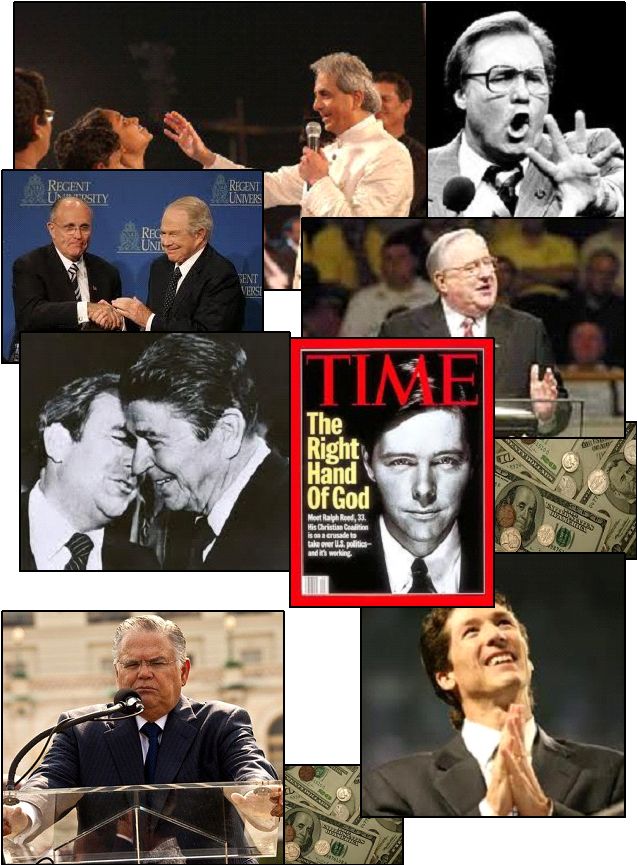
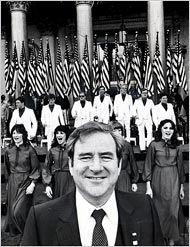
From top left clockwise: Benny Hinn, Jimmy Swaggert, Jerry Falwell, Ralph Reed, Joel Olsteen, unknown, Falwell and Reagan, Guiliani and Pat Robertson

Undeterred by the strong evidence (in writing) that the founders of the country had no interest in mingling church and state, the religious right has continued to characterize their movement as one to defend a nation they view as divinely inspired.  Once simply a faction of heavy-handed Protestantism relegated to country churches, revival tents or low budget television, the  evangelicals, fundamentalists and “charismatics” have forged a unified strength built from their shared vision of America and a never-ending thirst for power.  Grown from decades of practice in the use of modern media such as radio and then television and the privilege of a tax-free ride on the backs of the public, the Christian far-right has become a meaningful and forceful part of the political landscape, supporting Republican causes.

Right around the time that fundamentalist and evangelical leaders began to develop followings through the use of media such as television and wide scale network radio broadcasts, the Johnson Amendment came to pass.  Restricting the ability of tax exempt organizations to engage in political campaigning or directly support political campaigns, the amendment immediately blunted the Christian right’s ascendancy to political power.  While the right likes to say that Johnson had no intention of restricting the free speech of churches, but instead wished to curb the activities of senatorial opponents on the left, not one shred of evidence has ever surfaced to prove this claim.

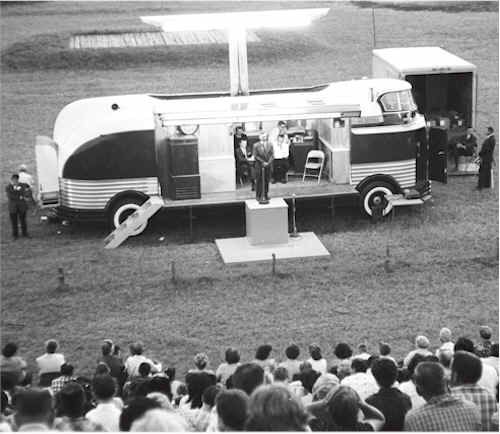
Early Pentecostal Evangelist self appointed “faith healer” Oral Roberts on the road in the 50’s; the modern revival tent.

 “God said, ‘I told you to raise $8 million to carry on my medical work.  You have from January 1 to March 31 to get it done.  If you don’t, then your work is finished, and I am going to call you home.’ – Oral Roberts in 1987 raising funds for a ‘medical mission’, telling his television audience that God would be done with him if he didn’t raise the money.  Roberts raised the money and lived.

In addition, the Christian right and the Republicans like to claim that the Johnson Amendment hampers free speech, but a cursory look at the amendment’s wording makes clear such is not true.  The amendment restrict direct activity on behalf or against a candidate.

The IRS explanation reads as follows:

Contributions to political campaign funds or public statements of position (verbal or written) made on behalf of the organization in favor of or in opposition to any candidate for public office clearly violate the prohibition against political campaign activity. Violating this prohibition may result in denial or revocation of tax-exempt status and the imposition of certain excise taxes.

But the religious right, bounded by its belief in its divinely inspired purpose, pushes on.  Since 2008, James Dobson, the founder of the radical right wing group Focus on the Family, has taken upon his shoulders the effort to destroy the wall between church and state by force of action by putting his backing and funding behind the Pulpit Sunday action.  Since far right wing churches have repeatedly attempted to force the IRS to rule on the issue, a bait it seems to refuse to take, the new tact seemed to be to force the issue to court by practicing flagrant defiance of the law.

The way in which the religious right characterizes the amendment and its interpretation, one would think that state’s militias stand outside the door of every right-wing church in America waiting for preachers to make banned utterances over the pulpit.  Or cops and IRS regulators attending services and pouring over sermons to find a shred of prohibited speech.  Skilled in the art of hyperbole, church leaders characterize the amendment as crushing speech critical of any political agenda.  Anyone who has watched mainstream media where right-wing preachers have received nothing short of a megaphone for their fundamentalist soapboxes knows this untrue.

With the help of expanded media exposure and cable television, the Christian right has grown from its hill-billy roots into a multi-million dollar business venture supported by member/supporter donations.

[Note: figuring out the number of churches that donate to right-wing causes and their number is beyond the scope of this article, especially considering the number of non-denominational religious organizations and their offshoots such as ‘universities’, any cursory observation though can conclude the cash inflows to be significant.]

One must differentiate between the traditional church member who attends and participates in a traditional church community and the supporter who responds through media to televangelists who plea for donations, usually in exchange for either something tangible or the privilege of having a wish or prayer granted or heard. From the Jimmy Swaggerts to Jim Bakker, whether exists the old style preacher or the  hucksters– no personal connection or community exists among the media driven donors.  One would typically characterize such as regular commercial transactions, but under tax code, the church needs pay no income tax.  The potential power to gain as a constituency with such money became self-evident when in 1980, Ronald Reagan walked into the White House with the religious right at his side.

Falwell, his Moral Majority and Liberty University students rally outside Virginia statehouse 1980

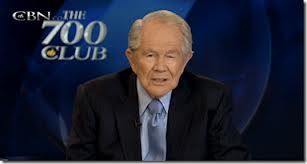
Jerry Falwell (and here), Pat Robertson (and here) and a young upstart named Ralph Reed worked together and formed the Christian Coalition, that not only helped propel Ronald Reagan into office, but also melded far-right religious theocratic tendencies with the Republican party.  The result was immediately palatable. The American culture fell in love with conservatism and embraced a media driven new conservatism.  Exhausted from long unemployment, inflation, war and social upheaval that demanded core cultural changes many resisted, Americans embraced the new turn backward.  The media wizened far-right Christian leaders played the public like a fine tuned harp and out flowed a mythology of America that soothed the troubled American mind.

The social backlash of the 1980’s and the roll of the evangelist movement within cannot be understated.  Randall Terry, the founded Operation Rescue, a group that led the charge early to take a militant stance against a woman’s right to bodily sovereignty by committing and/or supporting terrorist acts against or harassment of women, doctors or clinics who served women.  Propelled by the love-affair with the far-right, the media became a willing dupe, eagerly using their framing of social programs such as affirmative action, cuts to assistance programs to poor, in racism terms (the religious right is no stranger to supporting the powerful and has a strong following among poor whites, usually the most racist in the country) attacks on unions and even attacks on environmental legislation and policy, championed by controversial Interior Secretary James Watt who typified the new culture of conservatism.  All the while, hyper-nationalism mixed with religious conviction gave justification for a huge military expansion.  The doctrine of the evangelical right of the blessed sanctity of capitalism laid the groundwork for plowing through nearly a century’s worth of struggle to create government regulation to balance out the barbarian narcissism inherent in capitalism.

The response of the center-right in the Democratic party was to chase the bandwagon and jump on. Many key Democrats couldn’t trample workers, poor folks, women’s rights, civil rights, environmental protections, anti-militarism and many other once core liberal beliefs in their clamoring to please the powerful formed the Democratic Leadership Council (which in the 90’s morphed into the “New Democrats”).  All the while Reagan attacked years of social progress from within by defunding, denouncing and destroying every possible law, regulation and agency that threatened corporate profits. The far-right served the corporate agenda by distracted the public like a side-show act during set changes with assaults on clinics, hatred toward gay people (and the ensuing delay on the part of Reagan to act on the AIDS crisis), attacks on affirmative action and the growth and development of “think-tanks” such as the Cato Institute or the Heritage Foundation to bolster activists and politicians with manipulated numbers, half-truths and mythology to sway public opinion.

The growth of evangelical and fundamentalism cannot be understated, nor can its intention to control government policy be over looked.  The power of extremist Christians built with their skillful use of media and money deserves serious attention.  American Christian culture has deep roots in a mix of Calvinist individualism and pre-destination and the Puritan belief that God speaks through the dollar which has allowed evangelicals to amass fortunes with only passing amusement from most of the public. No one can doubt that the tax exempt status such churches enjoy helps substantially with their portfolio expansion.

By the late 1920s, as George Marsden notes,[writer of religious fundamentalism] ‘most evangelicals remained on the fringes of American politics’.8 Fundamentalists did not rejoin the political system in large numbers until the growth of the New Religious Right in the late 1970s, through such organisations as the Moral Majority and the Christian Coalition. *

In the 1990’s, Ralph Reed’s Christian Coalition nearly lost its tax exempt status over voting guides which they distributed nationally to fundamentalist and far-right churches. In contradiction to the wording of the Johnson Amendment, the voter guides had direct instructions as to what candidates the congregants should support.

Currently Ralph Reed has resurrected the voter guides and has bragged that distribution through media such as cell phones has the potential to reach as many as 3 million voters.  The IRS has not come knocking — yet.  As long as Reed’s group does not actively support one candidate over another, they can continue to operate.  In fact, preachers have been and are quite free to propound endlessly on social issues of their choice and extol their faithful followers to view certain policies or social activities as alien to their beliefs.  Ecumenical groups on both sides of the aisle regularly engage in social criticism that goes into or borders on commentary about the political.  While most mainstream protestant churches shy away from such, far-right religious establishments have made political and social commentary their brand du jour.

Jim Garlow, pastor of the Skyline Church and one of the leading preachers to take the mantle as promoter of the pulpit event and aleading proponent of the California Prop 8 which banned gay marriage, is seen in this video explaining the Pulpit Sunday event.  Implicit in his speech lies the assumption that American society must act in obedience with their interpretation of their holy text.

No where in the screed is mentioned the factor of tax exempt status which allows the churches to amass millions of dollars, to fight these battles they see as their own personal jihad against western secularists.

Presently the legal action arms of the Christian right has focused legal battles across the country in small municipalities to in a concerted, long battles to erode the separation of church and state.   Lawyer James Sekulow has made a fortune with two charities that have made frightening inroads into the mixing of the public funded sphere and the religious.

Most importantly, religious fundamentalism, interprets the bible as the real voice of their god, sacred and unquestionable, most religious fundamentalists resent the mandated obedience of a secular government.  They instead envision not a secular and broad democracy as laid out by the constitution and the bill of rights, but a theocracy more in line with the social orders described in their holy text; the bible.

As a form of revolutionary control, since the 1980’s, corporate capitalists have increasingly found that their brand of capitalism, American exceptionalism and religious evangelism, particularly the “prosperity gospel” brand,  can run hand in hand.  Since extreme, unregulated capitalism resents government regulation as intrusion, so do religious extremists.  Both envision a country where their world view and vision can exercise without ‘interference’ of an objective body protecting the rights of all minorities.  Thus, they have melded and capitalists have come to see the potential voting block of the religious right and right wing libertarians as useful to build the state in their model of control for the extraction of capital; the exchange would be suppression of the population through theocratic control.

We encourage all readers to attend a fundamentalist or evangelical church in their neighborhood on October 7th to get a feel for the kind of world these people wish to use the government to enforce on all of us.

For further reading and sources:

“Teavangelicals; How the Christian Right Came to Bless the Economic Agenda of the Tea Party”, The New Republic, 7/11/2011

*“Religious Violence and the Myth of Fundamentalism”, Michael Barkun

Capitalism and Christianity – for an interesting observation of a left religious European blogger and American Christian readers.

Amazon.com reviews  of “Money, Greed and God: Why Capitalism is the Solution and Not the Problem”, David Bahnsen that will make your hair curl.

Who would Jesus Endorse? Pulpit Freedom Sunday, Ronald Lindsay for the Center for Inquiry, 9/24/2012

Tennessee Lawyer’s Family Firm Collect Millions from Charity, USA Today.com from the Tennessean, 9/5/2011 – story of Jay Sukelow and his questionable practices in handling Evangelical based charities and the rise of his “charities” that offer legal work to evangelical Christians, mostly opposing separation of church and state rules.

SBOE Votes Down Church-State Wall in History Books, , The Texas Tribune, 3/11/2010 – old but an example of the infiltration of right-wing Christian ideology in education.

The History of the Johnson Amendment – written for a “Christian Calvary” school somewhere, read it and weep for our country and the children brainwashed by such drivel called “christian education”

Against Pulpit Sunday, (unless churches pay their taxes first)

Tax Laws and Religious Speech: What the Constitution Says, LA Times, 9/25/08

Tagged , , , , , , , , , ,

Reblogged Michelle:
The human cost of living the “free-market” world that Libertarians and the right-wing praise.

Michelle's avatar

Recently I sent a resume to a nonprofit organization for a job I was qualified for. For almost a week I held my breath waiting for a response to my resume. Then I got an email from the woman in charge of filling the position. It went straight into my spam folder and sat there for three days. In the meantime, I got a phone call from the woman, I think. That is, there was a very garbled message on my voice mail. I returned her call but never received the same when I left her a message. When I found the email in my spam folder, I responded right away stating the message had gone into that particular folder. A day later she responded to my email asking for a 20 minute phone interview. She gave me a date and a time. I emailed her back saying I could…

View original post 572 more words