Matt Richards submits in answer to “The Protest of Nothing”, an excellent survey of presidential candidates and a compelling argument explaining the Boycott rationale through Matt’s perspective.
I’m writing this on the eve of the first televised debate between Barack Obama and Mitt Romney, in response to Katie Talbert’s opinion piece, The Protest of Nothing: https://progressiveactionnh.wordpress.com/2012/09/16/the-protest-of-nothing. There’s been a lot of buzz about an election boycott this year. Over the past few months, the idea has been swirling around the internet, gaining some airtime on the podcast of Left-wing activist Cindy Sheehan, and drawing fierce criticism from icons such as Michael Moore and Noam Chomsky. I’ve begun to notice how voting is considered a sacrosanct ritual among many Americans, especially progressives who still look toward the ballot box for social change. As a result, many people have been asking me what I’ll be doing this November 6th.
There was something in Katie’s editorial that caught my attention. She stated that “Democracy demands engagement for success.” She seems to imply that both rebelling against the current system and engaging in democracy are two separate processes, both of which are important. “Engaging in democracy” seems to be code for “voting and campaigning for candidates.” It made me wonder—what is democracy? How do you engage in democracy when the system set in place by the ruling corporate oligarchy seems completely undemocratic in nature? How many votes does it take for democracy to suddenly activate? Will it activate when 75% of the population votes? When 100% of the population votes? Or must we stop participating completely and attempt to build a system not controlled by the wealthy few?
So what is a young, anti-war anarchist to do? Originally, I had just planned on rebutting some of the points in Katie’s essay. Instead, I decided to review the full slate of choices this November, and evaluate what I feel are the pros and cons of each. Without further ado, here it is:

Voting for Romney/Obama
PROS:
- It only takes five minutes, and one of them will be President anyway
- The Supreme Court
- Voting for one of them might precipitate an economic collapse and make revolution come sooner
CONS:
- Voting for the lesser of two evils is still voting for evil
- Voting for Obama/Romney completely defeats the purpose of the Occupy Movement and Arab Spring
I would give more attention to why both Obama and Romney are awful choices for President, but Katie already did a good job of that in her essay. I mean…does the world really need four more years of drones, Gitmo, indefinite detention centers, and huge bonuses for Wall St. executives? In my opinion, any of those things alone is enough to deserve either of them a lifetime prison sentence. But the non-delusional among us know that either Wall St. Candidate A or Wall St. Candidate B will be sitting in the Oval Office next January. So should we just grit our teeth, hold our noses, and spend five minutes voting for the person who will be the least awful? Should we, for five minutes, ignore the drone bombing in Northern Waziristan, and vote for whichever of the two has the least horrendous social policies? The one who will select the least worst Supreme Court nominations?
Honestly, it’s hard to tell which of the two is the least evil, and I have no interest in trying to decide which: http://ivn.us/2012/07/17/100-ways-mitt-romney-is-just-like-barack-obama/. The whole thing would be an exercise in futility. Whenever I tell Democrats I’m considering boycotting, they warn me not voting would be a vote for Romney, and that it will be my fault when he’s elected. Whenever I tell the few Republican I know that I’m considering boycotting, they warn me that my absence from the polling place will result in Obama getting re-elected. The partisan divide in this country is fierce, and I start to see everyone’s true colors show come election season. To be honest, I don’t think we’ve had two worse candidates running for President since the days of Andrew Jackson.
The most interesting reason I’ve heard for voting for the two is that under an Obama or a Romney presidency, living conditions will deteriorate so much that people will be forced to revolt against the government. The advocates of this position, whom I will affectionately refer to as “anarcho-totalitarians” presumably believe that once enough people lose their homes, their food stamp benefits, their jobs, etc, there will be a revolution, and a much better system of government will suddenly appear. Of course, much of this is satire. There’s even a youtube video entitled “Revolutionaries for Romney”, endorsed by none other than Vermin Supreme himself: https://www.youtube.com/watch?v=MOf-g5UnIWo. Satire or not, is there perhaps some merit to this? Are we willing to vote for the worst candidate and cross our fingers that people will start revolting? While it sounds somewhat appealing, I’m not interested in doing it. I think Obama/Romney will do a good enough job making things awful without me “helping them” with my vote.
And of course, there’s the fact that a vote for a Wall St backed candidate completely undermines the objectives of the Occupy Movement. Why would someone protest outside Goldman Sachs and Bank of America, then vote for the same candidates being funded by Goldman Sachs and Bank of America? I sure as hell know I didn’t become an occupier so I could see a Romney or an Obama presidency.
Voting for Jill Stein

PROS:
- Voting for her sends a message that we’re fed up with the two-party system
- She’s on the ballot in 39 states, which is enough to (theoretically) win the electoral vote
- If she gets 5% of the popular vote, the Green Party gets $20 million in federal funding next election
CONS:
- She won’t win, and voting for her “takes votes away” from Obama/Romney
- Protest votes do not “register dissent” the way we’d like them to
- She’s a capitalist, and the Green Party is a capitalist/reformist party
And then there’s Jill Stein! In the picture above, she and her running mate, Cheri Honkala, are being arrested for a foreclosure protest against Fannie Mae in Philadelphia. Taking part in foreclosure actions and Occupy protests all over the country, Jill Stein has displayed a commendable level of courage, and certainly deserves her place as one of the forebears of the “Occupy Wall St” candidates. I met her here in Manchester during Occupy the Primary, and she proved herself to be a very intelligent and articulate woman: http://www.youtube.com/watch?v=gbc4fCh3HVE. Her campaign staff has been working tirelessly to get her ballot access in 39 states, a total of 447 electoral votes.
Why vote for Jill Stein? Because it sends a message that people are fed up with the two-party system. Her “New Green Deal Platform”, borrowing the memory of FDR, is appealing to a large section of progressives, and people who are fed up with the Democratic Party. Many activists I respect and admire are voting for Jill. They believe that registering their dissent in the polls is very important.
Why not vote for Jill? We’ve all heard it. Jill knows it herself. She’s not going to win. She’s somehow “taking votes away” from Obama. But is that a reason for not voting for her? I think it’s a terrible reason not to vote for her, because people not following their consciences is part of what has gotten the world into the huge mess it’s in right now. In my view, there are much better reasons not to vote for the Stein ticket than “she can’t win”, because the implied alternative would be voting for Obama, something I have no interest in doing.
I doubt Jill is even trying to win the election. Which brings us to the “main” pro of voting for her: if she gets 5% of the popular vote, the Green Party will receive $20 million in federal matching funding next year. I actually tried to research this claim, and was able to find information about it here: http://www.fec.gov/press/bkgnd/fund.shtml. Is this something that could possibly happen? The last time a third party candidate got 5% of the vote was Ross Perot in the 90s, and the Reform Party dissolved by the next election—not a good omen for Jill. In fact, Jill would have to get twice as many votes as Ralph Nader did in 2000 to pull it off. But what if she does get the funding for the Green Party? Would their $20 million in federal money give them the ability to compete against the billions of corporate dollars that will be funneled toward the Democratic and Republican candidates next election cycle? Will we see the rise of a functional multi-party system in the United States?
If I were taking bets, I’d wager the odds are 100,000 to 1 that we’ll see our economic system collapse under the weight of its own greed and selfishness before we ever see a functional multi-party system in the US. My main problem with Greens is their propensity to engage in magical thinking. I cannot count the number of times I’ve heard the phrase, “But if EVERYONE voted for Jill Stein, the wars would end! If EVERYONE was a Green, Wall St would be held accountable!” It is this thinking, in part, which keeps people from realizing their own potential. It convinces people the solution to their problems is as easy as pulling a lever. Even in the million to one scenario Jill was elected President, what are the odds that she would end be able to “fix” a system designed by Wall Street. Jill has too much integrity in her views and personal life; Washington, as it is now, has no place for her. Why toss a good apple into a rotten barrel?
There are those who would question whether Jill Stein is even a “good apple” at all. I’ve heard the critique of several socialists that she has never come out in support of socialism. That she merely wants to reform capitalism into something “less bad” while keeping the power structure that oppresses working class people and minorities intact. While I certainly understand the criticism, I think she’s a good person and a good candidate. I wish her all the best with her campaign, and if she does get federal funding, I hope the Green Party proves me wrong.
Voting for Gary Johnson

PROS:
- He’s on every ballot except Michigan and Oklahoma, giving him more electoral access than Jill Stein
- His views on abortion/the death penalty/gay marriage/the drug war are decent
CONS:
- He’s a right-wing wackadoodle
- He won’t win, and did terribly in the Republican primary
While Jill Stein has been busy courting the Left and disenchanted Obama voters, Gary Johnson’s attracted attention mostly from Libertarians and Recovering Republicans. Libertarians of a bunch of stripes have been raving about him over Facebook. Especially tonight, when he’s being “locked out” of the debate. Unlike Jill, he’s never been a professional activist. As a former governor of New Mexico, he’s a politician, and he’s familiar with the system he’s running for. Some people think someone with experience runs a better campaign, but to me it just makes him untrustworthy. I guess it’s just a matter of perspective.
His views aren’t going to be as attractive to progressives and those on the Left as Jill Stein, either. He certainly has some good points: wanting to keep the government out of people’s uteruses, his opposition to the death penalty, his support of gay marriage, and his opposition of the drug war, to name a few. But for many, including myself, those views are overshadowed by his typical right-wing rhetoric. The worst of this, in my view, is his position on healthcare. Remember Romney telling people they should just go to the emergency room when they’re sick? I talked to Gary Johnson when he came to New Hampshire, and he actually told me, “When I was governor of New Mexico, no one died due to lack of health insurance.” Talk about delusional! There’s a difference between supporting a terrible policy and denying reality, and I definitely think it’s a line he’s crossed over. I wasn’t left with the impression that he actually gives a shit about people who are suffering.
The only thing that makes Gary Johnson a better choice than Jill Stein is that he’s on the ballot in more states. I’ve actually heard friends tell me, “You need to vote for Gary Johnson, because he’s the only one with enough electoral votes to realistically win!” In this way, some of Johnson’s supporters are just as delusional as Stein’s supporters. Let’s be real, here: we will not see Jill Stein, nor Gary Johnson, in the White House this January. The only reason to vote for either is out of moral conviction. And since most of the left isn’t going to be morally compelled to vote for Gary Johnson, let’s move on.
Voting for Rosanne Barr/Peta Lindsay/Stewart Alexander

PROS:
- They’re the only socialists on the ballot
CONS:
- Voting for them is “divisive” and takes votes away from Jill Stein
- They might not have the popular appeal Jill Stein does
- Voting for them is still participating in capitalist elections
The socialist candidates are the most paradoxical among the field this year. They want to “Build a Party of the Working Class”, but do it within a system they consider to be a “dictatorship of the bourgeoisie”, or, as I’d put it, “the dictatorship of the 1%.” They want to have a working class revolution, but do it within a ballot box which is counter-revolutionary. Or at least that’s what it would seem at first glance.
Peta Lindsay of the Party for Socialism and Liberation is appealing because she only wants to use the election as a gimmick to get the message of socialist revolution out to the general public. She is under no illusions that she will win. She is only on the ballot in 13 state, and, perhaps most illuminating, she’s only 28, and therefore ineligible for the Presidency under the current constitution. And the platform she wants to get out there is a pretty stellar platform: http://www.pslweb.org/votepsl/2012/media-coverage/media-lindsay-globe-gazette.html. Likewise, Roseanne Barr is simply trying to use her celebrity to get the message of drug decriminalization, socialism, and feminism out to the general public. Her platform might not be as cohesive, but I think she has a much better chance of getting it out to the people than Peta. (There’s no way the mainstream media will cover Peta, but they’ve already given a bit of attention to Roseanne.)
The most hilarious thing about the two of their candidacies and Stewart’s candidacy are the ire they’ve drawn from certain Jill Stein supporters. I have seen them accused of “dividing the progressive vote” in a time where it’s absolutely crucial to vote for the Green Party. The irony, of course, is that this is the exact rhetoric Obama supporters tend to aim at people voting Green.
My conclusion is that the Peta/Roseanne/Alexander tickets are not tickets to vote for, but tickets to lend moral support to. They don’t want people voting for them; they want people to help them get their message out. That’s definitely something I’d be willing to help them do.
Writing In Ron Paul

PROS:
- Ummmm…he’s kind of anti-war?
CONS:
- Everything else about him is awful
- He’s not even running as a third party/independent candidate
I wouldn’t even bring this up if a whole lot of people weren’t planning on doing it anyway. In 2008, Ron Paul received 41,905 votes in states where write-in votes were counted. Based on how many of my Facebook friends are voting for him instead of Gary Johnson, I imagine that number will be ten times as high this year. So why are people so enchanted with this Texas Congressman? Because of his anti-war rhetoric. Because he said he would bring American soldiers home “as soon as he can get the boats there.” Even though he voted for the Authorization of the Use of Military Force which got us into Afghanistan. Even though he said he wouldn’t hold Obama accountable for his war crimes. And even though some of his top campaign contributors are military contractors Northrop Grumman, Boeing, and Lockheed Martin (I shit you not): http://www.opensecrets.org/pres08/contrib.php?cid=N00005906. Let’s face it: Ron Paul is one of the slimiest, weaseliest, pandering-est politicans this side of the Rocky Mountains. You don’t stay in office for over 30 years unless you’re willing to compromise your integrity over and over again while putting on your good guy face to the general public. I call it like I see it.
And since he’s not even running, we might as well get over him. Moving on.
Writing in Vermin Supreme

PROS:
- He’s hilarious, and is appealing to more than just third party candidates
- He gets why he’s running
- He’s the only legit Anarchist on the ballot
- Voting for him sends a message that we’re fed up with the entire election system
- Free ponies! Okay, maybe not…but he did give me free long johns.
CONS:
- He’s not on the ballot in any state
- Voting for him still counts as “participating” in the system
- Americans are too stupid to get satire
You have to have been living under a rock for the past year if you’ve never heard of this zany, over-the-top satirical candidate who promises free ponies for every American. The king of meme, Vermin Supreme gained millions of youtube views when he glitterbombed anti-gay Democrat Randall Terry at the Lesser-Known Democratic Candidates forum, transforming a rather mundane event into a media spectacle. A perennial candidate since 1988, Vermin has perfecting campaigning into a performance art. This Democratic primary, he got more votes than ever before, scoring a good 833 votes in the race against Barack Obama. More importantly, he’s probably generated more press than Jill Stein or even Roseanne Barr. He has a weapon other third party candidates don’t that connects him with the average, everyday American: his super-satirical style of humor.
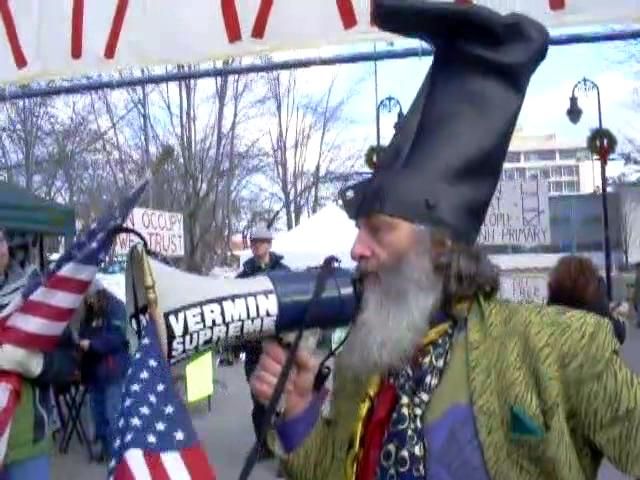
If Jill Stein is the “Occupy Wall St candidate”, Vermin Supreme is the Occupy Wall St. God. As the above picture can attest to, Vermin Supreme has been to more Occupy Wall St rallies than any other candidate. Vermin lives, breathes, and sleeps Occupy. In my view, he really captures the spirit of the movement. And he’s the only candidate who’s a legit anarchist: if you dig under the exterior sarcastic despotism, you’ll quickly find the creamy revolutionary filling inside.
The main criticism I’ve seen of Vermin’s campaign is that he’s “not taking it seriously.” Which is like telling Jonathan Swift that eating babies is gross and he should stop telling people to do it. Like the comedy of Dave Chappelle, Vermin’s complete mockery of the political process might fly over a lot of people’s heads. I like to think Americans are smarter than they are, but all my experience has proved this to be false; the only ones who laugh at the cruelty of life or the cruelty of the electoral system are the ones wise enough to get the joke. Regardless, given that he’s not on the ballot in any state, if you cast a ballot for Vermin this election cycle, rest assured it will make no difference whether you place it in the ballot box or burn it.
Or, in the immortal words of Vermin, “A vote for me is a vote completely thrown away.”
Vote for Nobody/Leave Presidential Slot Blank but Vote Locally

PROS:
- Local elections are much more important than the Presidential election
- You can vote on things you want, while still showing disapproval of the system
CONS:
- You’re still not completely withdrawing from the system you acknowledge as illegitimate
- There might not be any independents running locally
- If you live in a state with electronic voting machines, they might “fill in” your empty Presidential spot for you. (I have not found evidence confirming this, but if someone finds any, please let me know.)
This option is one of my personal favorites. Curiously enough, most of the criticism I’ve seen of election boycotters is that they are “Letting Obama/Romney win” by not voting. Which means it’s the presidential election, the one that’s most controlled by corporate money, the one where our votes matter the least, that people tend to value the most. What I appreciated the most about Katie’s editorial is that it wasn’t the Presidential elections she told people they should “get engaged” in—no, she focused the battle happening in state legislatures across the country. I can certainly see why people find value in local politics; I don’t think we have a whole lot of influence in any part of this electoral system, but if enough effort was put into it, I bet people could certainly make a dent in local politics if they really wanted to. The presidential elections are a totally lost cause, but when it comes to the down ticket, why not have your cake and eat it too? Why not leave the presidential slot blank in protest or “Vote for Nobody” while voting for initiatives and local candidates that are important?
The main problem with this strategy is when there are no local, independent candidates to throw your support behind. I actually went to a progressive “state legislator training session” in Concord, and told the trainers I was considering running for state house or senate sometime in the distant future. When I told them I would never run as a Democrat or a Republican, I was all but laughed out of the room! The fact is, the two party system not only has a stranglehold over the federal elections, but based on the way the rules are written, they often dominate local elections all over the country as well. The last time I voted for mayor, I voted for the one Independent, Glenn Ouellette, and he got 2% of the vote. While I admire those who want to change that and run as independent or third party candidates in local politics, I feel like my time and energy is best spent elsewhere. And since I don’t imagine any third party candidates are going to throw their hats into the ring in the next few months, why not go the full way and boycott the whole damn charade?
Boycotting the Elections

PROS:
- It’s the most “revolutionary” of the options, in that it rejects the whole system
- Shows solidarity with people boycotting elections worldwide
- Shows solidarity with indigenous communities struggling against a Colonial Power
- It feels freeing and relieving
CONS:
- “If you don’t vote, you have no right to complain!”
- Boycotters are mistaken for apathetic; it sends the wrong message
- It may not be appealing to minorities and marginalized people
- There aren’t enough people doing it; it won’t catch on until Third Parties/celebrities publicly join in a boycott
- There are better things to boycott than elections
So, we’ve finally come to the crown jewel of the controversy: the election boycott. The crass, boisterous, in-your-face election boycott which makes no compromises and offers no apologies for itself. It’s beautiful the way a castration is beautiful; it takes all we’ve been taught as a culture about democracy, throws it bloodied to the dirt, and spits on it. Some will indeed call it “The Protest of Nothing”. I don’t blame them. Really, there are too many things to protest these days, and it’s easy for The Protest of Everything to look like the Protest of Nothing to the uninitiated. The biggest myth about the boycott is that it takes no courage to perform—boycotting is not for wimps. There are few things more frightening than unshackling yourself from the illusion of hope and learning to trust your own abilities. And yes, the election boycott throws the baby out with the bathwater, but this presupposes the bathwater is morphine, and the baby was a battery in the Matrix, and that maybe we’ll build a bridge over our failures before the floodgates of cataclysm close over humanity.
I hyperbolize. But my point remains the same: the boycott’s not for everyone. That being said, there are plenty of good reasons to boycott. The first being the solidarity it shows with groups of revolutionaries around the world who are fighting tyranny by boycotting their countries’ elections. From Egypt to Mexico, there is a growing movement of people boycotting all over the planet: http://electionboycott2012.org/election-boycotts-around-the-world-and-now-in-the-us-too/. I’ve heard the argument that those societies are very different front ours; that people in the United States have much more voice in their government than people in “third world countries”. The truth is quite the contrary. We are the model for tyranny everywhere: there are few undemocratic governments in the world that the United States has not had some hand in bolstering. Furthermore, there is more corporate cash poisoning our system of government than in any other country. We are living in a society where dollars equal votes. Also, there is no military empire larger than ours; to oppose the elections is to oppose the military interests attached to the system. Dr. King once said his government is the largest purveyor of violence on the planet. Not much has changed since then.
United States imperialism doesn’t only affect other countries, though. Most people who argue that citizens are “obligated to vote” tend to forget the fact that the United States government is still a colonial power. They tend to forget that those most hurt by upholding the current system are people living on reservations, the indigenous community who lost their homes, their language, their families, their history, their environment, and everything they had. The boycott has gained some traction among some members of the indigenous community, who wish not to uphold a colonial power, and instead wish to choose their leader according to traditional custom. This is most organized in Mexico, where two indigenous communities, the Nahua and the Purepecha, have decided to boycott the elections: http://www.grass-roots-press.com/2011/09/30/indigenous-communities-boycott-elections/. I propose that, in solidarity with these communities, the Boycott the Election movement ought to change its name to the “Decolonize the Elections” movement.
Now, on to the negatives of boycotting. The first thing I always hear from people opposing the boycott, usually Obama or Romney voters, is that “If you don’t vote, you have no right to complain!” Just like “Support Our Troops” this is a mindless piece of propaganda without much substance. It’s effective because it doesn’t mean anything. I believe that every person, whether they voted for Obama or McCain or Cynthia Mckinney or no one at all, has the right to complain about the corrupt and morally bankrupt system they didn’t build. Moreover, they have the right to try to change it or destroy it in the best way they see possible. No one should be silenced for expressing their victimization. I would go on about this point, but I think the late George Carlin satirically refutes this point more eloquently than I ever could: http://www.youtube.com/watch?v=xIraCchPDhk.
The next point of opposition I always encounter is that not voting makes you seem apathetic. This is indeed a serious image problem. Luckily, it’s a problem with a very simple remedy. If people see you participating in society on days other than election day, they’ll realize you do care about what happens. If you can show that you understand the issues the country is facing, it will buck their preconception. If they see you helping your neighbor instead of spending all day in front of your TV (I realize I’m condemning myself), they won’t think you’re a heartless, apathetic dolt. We all must become leaders in our community. We all must help each other and gain allies wherever we can.
Of all the points of opposition to the boycott, the one that troubles me the most is the issue that it doesn’t speak to the concerns of minorities. That because so many people of color, women, and immigrants fought hard for their right to vote, and still are, this is a tactic that really doesn’t speak to them. As a person who is male and looks mostly white, I benefit from those privileges, and feel an obligation to confront the ingrained bigotry around me. I don’t want to see the election boycott become like social movements of the past; we’ve all heard stories about the women’s suffrage movement excluding black people, the civil rights movement excluding gay people, the gay liberation movement excluding trans people, and so on. I’m afraid of history repeating itself. And I’ve seen a lot to worry me about the ilk I’m associating with—I actually saw an election boycotter tell a critic that he was “playing the race card” when he argued that the movement wouldn’t be appealing to black people. This is clearly a problem that needs to be confronted.
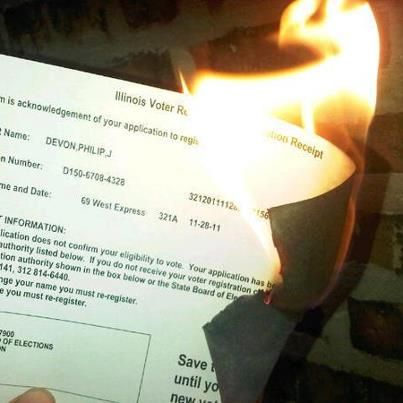
So, is this election boycott really the movement of angry white men and young white libertarians living with their parents? I don’t know. It’s too soon to tell. In Chicago, there was already a counter-protest to the burning of voter registration cards where an elderly gentlemen said that by burning their cards, they were helping voter suppression efforts and contributing to the disenfranchisement of “colored voters”: http://www.examiner.com/article/occupiers-burn-their-voter-registration-cards-protest. While I don’t see how burning your own registration card can “disenfranchise” anyone, it’s a sign that the boycott may not have a message that’s appealing to minorities by and large. But, hell…I’m not sure yet that the election boycott is appealing to most people, anyway. And if history tells us anything, women, immigrants and people of color have often been leaders of boycotting efforts. Emma Goldman was famous for standing against the suffragettes and stating that participating in capitalist elections did not further equality for women, because it did not take class order into to count. W.E.B Dubois also gave a speech about why he refused to vote: http://www.blackeconomicdevelopment.com/why-i-wont-vote-by-web-du-bois-the-nation-20-october-1956/. Perhaps we will see it catch on the more disenfranchised communities become, just as we’ve seen with indigenous groups.
The next criticism of the boycott is one I often level against it myself: it’s not big enough yet. The election boycott isn’t really a movement, it’s a tactic which is of little value when it comes to changing the system. The “Boycott the Presidential election” event page on Facebook has 772 attendees, which is more than nothing, but still isn’t really putting a dent in removing the government’s popular legitimacy. I think in order for the boycott to gain traction, one of two things needs to happen: third parties need build a coalition to boycott the election, and/or A-list celebrities need to endorse the boycott. I think the Party for Socialism and Liberation is likely to call for an election boycott way sooner than the Green Party; the Greens are still too engaged in magical thinking that they have the ability to eventually change the system.
Lastly, there’s the assertion of critics that it is much more important to take other direct action than boycott the election. I can’t say I disagree. Boycotting is just one tool in a toolbox of many methods to achieve a peaceful revolution: http://www.aeinstein.org/organizations103a.html. It’s much more important to democratize your workplace to strike. It’s much more important to boycott corporations which engage in unethical business practices throughout the world, or take your money out of banks. I think the most necessary action of disengagement, championed by Cindy Sheehan, is to stop paying Income taxes if at all possible. Income taxes go to pay for wars throughout the world. When I hear about someone boycotting the election, then I hear that person is still paying taxes and has not even attempted to stop paying, I take it as a huge sign of hypocrisy. If everyone in the country didn’t vote, it might not change the system, because the system does not require our votes to operate. But if everyone in the country stopped paying taxes and redirected the money to worthy causes, we’d see a more peaceful, democratic society in place much sooner.
———————————————————————————————————————
So what will I be doing this November? Right now, my plan is not only to boycott, but to Decolonize the 2012 Elections. I probably won’t be putting much effort into actively organizing theater surrounding it, because there are projects much more worthy of my time. What I do know is, I will be going to the polls, refusing to show my ID in solidarity with those whose rights are being oppressed, then getting my ballot. I don’t know what I will do with the ballot afterwards…perhaps I will burn it, perhaps I will put it in a bottle and sent it adrift to sea, or perhaps I will turn it into a paper boot hat in honor of Vermin Supreme. Your guess is as good as mine.
Do I know that I’m making the right decision? No. I only know that I feel the most free I’ve ever felt in my life. I know that my conscience is telling me to do this, and my conscience rarely leads me astray. Maybe the Green Party will manage to establish a presence in the future. Maybe the US will see the rise of a multiparty system. I think it’s very unlikely. But I’m always willing to be proven wrong.
 Matthew Richards is a life-long resident of Manchester, and was active in Occupy NH. As assistant director of New Hampshire Pridefest, he took part in organizing the first Pride event in New Hampshire after a decade long hiatus. He’s been performing regularly at poetry open mics throughout New England for the past three years, and competed in the 2011 National Poetry Slam as part of the Slam Free or Die team. His upcoming collection of poetry, tentatively titled ‘Revolution is a Ruthless Boxcar’, will highlight his experiences in the Occupy Movement.





 Progressive Action New Hampshire